The end of August always seems to be something of a surprise in our household. We arrive home from our holiday feeling relaxed and calm and then almost immediately face a madcap race to reach the finish line of shoes bought, uniform named, PE kits found and bags packed before school starts. In years past I have also had to make sure provisions are packed, discussions had and medical notes updated for M, but, for the first time ever, this year I wasn’t trying to squeeze in a critical meeting alongside my own new start with a new job. 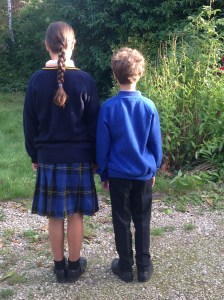 I know that next year when M moves up to our local secondary school it will be a very different picture, but after 3 years of working with the teaching community at our junior school, and with no major changes to contend with, M was able to start in Year 6 without this over-anxious Mum hovering in the background.
Without a doubt we have been incredibly lucky with the amazing support given by the fantastic teaching staff at our local school, but we have also had more than our fair share of bad experiences and teachers who don’t care in the past and I can well remember the anxieties and hours of meticulous planning that heralded the start of every new school year. The novelty of not having to head into the classroom before the end of M’s first week back has still not worn off and I’m certain that it’s thanks to the hard work that’s been put in on all sides to formulate strategies that meet M’s needs and to develop a strong working relationship between home and school that is reliant on open communication that flows both ways.
Over the last few weeks, there’s be a lot of chatter in the online allergy community about the fears that surround the milestone of starting school and, with over 8 years of “parenting-a-school-child-with-allergies” experience under my belt, I’ve been asked what tips I would give to any parent facing this situation for the first time. In all honesty, M’s first few years at school were difficult and certainly not the positive experience we would have liked. We had to deal with a SENCo, who trivialised his allergies because they “…wouldn’t have to call 999 if he ate something he shouldn’t…” and refused to recognise how important it was to communicate his allergies and health issues to any member of staff dealing with him and not just his class teacher, which led to numerous occasions of him being offered food he couldn’t eat. His teachers lost their focus in teaching him because they felt he already had a lot to cope with with his regular appointments at GOSH and his education suffered as speech impediments, dyslexia and dyspraxia were missed by those who worked with him on a day-to-day basis.
Fast-forward to the start of Year 3 and all our negative experiences became a thing of the past. The year actually began at the end of Year 2, when I met with the Head, SENCo and class teacher of his new school to discuss all of M’s health and educational needs and worked with them to put practical solutions into place before the term started. They understood the value of seeing him as more than just his EGID and food allergies,  but also knew that his health problems were a big part of his everyday life and couldn’t be ignored. At the end of his first week there, M’s teacher held a circle time in class where she shared about M’s ill-health and restricted diet with his classmates. It was done in such a nurturing and non-confrontational manner that by the end of the session M was willing to answer any question that his new friends had about what they had been told himself and has being doing so ever since.
 The information sheets that I had provided were given to the teachers and, combined with the notes they had taken whilst talking with me, used to draw up a healthcare plan for M that covered all possible situations. His on-going bowel control problems were sensitively handled and a contingency plan put in place to ensure that he always has access to a toilet wherever he is in the school. The HCP was written by the school SENCo and then sent home for my review before being published, shared with the whole teaching team and displayed prominently in the staff-room. Even better, every year since then I have been asked to review and amend his HCP to reflect any medical changes that have happened and the school continue to be sympathetic to his needs.
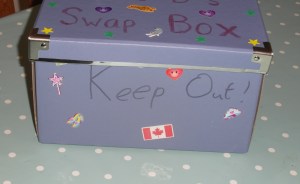 As for his swap box, it has proved to be an invaluable tool in the classroom setting and is something that is really easy to implement. The idea behind the swap box is a simple one – it contains a selection of safe items, be they edible or non-edible, that can be swapped for those unexpected treats that sometimes come into the classroom to celebrate birthdays or other special events. When M’s swap box came into being, it was filled with a mix of Haribo sweets and the odd Lego minifigure and the choice was his as to what he chose to take. Since going elemental 2 years ago, the box now contains Lego, trading cards and other fun small toys and ensures that M never feels that he is missing out when his friends celebrate. What’s more, his teachers have taken inspiration from it for their own purchases of small gifts at Christmas or the end of term and given him something he can enjoy.
I think the biggest secret to our great experience with our Junior school is communication. The lines of communication are always open and actively work in both directions between home and school through meetings, phone calls, e-mails and the home/school book. The willingness of so many of the school staff to learn to support M to the best of their ability has created a level of trust unlike any other and means that I am 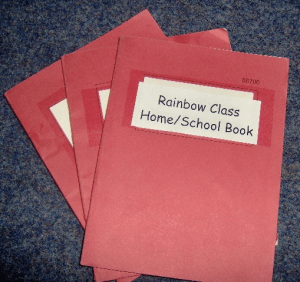 happy to leave M in their more than capable hands on a daily basis. It is a testament to their dedication to their work that, in the last 3 years, the only things that have caused an extended absence from school have been the annual hospital admissions at GOSH. They have always endeavoured to make sure that M is safe whilst at school and the fact that he was able to attend as normal with both his NG feeding tube and his broken leg is incredible. A truly remarkable relationship has grown over the years between our family and so many of the teachers and is something I really value.
They have also nurtured and encouraged M to talk about his allergies and EGID and have shown continued support as he has become an advocate for educating others about his illness. M has held cake sales, run playground games and created short films explaining the impact his diagnosis has on his life. He has developed a confidence in talking to others and 18 months ago was able to answer the questions asked by members of  every class in the school. When he left his Infants school, he was a child reluctant to talk about his food allergies or hospital appointments because he was scared of being isolated and bullied because of how different he was to everyone else. These days he has an incredibly strong friendship group who look out for him during school hours and think about him when he’s had to be in hospital, and he never thinks twice to share what’s going on with his friends.
If I had to sum it up, I guess I would say this:
Be open, be honest, be available. Keep communicating and tell them how they can make it better if you need to. Do what you can to help them out and don’t forget to say thank you when they get it right.


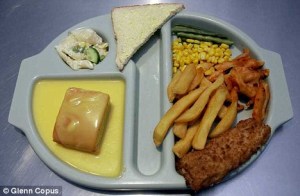 from the independent sector to a school with external caterers. We did manage for a couple of years once M had started at school by making sure that G and her teachers knew to pick the safe option from the choices given, but once M went MEWS-free in 2011, school dinners became a thing of the past and packed lunches were the way forward.
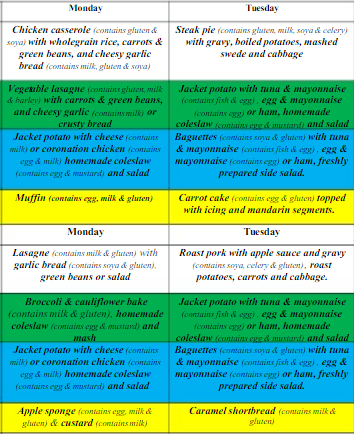 so that they can work together to provide a healthy and nutritious alternative menu customised for that child. I’m sure that they cannot be the only school to make such efforts, but they are certainly the first I’ve heard about from someone in the know and I was impressed by what she told me they offer.


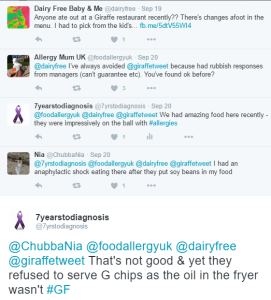
 G, M and I had headed there for an early supper following a busy day in London. G had been at her 2nd
  Decisions made about what they’d like to eat, our waitress came to the table to take our order and this was when their attention to details become really apparent. I started by telling her that both children had allergies and she immediately disappeared to grab their allergen listing to run through their menu choices with me. I mentioned that M’s allergies in particular were complex and unlikely to fit the detail given in their book, but she advised me that she had to go through it because she would be asked about it as soon as the order went to the kitchen and that her neck would be on the line if she hadn’t taken that first step of checking it all out. We started with discussing what would be safe for M to eat and she was immediately able to offer brown rice, a grilled chicken breast and cucumber slices, a meal that would more than meet his needs and then we moved on to G.
 However, our waitress came to the rescue and suggested that G had the crushed potatoes as, whilst the menu stated they included dairy, she could request that they be prepared with just a little oil instead. Situation saved!
 , when what they really mean is that such events have saddened or upset them rather than the total immobilisation that comes when you struggle with depression on a daily basis. I am not devaluing the emotions they may be experiencing when those things happen, but are they really akin to the overwhelming nature of depression? I think not.
 I did eventually come to terms with my diagnosis, though sadly my determination to get my T1D control back on an even keel brought with it an unexpected complication with my eyes, which in turn has led to even more serious implications than I could ever have imagined when I was 13 and feeling very much on my own in a battle against the rest of the outside world.
 That strong support network of family and friends who are constantly surrounding me is invaluable and the knowledge of what is really important – M and G – keeps me getting out from under the duvet every morning and making my way through each day.
 is that he doesn’t feel ashamed or embarrassed by the times when he’s not able to cope emotionally, or mentally, or even physically with the pressures that his diagnoses will have on his life, and that he learns to openly acknowledge them; and that he realises that he’s not on his own in that regard.


 I mentioned a couple of months ago that G has been
  Members get involved in all aspects of hospital life from inspections such as the
  different religions and a sneak peek at the
  M going for the next few weeks. I pondered on whether I could use the mix to bake similar cupcakes to those I would be making for M and settled on the classic flavour combination of pear and ginger that has served me so well in the past. I haven’t made pear and ginger cupcakes before, but combining my recipe for
  I can’t remember the last time I used an egg in my baking – and then added my own twist of pear and ginger. A quick taste reassured me that the flavour was good and then, with M’s cakes already out and cooling on the rack, popped G’s batch in to bake. The results looked and smelled delicious and soon joined M’s to cool, whilst I moved on to think about the icing.
 Not too many months ago, we happened to find ourselves near the beautiful town of Great Malvern and in need of a late Sunday lunch. Much to my surprise, given how small I’d assumed this town was, I discovered through a hurried internet search that Great Malvern itself hosts an ASK restaurant and quick glance at their online menu suggested that we’d be able to feed our dynamic duo there without too much hassle. It doesn’t fail to amaze me that we consistently find ourselves enjoying the food at Italian restaurants given their regular gluten-laden fare of pasta and pizza, but I suppose it should really come as no surprise given how many allergy-friendly foods we found on our recent trip to
  As always the children ordered their perennial favourites when we eat anywhere that has Italian food on offer. G opted for a gluten- and dairy-free pepperoni pizza with extra goats cheese, whilst M had his usual dish of grilled chicken breast and cucumber. Our waiter made sure he fully understood our allergy requirements as well as making a note for the kitchen and checked their allergen menu to make sure that everything we had ordered could be safely prepared for G and M.
 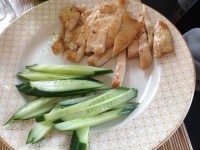 We’ve taken to ordering adult-sized portions of meals for both children these days and the generous amounts that arrived were more than enough to satisfy my ravenous pair, with both clearing their plates in impressive fashion.
![IMG_0743[1]](https://7yearstodiagnosis.com/wp-content/uploads/2016/07/img_07431-e1469212032275.jpg?w=292&h=300) have been filled with unexpected angst as one of the other positions I had applied for requested an interview and then offered me the job. After hours of deliberation and discussion and numerous sleepless nights, I have decided to accept this second role as it is an incredibly exciting and challenging position that I believe I would regret turning down. I am really looking forward to starting this new job at the beginning of October, which will bring some significant changes to our household as I will be back to working full-time hours for the first time since G was born, although I am lucky that they are happy to give me flexible hours and everything I need to sometimes work at home.
have been filled with unexpected angst as one of the other positions I had applied for requested an interview and then offered me the job. After hours of deliberation and discussion and numerous sleepless nights, I have decided to accept this second role as it is an incredibly exciting and challenging position that I believe I would regret turning down. I am really looking forward to starting this new job at the beginning of October, which will bring some significant changes to our household as I will be back to working full-time hours for the first time since G was born, although I am lucky that they are happy to give me flexible hours and everything I need to sometimes work at home. September has also been the month where we enjoyed a flying visit from Grandma and Grandpa, Mike’s parents, from Canada. G and M were so excited to see their grandparents for the first time in 4 years that they created a banner to welcome them when we went to collect them from our local airport.
  Mike finally finished the renovation job on our 4th bedroom, a task that had been started back in April,
 7 years to diagnosis