
 Two years ago, M and I waved goodbye to G as she trekked off on the adventure that is Year 6 Camp and, as he had his NG-tube in place, we chatted about whether Year 6 camp was a possibility for him. I reassured him that Mike and I were both keen for him to go and would work hard with the school to ensure that his every need – medical, dietary or otherwise – was met as he needed, whether the feeding tube was still in place or not. Despite never having spent a night away from family, M wanted to go, to try out new activities and to challenge himself as opportunity offered.
 One year ago, as I manoeuvred M’s wheelchair through the back gates of school and across the school field to his classroom, we breathed a sigh of relief that it was during Year 5 that he had spectacularly broken his left leg and not in the weeks leading up to the Year 6 camp. The slow reintroduction of foods following the removal of his feeding tube would not hold him back and once again I found myself reassuring him that, if needs be, I would bake a batch of M-friendly cakes or cookies to accompany him on the trip and that we would ensure that the camp kitchen could safely cater for whatever his food requirements were when he went. His week away at Over The Wall built his self-confidence as he realised that he could tackle anything he put his mind to and succeed.
For the last 2 years, M has been looking forward to this rite of passage, this week of school camp and practically counting down the days until it was finally his time to go. He has been in discussion with G about the different activities he might get to do and planning all that he would need to make the week the success he so desperately wanted it to be. I met with the school to talk over the arrangements for meal-times and sleep that would need to be in place and was confident that they would do everything in their power to make it a week to remember for him and all his class-mates.
And then 2 weeks ago, M had to make what has been, without a doubt, one of the hardest decisions in his life so far. The past 4 months of food challenges have taken their toll and when that was added to the stresses of SATS, we saw an unwelcome decline in his health that we weren’t sure could be overcome easily. Despite our best efforts and hard work since mid-May, M has decided that going away to Year 6 camp is not the right thing for him to do at the moment. To say that my boy is bitterly disappointed would be an understatement. For 2 years of longing and planning to come to nothing is heartbreaking for us all and has been a bitter pill to swallow. For M, life has just seemed incredibly unfair once again.
M is frustrated that he can’t go, but he has based his decisions on the health struggles he is currently facing and knows that ultimately it is the right choice for him. He has tried to remain cheerful in school and has been an active participant in the tasks  set to his class as they have researched where they’re going and what they’ll be doing. Mike and I met with his teachers and arranged for Mike to take him to the camp today for a half-day*, so that he can join in an activity of his choice and not feel that he is missing out completely. What has made it even harder to bear is that he currently doesn’t have a place on this year’s OTW Health Challenges Camp and is instead on the waiting list, with his fingers tightly crossed that a place might become unexpectedly available.
I know that in the long-run, M will pick himself up and dust himself off and keep going, just as he always does, but it’s hard to comfort him when he’s railing against just how unfair life can be because, in all honesty, right now I agree with him and it’s hard to find the positive and that silver lining we so desperately need to cling to.
*I’m delighted to share that today’s morning has turned into a full day at camp with his friends. M enjoyed the mud assault course so much that he felt confident to stay on and try his hand at abseiling and anything else he could find the time to do.
 When you’re growing up with a chronic illness as your one constant companion, it can come as no surprise that that condition begins to
 some progress, albeit very slowly. We last saw M’s GOSH consultant in the middle of March, when it was somewhat reluctantly agreed by us that we would wait until November for his next GOSH appointment with the plan being that we would meet and then have an appointment with our local gastro team during the interim period.
 Dr W had already agreed with GOSH that he was happy to meet with us and look at the potential possibility of taking over some of M’s care during last year’s disastrous
  M would eventually stop drinking the E028 altogether and stressed that we need to find a viable alternative before we reach that point. This has proved to be remarkably insightful as it is now one of the biggest issues that we have had to contend with since that June appointment, with M struggling to drink even half of the required amount and with no new foods in his diet, there are growing concerns about both his weight and his nutritional intake.
 , when what they really mean is that such events have saddened or upset them rather than the total immobilisation that comes when you struggle with depression on a daily basis. I am not devaluing the emotions they may be experiencing when those things happen, but are they really akin to the overwhelming nature of depression? I think not.
 I did eventually come to terms with my diagnosis, though sadly my determination to get my T1D control back on an even keel brought with it an unexpected complication with my eyes, which in turn has led to even more serious implications than I could ever have imagined when I was 13 and feeling very much on my own in a battle against the rest of the outside world.
 That strong support network of family and friends who are constantly surrounding me is invaluable and the knowledge of what is really important – M and G – keeps me getting out from under the duvet every morning and making my way through each day.
 is that he doesn’t feel ashamed or embarrassed by the times when he’s not able to cope emotionally, or mentally, or even physically with the pressures that his diagnoses will have on his life, and that he learns to openly acknowledge them; and that he realises that he’s not on his own in that regard.
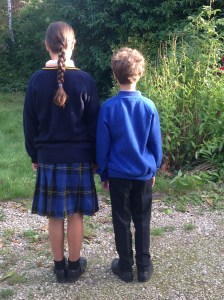 I know that next year when M moves up to our local secondary school it will be a very different picture, but after 3 years of working with the teaching community at our junior school, and with no major changes to contend with, M was able to start in Year 6 without this over-anxious Mum hovering in the background.
 but also knew that his health problems were a big part of his everyday life and couldn’t be ignored. At the end of his first week there, M’s teacher held a circle time in class where she shared about M’s ill-health and restricted diet with his classmates. It was done in such a nurturing and non-confrontational manner that by the end of the session M was willing to answer any question that his new friends had about what they had been told himself and has being doing so ever since.
 The information sheets that I had provided were given to the teachers and, combined with the notes they had taken whilst talking with me, used to draw up a
 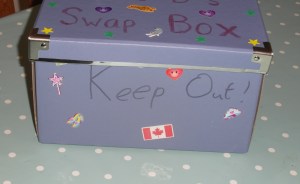 As for his swap box, it has proved to be an invaluable tool in the classroom setting and is something that is really easy to implement. The idea behind the
  happy to leave M in their more than capable hands on a daily basis. It is a testament to their dedication to their work that, in the last 3 years, the only things that have caused an extended absence from school have been the annual hospital admissions at GOSH. They have always endeavoured to make sure that M is safe whilst at school and the fact that he was able to attend as normal with both his NG feeding tube and his broken leg is incredible. A truly remarkable relationship has grown over the years between our family and so many of the teachers and is something I really value.
 every class in the school. When he left his Infants school, he was a child reluctant to talk about his food allergies or hospital appointments because he was scared of being isolated and bullied because of how different he was to everyone else. These days he has an incredibly strong friendship group who look out for him during school hours and think about him when he’s had to be in hospital, and he never thinks twice to share what’s going on with his friends.
 Our back-up plan is our self-catering apartment, which means that there is always somewhere to prepare a simple meal of M’s safe foods without too much trouble, but I do, perhaps selfishly, want a holiday from that daily grind of cooking and be able to enjoy a family meal as we used to do when the children were small. Our previous holidays to Portugal were challenging, but not impossible as M loves fish and seafood which are always readily available, but I worried that the current restrictions might be a demand too far.
![IMG_0824[1]](https://7yearstodiagnosis.com/wp-content/uploads/2016/08/img_08241-e1470587215827.jpg?w=220&h=300) Thanks to a detailed e-mail conversation with Yellow Cross Director, Jane Harrison, she agreed that it would make far more sense to detail what M can eat, rather than a lengthy list of his many allergens and suggested she spoke to their translator to cost out these personalised cards. We settled on appropriate wording, it was passed to their Portuguese translator and I was quoted a very reasonable £20 for a set of 4
Thanks to a detailed e-mail conversation with Yellow Cross Director, Jane Harrison, she agreed that it would make far more sense to detail what M can eat, rather than a lengthy list of his many allergens and suggested she spoke to their translator to cost out these personalised cards. We settled on appropriate wording, it was passed to their Portuguese translator and I was quoted a very reasonable £20 for a set of 4 
 How do we define a hero?
 7 years to diagnosis