

The headline in our local paper for this year’s #NEAW focuses once again on the allergies
I share a frustration with Michelle, one of the lovely co-founders of the FABED, that all too often people living outside of the EGID world get drawn into the food allergies side of this illness and don’t really understand that that is just a small part of a much bigger picture. I can understand why the focus so often falls on it as it’s the bit that people think they understand and can relate to the most. After all, just about everyone knows someone, be it their next-door neighbour, the family down the street or Great Aunt Joan in Australia, who has an allergy. They often feel that that acquaintance, however remote, gives them an insight into what life must be like when your every waking moment is ruled by their presence and I’m all for that belief encouraging them to engage me in conversation about it. Added to that, so much of our social life revolves around food, a fact that isn’t a revelation to me as I’ve discussed it before on my blog. In the last week alone we’ve had to survive the “Second Sunday” breakfast held at our church, sweets brought into school to celebrate birthdays and M’s class cake sale to raise funds for classroom resources. We managed them all in our own way, from arriving late and avoiding the table of food in the church hall, to M’s trusty swap box, which has finally been refilled and returned to his teacher and the gentle request to the TA that the class cakes be moved to somewhere other than next to M’s stationary wheelchair for the day.
 Of course, I obviously can’t ignore the fact that my blog focuses a lot on the impact M’s complex food allergies has on our everyday life. So much of my time and energy is spent researching, adapting and learning more about how to feed him varied meals whilst coping with such a restricted diet that food allergies undeniably rule my kitchen. As a fellow EGID Mum recently posted, every single aspect of our children’s lives are affected by food, no matter how many food allergies they are dealing with. Everything has to be planned and thought about, there can be no leaving things to chance and there’s rarely an opportunity to be completely spontaneous. At home, at school, going out for meals, tea at a friend’s house, family gatherings, holidays, hospital admissions, trick or treating, birthday parties, Christmas, Easter, the list is endless and all-consuming. There’s also unquestionable irony in the fact that we as a family will be “eating like M” to draw attention to the eosinophil awareness week. The reason? I know our restricted diets will allow us to engage with others who will be intrigued by the limitations and in turn that will enable us to share the EGID story too.
However, despite the truths above, it’s really important to get the message out there than EGID is about more than food allergies, a whole lot more. Whilst it’s common for people with EGID to have food allergies, those with allergies do not always develop EGID. At the risk of repeating myself, EGID is, as I wrote for last year’s #NEAW, about “…the unexplained joint aches, the never-ending tummy cramps, the relentless feelings of nausea or reflux whenever you eat. The dark shadows under the eyes, the manic mood swings, the overwhelming lethargy, or the inability to fall asleep and stay that way. The damaged bowel, the fear of not being near enough to a toilet whenever you need one, or knowing that you’ll never get there in time anyway. The fear of your friends making fun of your allergies or finding out that you’re still wearing a pull-up because your bowel can’t be relied on when you most need it to. The daily medicines, restricted diets and the feeding tubes. The chronic pain that can reduce you to tears, yet you don’t complain because nothing helps, even when it’s at its worst.
It’s about getting used to these things as being normal, or not even realising they’re not.”
 We’re marking our 4th National Eosinophil Awareness Week and despite all our best efforts, I still find myself spending a lot of time explaining that there is more to M than his food allergies. This year is a particularly tough one as there is a lot of uncertainty and discussion in the medical community about the validity of EGID as a diagnosis. Hospitals and their consultants are questioning whether EGID is really anything more than complicated food allergies, but they are failing to talk, and more importantly to listen, to the families who are living with it on a daily basis, who are surviving those symptoms I’ve mentioned above and who are having to battle to get their voices heard. Some parents have found themselves in a situation where treatment has been removed suddenly because the veracity of their child’s EGID diagnosis is under review and are left watching their loved ones spiralling back into chronic ill-health whilst the medics argue over whether EGID exists. I can’t predict what the next 12 months will bring for those of us living with the presence of EGID in our families, but I do know, without a shadow of a doubt, that we will all continue to fight for ongoing good health and that every battle won is a huge success.
EGID is about #morethanfoodallergies and that’s a message the world needs to hear.
Just a reminder that as well as raising awareness of EGID this week, we are also fundraising for Over The Wall Serious Fun camps. If you are able to donate, even a small amount, that donation will make a big difference to children like M and G, who benefit massively from these camps. You can donate via my Just Giving page or the link on the side of this page. Thank you!
 It’s hard to believe that we’re already at the start of May, which means that in just 12 days time, it’ll also be the start of National Eosinophil Awareness Week 2016. For me, every year seems to follow the same pattern:
 so!
so! M’s broken leg required some significant amendments to our original plans, but we were determined to get the family, wheelchair and all, to the event, held near Regents Park, London at the rather impressive
  head than me and was our nominated driver for the night. The traffic eventually started to move, we crept past the accident site and soon were back up to speed and on our way without me completely losing my cool. We stopped just once and Mike, G and M were all able to nip into the service station toilets to glam themselves up for the evening. I was too anxious about our timings to take 5 minutes out to change myself and the following hour or so was filled with moments much reminiscent of Dirty Dancing – remember Baby changing on the back-seat of Johnny’s car? – as well as hysterical giggling from M as I contorted my body into unbelievable positions to don my own new outfit.
 for the evening and the awards presented by celebrity chef, Antony Worrall Thompson, who gave what has to be the quote of the night that “..free from people should not be seen as niche people but normal people..”, which was great to hear. It was wonderful to see so many creative and innovative producers receive commendations for their hard work and the winners were all deserving in their categories. It was good to remember some of the fantastic new foods that I had tasted and wonderful to see G so excited about the gluten- and dairy-free offerings available that her own mini fist-pumps could be seen as she heard who the winners were. The full list of winning entries can be found on the
 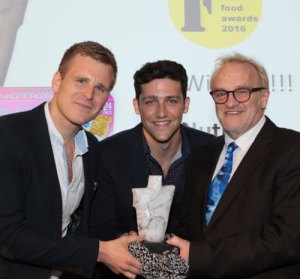 We’ve still to track down a box in our local supermarkets for G to try, but I’m even more determined to get my hands on some now that one of my favourites has won the overall title.


 your family’s life on a daily basis.
 he same is true when it comes to feeding tubes as sadly misconceptions are rife and the reasons behind a tube can be as complex and individual as there are stars in the sky. Even with children or adults living with the exact same condition, their symptoms and need for additional nutrition can be vastly different.
 going to make me feel better and I was very worried that I would be teased at school about it.
 Last summer, my classmates decided to wear a 2.5kg backpack for the morning so that they could understand exactly what I go through each day. The whole class did it as well as our teacher and the other teaching assistants.
 In addition to virtually every practising dietician in the UK, it is mailed directly to all senior gastroenterologists, all nutrition nurse specialists and all nutrition pharmacists, as well as lecturers, industry professionals, consultant dieticians and students.
For day 3 of
In addition to virtually every practising dietician in the UK, it is mailed directly to all senior gastroenterologists, all nutrition nurse specialists and all nutrition pharmacists, as well as lecturers, industry professionals, consultant dieticians and students.
For day 3 of  We weren’t provided with any information about enteral feeding beforehand from the health professionals involved in M’s care and I found most of our information came from online support groups, such as PINNT and
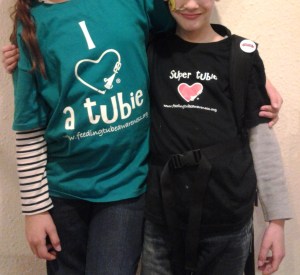 We’ve encouraged her to get involved as much as possible and as much as she wants, and she is now very capable of helping with his feeding pump. She’s recently started horse-riding, which is something M doesn’t do and gives me some time to spend just with her. As for our holidays, in the past we often went abroad, but didn’t feel confident enough to try it this first year with his tube. Instead we went to Cornwall this summer, with our car packed full of all the necessary medical equipment and enjoyed an amazing week away. We’re now feeling much more able to cope and are hoping to go to Portugal next summer.
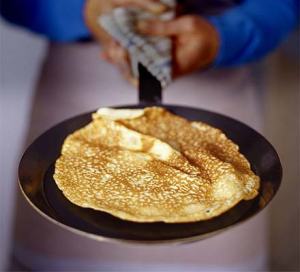 *I can’t let today’s post pass without a nodding acknowledgement that it is, in fact, Shrove Tuesday; the day when many of us enjoy a pancake or two before the start of Lent. I can’t even remember whether we managed to eat pancakes last year as M had only just started to trial foods after his 8 weeks on E028, but there’s a sneaking recollection that maybe my Mum cooked some for G, whilst the rest of us ignored the day to the best of our ability. I’m excited that this year I will once again be able to cook pancakes for the whole family and, just in case you need an allergy-friendly recipe to cook for your loved one, I’ve got the perfect one
  If anyone was going to describe the last decade of my life, the one indisputable conclusion they’d end up reaching is that it’s been anything but boring. Thanks to a pair of children who have thrown more than their fair share of life challenges into the mix, we’ve weathered more storms than I ever believed possible and, for the most-part, we’ve come out the other side still smiling and relatively unscathed. We’ve survived a lot of challenges, met a whole host of amazing people and learned a great deal along the way; and if I had to pick just one lesson that constantly resonates, I’d have to say that we now know to never take things for granted as they can change at the drop of the proverbial hat. Two years ago I
  We all felt the benefits of that visibility to start with and I no longer felt the underlying pressure to defend the true extent of M’s illness and food allergies whilst my outwardly healthy-looking youngster was intent on tearing around practically making a mockery of every problem and pain we said he was suffering.
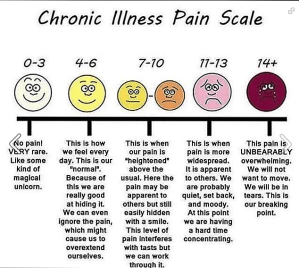 G’s godmother shared this pain scale image with me and I love the wording that is attached to it as it sums up to a tee how M has described his levels of pain over the years. From the magical unicorn of no pain at all which happens occasionally, to the breaking point of inconsolable sobbing and unbearable pain that little can ease, I’ve seen M pass through every stage of this chart on all too regular a basis. I doubt the colours, images or facial expressions would appeal overly to him, but it helps to clearly explain how he copes to those who need to know.
 A fellow
  This third one I discovered through Twitter and was posted up by @2tubies, whose 6-year old son helped make his own pain chart for the school environment with the help of the school SENCo and his Mum. They used Lego figurines to depict how he might be feeling and offered some easy solutions for his symptoms. This solution-based approach is one that I find works well with M and have started using it more and more over the years. I rarely give M the option of staying home from school when he’s feeling unwell, but will instead list out those solutions I think might ease not only his pain, but also the whirlwind of emotions that is so frequently tied into what he’s feeling on a physical level. Whilst he was still being tube-fed, I would always start with the offer to slow down or even stop his pump for a limited amount of time and then followed that up with pain relief or a hot water bottle. My final question has always been what M thinks will help him the most and given he has a clear idea of what I’m suggesting, then we have always been able to find a solution that works for us both. Whilst giving these choices verbally works well at home, I imagine that presenting them in a pictorial fashion would make great sense in the school setting.
 At G’s secondary school, they have included traffic light coloured pages in the back of the pupils’ planners and the children are encouraged to use them by putting the relevant colour facing up on the desk if they need some help during a lesson, but are too worried or nervous to ask. For some children, a “traffic lights” approach using counters or cards can also be effectively used to indicate how they are feeling in any given situation, where red can indicate their sense of losing control or not coping with the environment surrounding them. The opportunity to be tactile with the counters may also help children with sensory issues order their thoughts and be more able to express them when asked. Even if the child is not able to share what’s troubling them, a clear plan of how the teacher or adult in charge should respond to each colour will change that child’s perceptions and experiences away from home. Similarly, M’s school uses a “Fist to 5” approach to their work, where fist indicates a lack of understanding and the need for some help, and 5 means they are confident and happy to carry on on their own.
 those “virtual” friends from on-line support groups, who during the length of our admission were also admitted to GOSH. The ability to finally put faces to names, with a reasonably comprehensive background knowledge already in place and be able to spend time chatting, laughing, drinking tea and commiserating was priceless.
 7 years to diagnosis