Tag Archives: Allergy

Why #allergyawarenessweek is important

This week is Allergy UK’s #allergyawarenessweek and their aim is to raise awareness of the serious, and sometimes severe, impact of allergies on everyday life.  Their campaign #livinginfear has invited allergy sufferers to talk about the frightening side of allergies, not least of which are the statistics that show an astonishing lack of knowledge about how to deal with serious allergic reactions amongst the general public.  Recent research carried out by Allergy UK shows that 44% of allergy sufferers in the UK are living in fear of a serious reaction, whilst 68% of the people surveyed wouldn’t know how to deal with a reaction; and this lack of public knowledge could be forcing sufferers into a life of fear and anxiety.  This useful infographic published this week uses the acronym FEAR to educate us all on how to recognise, help and potentially save the life of someone struggling with a severe reaction:

Courtesy of Allergyuk.org

Courtesy of Allergyuk.org

Whilst M’s allergies are extensive and challenging, I have always been extremely grateful that he has never suffered anaphylactic shock from anything he has eaten, although the question of whether he could experience one has floated at the back of my mind for quite some time.  We were lucky enough to be able to bring home a training epi-pen after our visit to the Allergy UK annual conference in 2014, though other than a cursory look when it first came home, I have to confess it’s been gathering dust in a box on top of one of our kitchen cupboards since then.  We’ve even gone as far as discussing, late at night, whether we should have an epi-pen on hand at home “just in case”, but I’m ashamed to admit that that is as far as we’ve got in actually doing something about it.

Courtesy of foodb.ca

Courtesy of foodb.ca

However, less than a month ago that decision came back to haunt me and I learned unexpectedly just what the reality of the #livinginfear campaign could be like.  We were trialling sweet potato with M, a previous favourite that we were desperately hoping would bring some much-needed variety to his meals.  The first mouthful on that first Friday night had been eagerly received and much enjoyed by M and although the following day was a little more fraught on the toileting front than it had been for a long time, we hoped it was nothing more than a temporary blip to be overcome.  We ploughed on with the food challenges and M had taken to waxing lyrical about how much he was looking forward to including sweet potato in his diet once again.  He even asked how long it would be before he could enjoy a “whole baked potato” once again.

It was at the 3rd meal and the increase to 2 teaspoons of mashed sweet potato that things suddenly and rather dramatically went horribly wrong.  Mike, rather typically, was out for the evening at a charity whisky-tasting event and it was just me and the children enjoying our evening meal at home.  M tasted his mouthfuls of the mash before anything else and then got on with the rest of his dinner.  He got no further than half-way through when he suddenly grabbed at his throat and started gulping down mouthfuls of his glass of rice milk.  He complained that his tongue was stinging and itchy, his whole mouth was itching and it felt as if someone had grabbed his throat and was squeezing hard.  Two glassfuls of milk later and a frantic phone-call to Mike about what was going on, things settled down and M was feeling a lot better.

I had spent those 20 minutes just about holding it all together, whilst running anxiously through all the possible scenarios in my head and trying to work out what I needed to do if things took a turn for the worse:

  • Option 1 – Jump into the car with both children, trying to keep as calm as possible and race to our local hospital, 20 minutes away and with no car parking options on site:  I’d get there, but what if he stopped breathing in the car and I needed G to get involved, even if it was just by using my mobile to phone for back-up?
  • Option 2 – Dash off to one of several nearby friends who are also doctors and ask for their help:  much quicker, but at least one of those was at the same event as Mike and who knew whether the others would be at home
  • Option 3 – Call 999 and wait anxiously for an ambulance to turn up, all the time acting as the proverbial duck (calm on the surface, but paddling furiously beneath the water): how long would it take for an ambulance to reach us? Could I keep both children calm at home as we waited? What would I do if M stopped breathing? What would I do with G if we needed to rush off to hospital?

We were lucky.  The reaction passed, although the stinging pain in his mouth and throat and the sensation of his throat tightening returned at odd times over the next few days.  Following a lengthy conversation with our GOSH dietitian, it seems likely that M actually suffered an oral allergy to sweet potato rather than full-blown anaphylaxis, though it doesn’t quite fit with the known causes and triggers of Oral Allergy Syndrome.  If you are interested to learn more about living with OAS, then I highly recommend the blog Feeding my intolerant child, whose description of her son’s oral reaction to a simple fruit ice lolly whilst on holiday is definitely reminiscent of those frightening moments at home a few weeks ago.

epipenNeedless to say, sweet potato has been banished from M’s diet for the foreseeable future and we are now seeking a local allergist who can help advise us on dealing with any other more serious allergic reactions that M might experience as we continue along the food reintroduction road.  Oh yes, and we’ll also be pleading to get him an epi-pen for our own peace of mind and for the sake of his well-being and I will make sure that we all know how to administer it correctly.

Dinner Plans

The beauty of staying in the amazing Applause apartments in East Aldgate was the ease with which we could accommodate M’s current dietary requirements at mealtimes.  Every morning, he and G enjoyed a bowl of safe cereal and rice milk for breakfast, whilst Mike and I had coffee and brioche before we headed out for the day.  Once breakfast was done, the children and I would finish getting ourselves ready and Mike would make and pack lunches for us all.  The ability to prepare packed lunches was just what we needed as not only were we able to meet M’s extreme food requirements, but also the dairy- and gluten-free needs of G.

20150414_174629On our first day there, we stumbled across a fantastic shop called “Planet Organic“, where we were able to pick up some previously undiscovered M-friendly bits and pieces, including mini rice-cakes, which are perfect for his lunchbox.  Of course, with the packet now nearly empty, the race to find them closer to home is on before he finishes them off.  The brown rice noodles have also been a massive hit and make mealtimes just that little bit more interesting than they have been over the last 3 months.  Sadly, the one thing we had been hoping to find, rice pasta, was sold out and so my search for that alternative continues.

The more interesting task was that of our evening meal.  One of the things we have always loved to do is eat out as a family and it is one of the things that M in particular has found hardest about having his tube.  We have had a wealth of experience over the last decade of finding restaurants that will accommodate the ever-changing dietary needs of G, M and even me and we had settled on a few firm favourites that we knew would almost always meet our requirements.  Of course, the option to cook dinner where we were staying was great to have, but Mike and I were both looking forward to having a break from the monotony of 3-ingredient dinners and decided to do some focussed research before we even left the comfort of our own home.  We spent hours one evening trawling the internet, finding restaurants in the areas of London we were likely to be near at meal-times, looking at their menus and investigating whether they had allergen information readily available to read then and there.  To our delight, we found a few where we knew we could cater for G and where it seemed probable we would also be able to order safe food for M, and we couldn’t wait to put our selection to the test.

20150408_181702Our first was Giraffe, which is just round the corner from GOSH and a popular choice for our post-appointment dinners.  When we got to the restaurant, I asked the waitress at the door whether they would be able to cook safe food for M before she had time to find us a table and the response was fantastic.  She turned out to be the restaurant manager and headed off in the direction of the kitchen to talk to their chef and find out exactly what our options were. The chef assured us he could cook plain, boiled rice and grill a chicken breast for M without using any oil, so, feeling hopeful that this could prove a success, we found a table to enjoy our first family meal out for 5 months.  M was delighted with the plate of food that arrived for him and had no allergic reaction to any of it, reassuring us that Giraffe is a safe choice for the future.

IMG_0940As it turns out, Giraffe was the only restaurant we ate at that was able to cook plain rice for M, but we enjoyed 2 other great meals out and  both restaurants were more than happy for M to munch away on his own rice-cakes to accompany his chicken and cucumber.  The second restaurant was Bella Italia, a popular restaurant chain found across the UK and we had dinner at their St Martins Lane branch.   Again, our waiter worked with the chef to ascertain exactly what could be prepared for M and this amazing plate of food arrived – M joked that he thought they had cut him up a whole cucumber to make up for the lack of variety on his plate.  We were also impressed with how much their gluten-free offerings had improved since the last time we ate there as G was able to enjoy some GF garlic pizza bread alongside her GF margherita pizza with pancetta and ham with goats cheese.

20150411_152613My final recommendation is Jamie’s Italian and I can’t begin to tell you how impressed we were with the excellent service provided at their Canary Wharf restaurant.  From the greeter who listened to our initial needs to the manager who came to answer our questions before we even got to the table, they were keen to reassure us that they could meet all our requirements.  As for our amazing waiter, Tom H, he listened carefully and patiently to what we needed, made sensible suggestions based on M’s safe foods, checked with the chef that everything could be prepared safely and treated M just like any other child eating in the restaurant.  He was delighted with the plate of food that arrived at the table as it was presented in the exact same way as G’s dinner and his unparalleled attempt to eat almost all of the food served earned him the same prize that G was awarded for eating her salad – an achievement that we rarely manage at home.

All in all, our trip to London proved to be a fantastic and unexpected success when it came to our dinner plans for our stay.  We found 3 restaurants who were prepared to go the extra mile, make the effort and help us enjoy some great meals out.  Even better, M had the opportunity to feel more “normal” than he has done in a long time, which, for us, was absolutely priceless.

A tri-umph of rice-themed goodies!

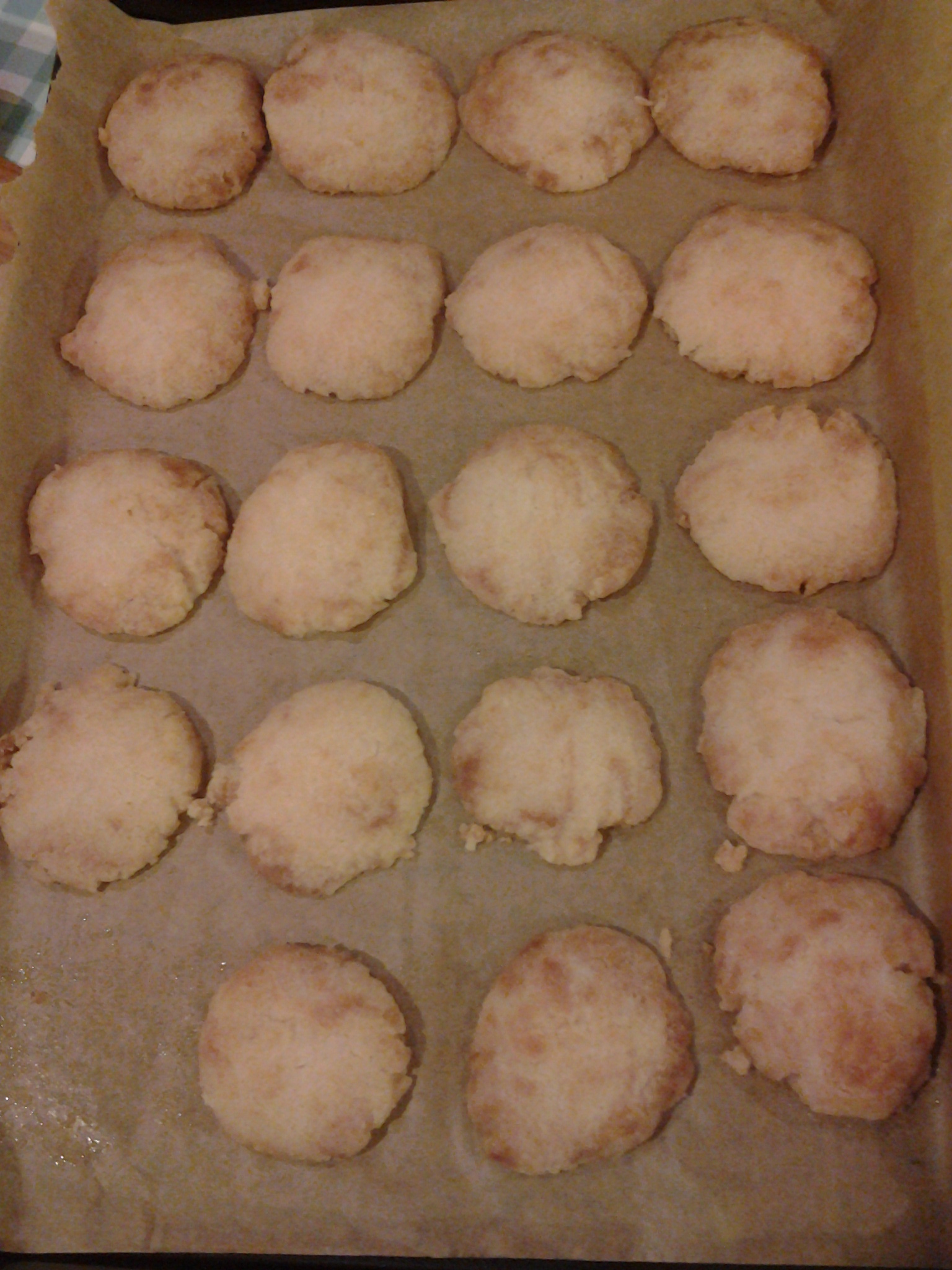
Recently I’ve been spending my time baking and cooking up a whirlwind as the days ahead have been looking busy.  With a day for G and M at the holiday club run at Mike’s work, an appointment with M’s consultant and dietitian at GOSH to review his progress 4 months post-tube and a planned short stay in London to see the sights and to dip our toes into the world of being away from home with NG-tube in tow, a plethora of safe snacks and treats for M were much in need.  I prepared rice pudding, rice-flour sugar cookies and rice krispie cakes to satisfy the appetite of my youngest and to reassure myself that we would have some things with us to feed him whilst the rest of us enjoyed some much-missed meals out.  I also used the opportunity whilst trialling banana to add some to the mix and made some banana sugar cookies too.

The recipes can be found in the everything-free recipes section and are so easy to follow that next time round, my plan is to be sitting back with a cup of tea, whilst G and M get on with the task of creating their own delicious masterpieces!

20150314_213802 20150321_191535

20150403_162354

Who knew you could make so much from rice, sugar, rice milk and canola oil?  Any other suggestions for simple recipes will be very gratefully received!

“Muuummm, what’s for tea tonight?”

1186944_650637321674312_1447413190_n

Oh how this resonates..

If your family is anything like mine, that question usually comes just as you’re struggling through the door: with house keys in one hand, car key gripped firmly between your teeth, handbag on one arm, cello on your back, mobile phone pressed to your ear as you attempt to talk to the dietitian/consultant/other healthcare provider, who’s asking if now is a good time to talk and you can’t say no as you’ve been trying to contact them urgently for at least the last 3 days and who knows when they might call again; plus the school bag(s)/shopping bag(s)/extraneous bag(s)* (*delete as appropriate) you’ve picked up along the way are weighing down your other side and threatening to upset the delicate balance you’ve perfected in your struggle to cover the 100 yards or less from your car to the house.  Meanwhile, your curious offspring are waltzing in behind you, or possibly squeezing past you, through the already impossibly small and too-narrow-to-negotiate-safely doorway, bearing no more than a half-empty water bottle and their coat, worn superhero style to leave their hands free to carry absolutely nothing else at all.  And just as you think you’ve achieved it and managed to get everything safely inside, they open their mouth and ask that unavoidably fraught dinner-question and the peace shatters and your world tumbles down around your ears.  Does any of that sound familiar or is it just my household?

For M at the moment, my answer is fairly standard, although he adds his own unique twist by asking if dinner will be “chicken with rice and cucumber” or perhaps “rice and chicken with a side of cucumber”?  For a while, when he was still 100% elemental, he would even ask if he could have “air-sticks” – “like bread sticks you see, but without the bread” – showing that the ability to laugh his way through this experience is his greatest strength in beating this disease.  I have become a self-confessed expert in cooking with 3 principle ingredients – rice, chicken and cucumber – and the bonus extras of herbs, rapeseed oil and sugar.  Rice has been broadened to include its derivatives and the inclusion of rice milk, rice cream and rice pops (as long as they’re gluten-free) has added to my ever-increasing repertoire of 3-ingredient recipes.

Rice-flour sugar cookies

Rice-flour sugar cookies

In the past few weeks, as well as my fall-back favourites of roast or grilled chicken with plain boiled rice, I have also perfected deep-fried savoury rice balls, chicken nuggets, chicken and cucumber curry, fried rice, chicken stir-fry, rice-flour sugar cookies and rice pudding.  My Mum has also made M a chicken breast stuffed with rice and cucumber, courtesy of the inspiration and some nifty hints suggested by our hairdresser and which was an instant hit with our young diner.  It’s surprising just how many different recipes you can create with just a few ingredients and there’s even a few more that I’m hoping to try out in the coming weeks.  What started out as a daunting challenge to entice M’s appetite and encourage him to once again eat whilst navigating the tricky world of identifying his food allergies, has become yet another success story in our household.

Letter-to-the-EditorSqareMy victory with such a limited range of ingredients has been all the sweeter given the recent UK news story of the letter sent to the Daily Telegraph newspaper by over 100 top chefs and restauranteurs condemning recent EU legislation requiring restaurants to provide information about which of the top 14 allergens the dishes on their menus contain.  It was never a requirement that they did not cook with these ingredients, but rather that they should be able to inform diners of what the food prepared contains, with the knowledge and pride in their ingredients that I would expect from any talented chef.  Whilst widely welcomed by those of us in the allergy-world as a step towards helping us make informed decisions about eating out, these chefs warned that such requirements would harm “…the spontaneity, creativity and innovation restaurants and others in the industry have enjoyed up until now.

Like so many others in my situation, I wrote a response on the Telegraph website, pointing out that this legislation will help me to protect my children and give them experiences that will ensure their continued health and enjoyment,  I do not deny that it’s up to me (and they as they grow older) to ask about allergens, but there’s no point asking these questions if the restaurants, waiting staff or chefs cannot provide the information needed and the lack of understanding about cross-contamination risks is sadly common across the food industry.

20140818_143459Our experience last summer in Disney proved that this type of requirement does not need to be restrictive as excellent allergen information was readily available and nearly everywhere we ate produced meals for G and M that rivalled those being served to any other customer there with a “normal” diet. The chefs were knowledgable, came to our table to discuss their allergy needs and made the effort to find out what my challenging duo would like to eat – excellent service all done with a smile.

The big challenge was always to cook M-friendly food and these days that task has become even more testing.  In my opinion, these rules will have little impact on spontaneity or ingenuity – try cooking or baking when you need to avoid wheat/gluten, egg, dairy, soya and potato to name but a few.  Ingenuity comes when you try to prepare a meal that makes your child feel that they’re not missing out and that’s something I feel I’ve proved is possible, even for an amateur cook like me.

Piece of cake

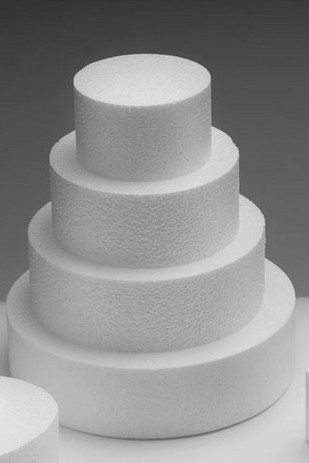
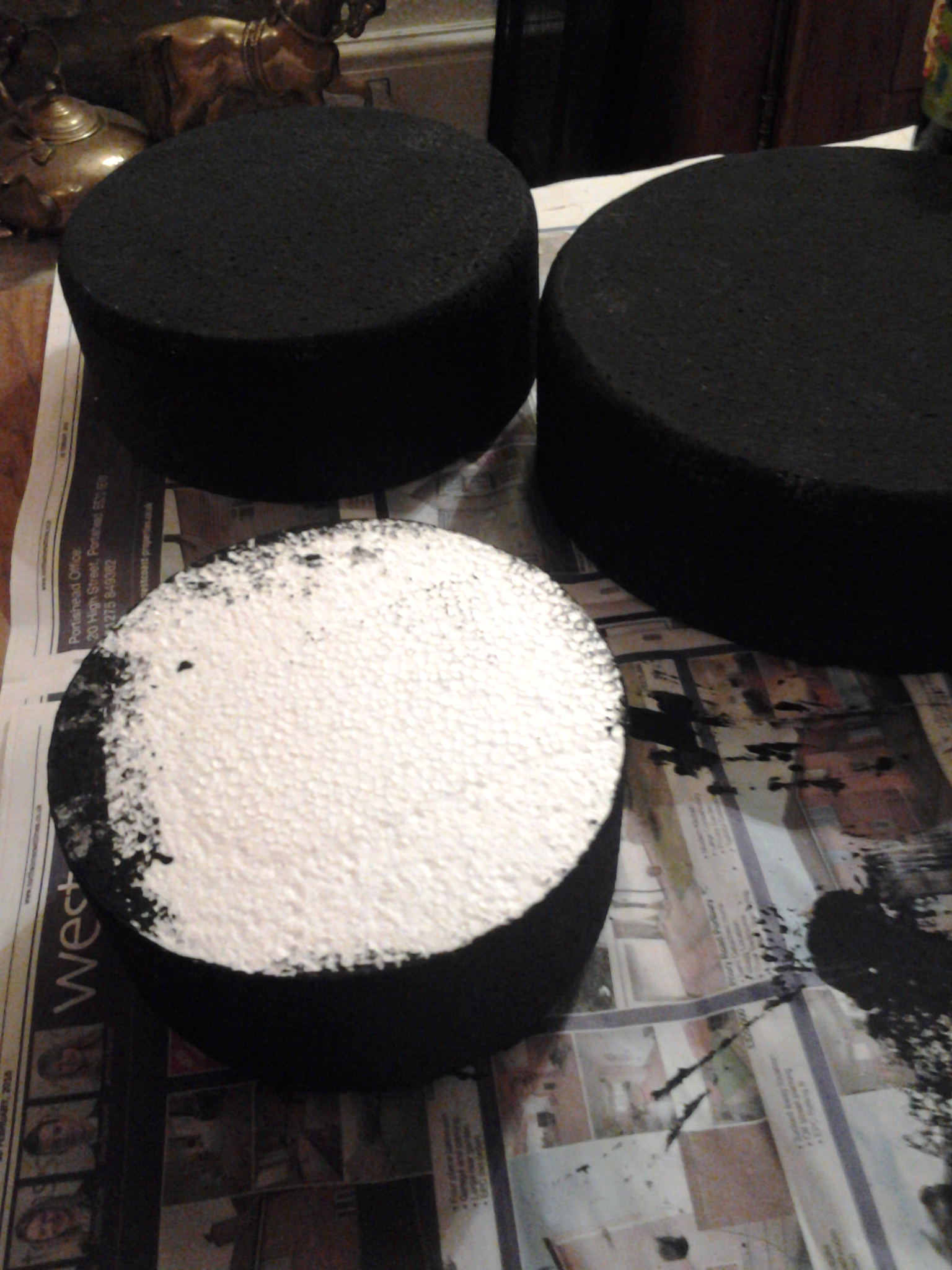
20150225_231442 sr_162935_largeThese photos are of the supplies I needed to create this year’s  birthday cake masterpiece for Master M as, after all, this had to be a birthday cake like no other I’ve ever baked before.  In the same way that I had discussed my plans for the food we would serve at their Cluedo party with M, we sat together to talk about the various options for his birthday cake.  I could bake a “normal” cake for him to give to his friends, I could use polystyrene dummy cakes to create an authentic-looking, but totally M-friendly cake or we could try something completely different.  A friend had suggested using small bottles of 7-up to create a tiered cake and then giving every party guest a bottle to take home, which I thought an inspired idea as it’s one of the few things M has been able to enjoy since his NG-tube was passed, but M disagreed.  He preferred the idea of the polystyrene “fake” cakes and we headed off to the shops over half-term to source the cakes, decide how many tiers he wanted and get all the art supplies I might need.

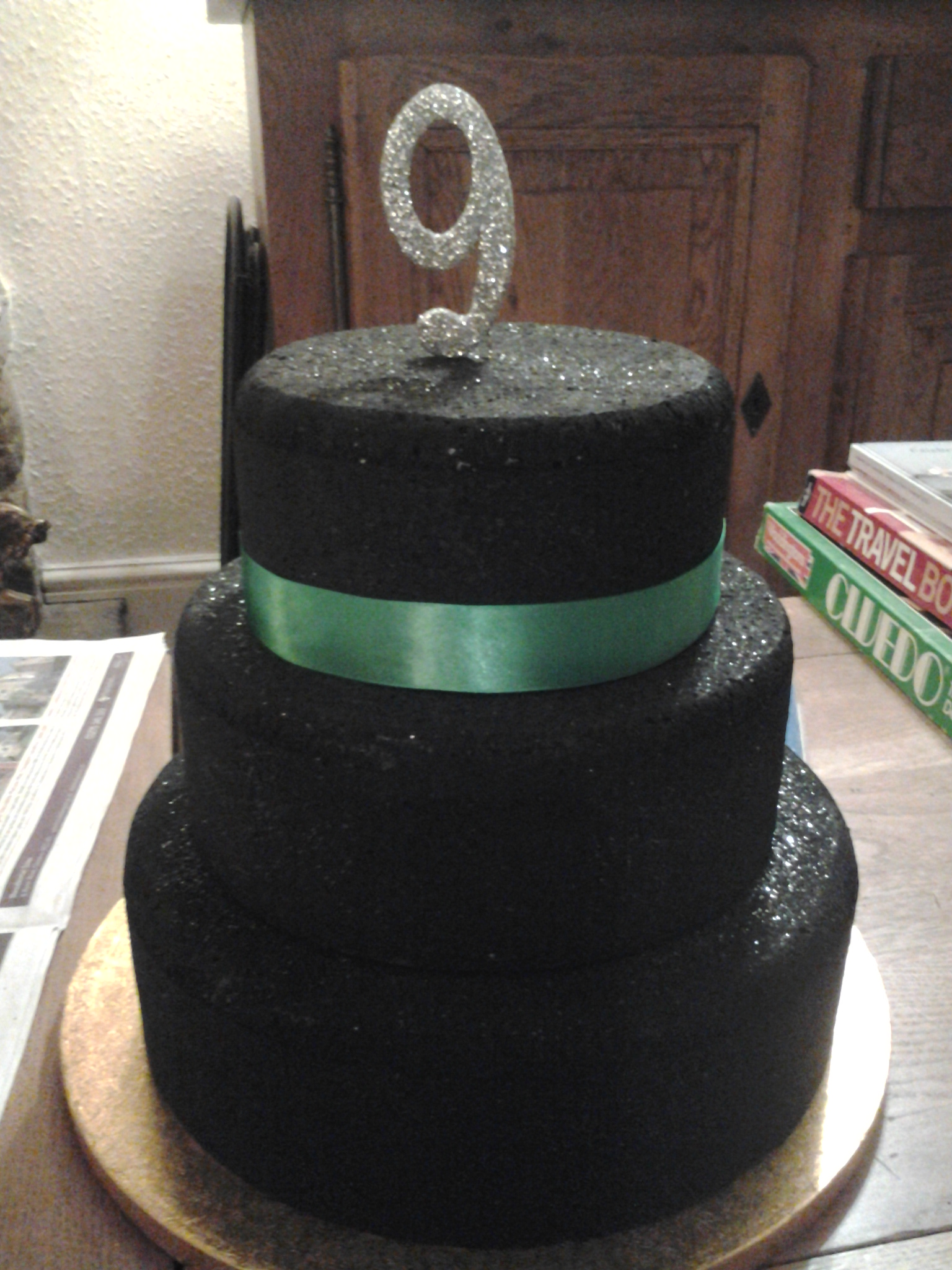
20150225_200407Every year I try to create birthday cakes that either echo the themes of the parties themselves, be that mini-golf, magic or minions; or that are innovative and something the children have never seen before, such as last year’s pinata cake for G.  This year’s Cluedo theme offered me a wealth of ideas and I just needed to decide how to put them into action. I settled on a black base layer and ever-grateful to avoid the nightmare of icing a free-from cake, attacked our 3 tiers with a sturdy brush and bottle of black paint.  “Cakes” fully covered, I liberally sprinkled some silver glitter over them all before the paint dried, positioned the silver 9 on the top and added an emerald green ribbon trim for that touch of old-fashioned glamour and to fit with M’s role as party host, “Captain Emerald”.  I stuck the tiers together using PVA glue and then inserted some wooden skewers, just to make sure there was no chance the cake would fall apart before the day itself.

20150225_210001Next came the fun part of adding the decorations.  I had previously printed out silhouettes to use for the characters and images for each of the murder weapons and had a number of them left-over after I had prepared the cards for the party itself. Choosing carefully, I glued the weapons to the bottom layer and a selection of characters to the middle layer, making sure I included the image of G’s character, “Countess Pearl”.  My final step was to stick Captain Emerald’s silhouette to a piece of black card that I had already covered generously with more silver glitter and added this, leaning against the top-tier of the cake, before leaving it all to dry.

20150227_132323M’s cake sorted, I moved on to the preparation of a cake for G.  Much as I had enjoyed exploring the “crafts” side of my personality, this was the moment I’d been waiting for since Christmas.  Not so much the baking of a cake, though I love decorating birthday cakes to wow my children, but more because I finally got to use the best Christmas present I had received and one that was completely unexpected.  I’ve been drooling over the KitchenAid food mixers for years, imagining one gracing my kitchen counters and last year started saving towards buying one of my own.  To my delight, and absolute surprise, my wonderful Mum invested in a Ice-blue model as my Christmas/birthday present and it’s been sitting in the kitchen, taunting me daily with its absolute beauty, whilst I’ve waited for a chance to take it for a test-run.  All I can say is thank goodness I needed to whip up 24 G-friendly cupcakes as well as the birthday cake itself as I flew through the first task and loved every moment spent doing it!

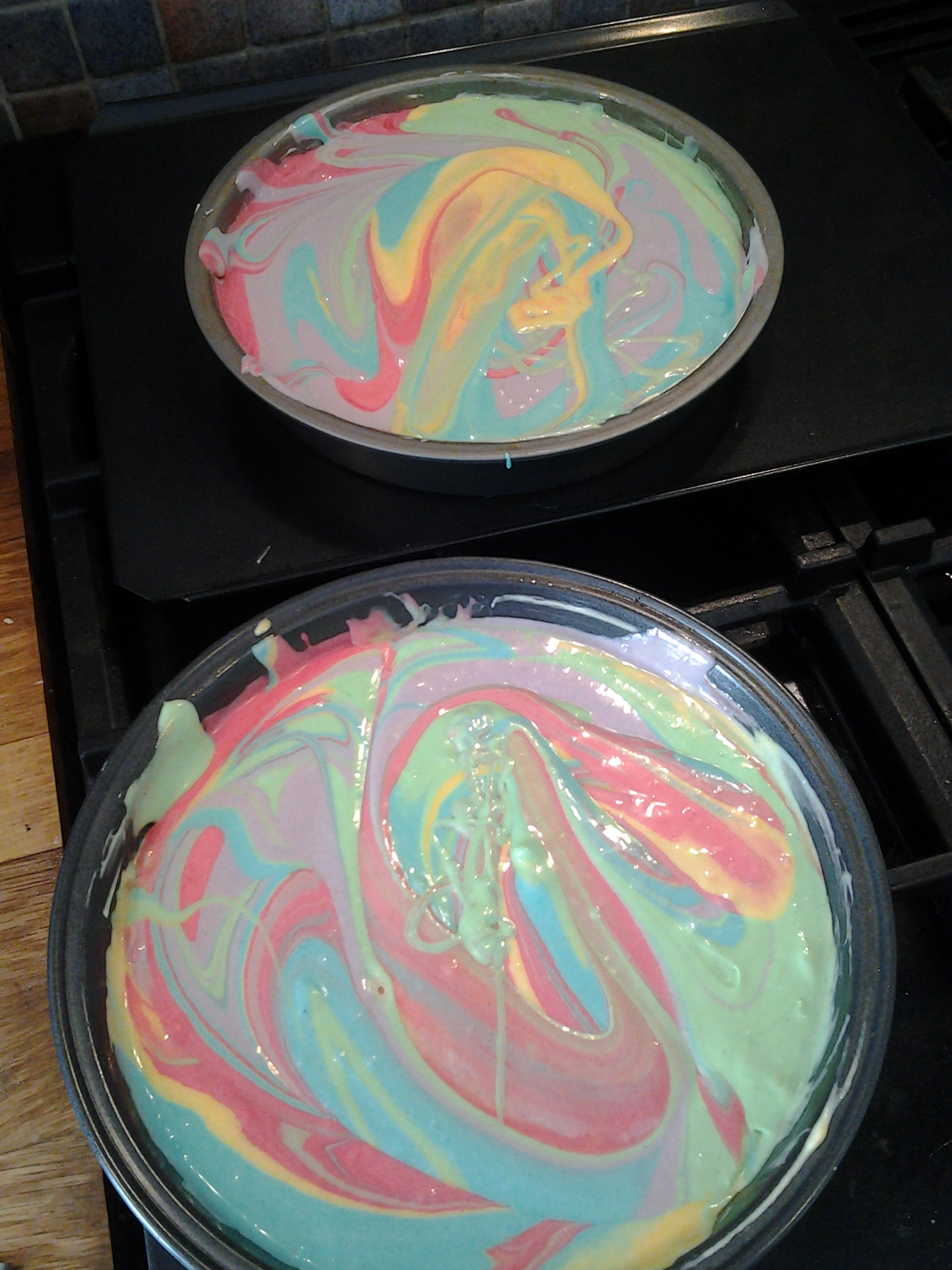
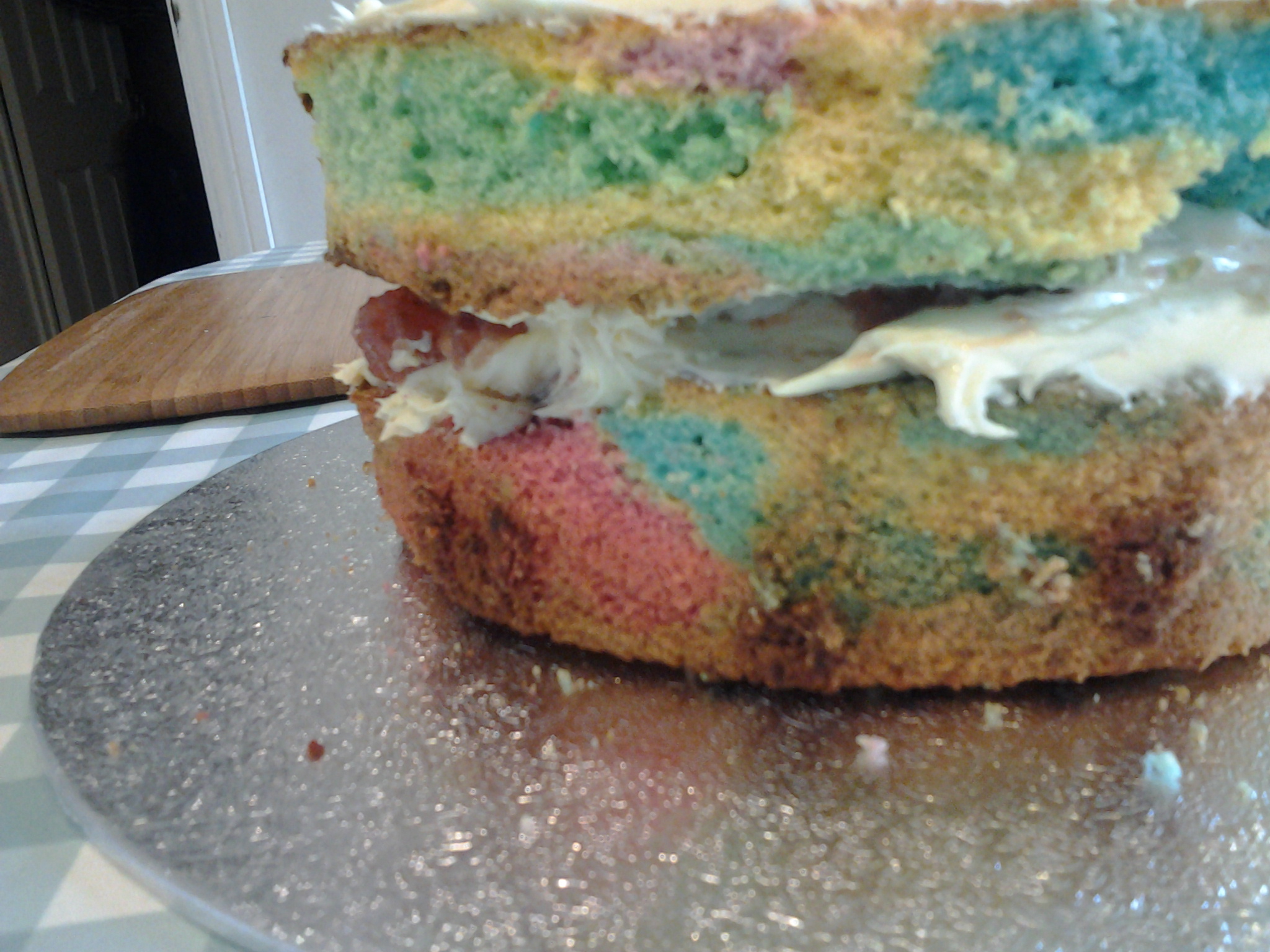
20150227_141709My birthday cake challenge was easier this year as although G has allergies of her own, I was able to use eggs, an ingredient I haven’t baked with in over 3 years.  I used a simple gluten- and dairy-free recipe and then split the mixture between 5 bowls.  Inspired by both the colourful characters in the Cluedo game and a recent episode of Great British Comic Relief Bake-Off, I added 5 different food colourings – 1 to each bowl – and then marbled the cake mix in the baking tins.  20150228_114150As I waited for the cakes to bake, I turned to my trusty laptop to search out some ideas for how to decorate G’s Cluedo cake and settled on recreating the board itself out of icing.  Working late into the early hours of Sunday morning to finish this final part of the party preparations and when I finally fell into my bed at around 3am, I was delighted with the end results.

The big reveal of my “showstopper” cakes was a huge success.  Both G and M were thrilled with their cakes and liked the fact that even though they were completely different, they both fit our Cluedo theme perfectly.  The cakes had pride of place at the centre of our Dessert buffet table and were a real talking point for children and parents alike.  A job well done, though I’m not rushing to make 2 cakes for the same occasion again any time soon – my nerves just can’t take it!

11009339_10152614451586123_8225188594845865541_o 11026157_10152614450811123_382817830123987117_o


“I like rice…

..Rice is great if you’re hungry and want 2000 of something.”

– Mich Ehrenborg

I never realised just how daunting food could be until we embarked on our dietary journeys with our children.  It might sound ridiculous, but having achieved such a resounding success from M’s move to the elemental diet, the prospect of food reintroductions caused my heart to beat a little faster, my palms to grow a little sweatier and several middle-of-the-night awakenings to contemplate just how the whole process would work.  A big part of the problem was the lack of useful any information from the dietetics team about…well about anything I wanted to know.  I like to have a clear plan to follow and needed to understand how we would choose which foods to start with, how each food should be prepared, how much to give and how often.  The vagaries of sweeping statements such as serve M “a portion”, with no hard and fast details of the specifics drove me insane, but with lots of discussion, frantic e-mailing and a move back to our old and trusted dietitian rather than the one I’d had run-ins with during M’s admission, we finally got the answers we were after.

Courtesy of alternative-doctor.com

Courtesy of alternative-doctor.com

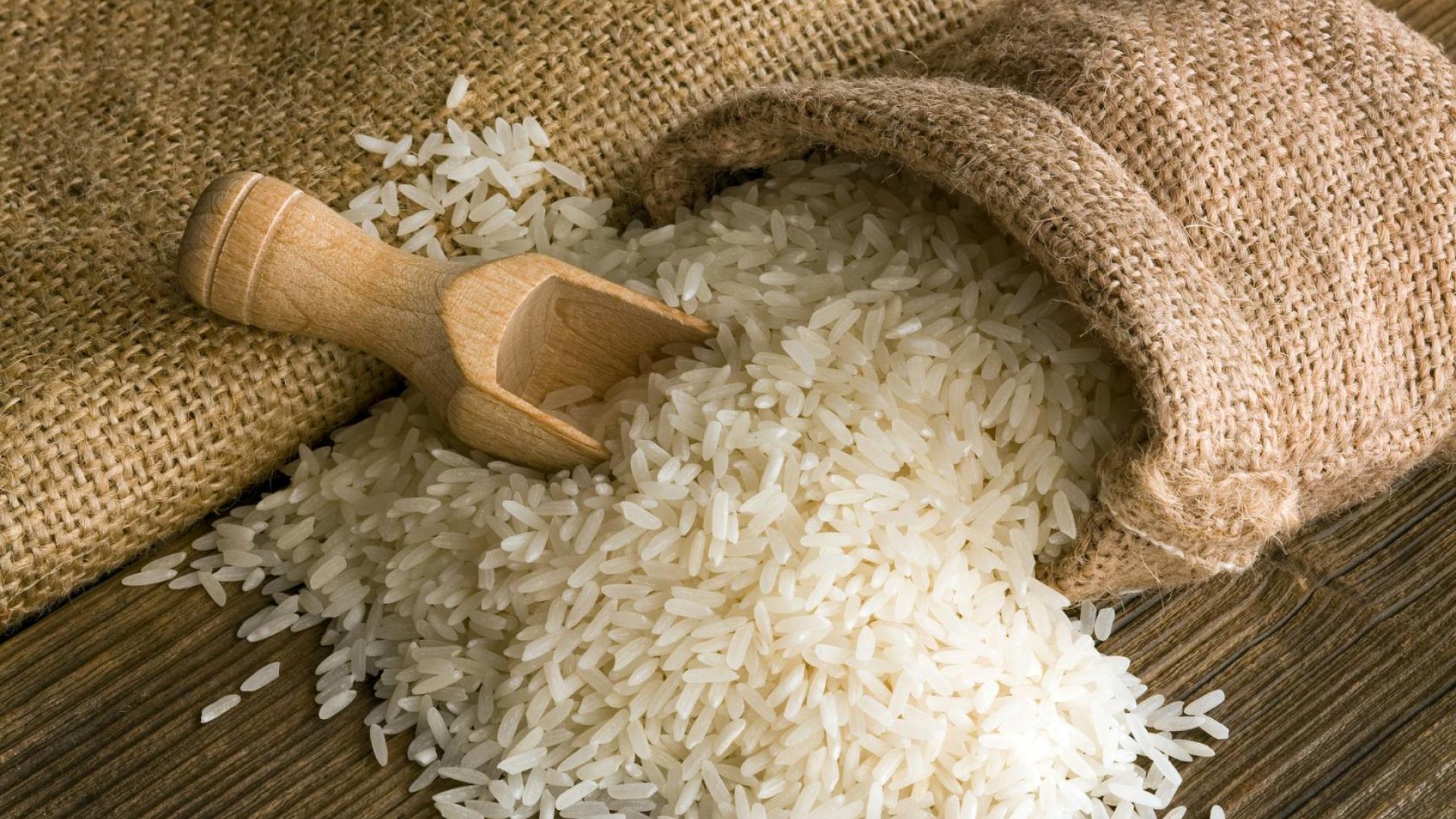
The decision was to begin with rice, commonly considered to be hypoallergenic and therefore a great starting place for M.  Whilst many children reintroducing foods following the elemental diet might trial potato first, this was one of the known triggers for M’s allergic reactions and so we needed to find a basic food that was likely to be safe.  Despite being told that we could comfortably start with a “portion” of rice, I chose instead to take things slow and M had just 1 tablespoon of plain, boiled rice on that first night.  He enjoyed his mouthful and, looking forward to having more the next day, carried on somewhat oblivious to the anxious monitoring I was trying desperately to hide.  The evening passed without event and we all went to bed happily – well, the rest of the family went to bed happily, I went battling the usual Mummy-paranoia that accompanies anything and everything that involves my children and their welfare.

Courtesy of smartwebsite.ru

Courtesy of smartwebsite.ru

Since that day, around 4 weeks ago now, we have been able to gradually increase the amounts of rice M eats each day and have branched out to include rice milk, rice cakes and gluten-free rice cereal – a veritable feast!  This week I even managed a rice batter, using rice flour and sparkling water and made some deep-fried rice balls to tantalise his taste buds.  M has shown an occasional atopic reaction to the rice as it triggered a rash across his shoulders and back, although the hives have now calmed down as his body has become accustomed to eating once again.  Despite this rash, we have seen no reaction in his bowels and are able to count rice as a “safe” food for him.  Even better, we have also been able to add chicken to the mix and this week have been trialling pineapple, though the jury is still out as to whether this may be causing a mild behavioural reaction akin to the one we’ve seen him experience before to soya.  Assuming all is well with the pineapple, we have plans to trial pork, cucumber and carrot over the coming weeks and may even have time to squeeze in another carbohydrate before we head back to GOSH in April.

E028 – the success story

When we started this new chapter in M’s life 10 weeks ago, we approached it with the attitude of “hope for the best, but prepare for the worst”.  We hoped that the move to an elemental diet, consisting of 1500mls of E028 each day, would bring some much-needed relief to his bowel and body and that, from that recuperation would come a way forward that would improve M’s quality of life.  And whilst we were well prepared that there was a chance it might not work; that it might not bring the recovery M desperately needed and that we might have to look to even more extreme measures to reach our end goal of improved health; that wasn’t a prospect we were prepared to spend too much time on, yet.  It was far more important to be positive about the route we had chosen, which wasn’t an easy choice to make and had its challenges from the start: be they passing the NG-tube at GOSH or figuring out our new routine at home.

Courtesy of nameonline.net

Courtesy of nameonline.net

Despite the roadblocks thrown in our path, we’ve kept plodding on, negotiating our way skilfully around the inevitable melt-downs, tantrums and even those tempers that lead to a tube being pulled out accidentally.  We’ve all learned valuable lessons – don’t storm off in a temper following a sibling argument leaving your pump behind being a key one for M – and we’ve survived as a family and, dare I say it, grown stronger as one too.  We have laughed, cried and got angry together.  We’ve used that laughter to overcome the depths of despair and we’ve focussed on the important things in life.  Mike and I have long been a team, since the disastrous surgery on my left eye for diabetic retinopathy 17 years ago just weeks after Mike had moved to the UK and before we were even married.  We may not always see eye to eye, but we have grown together and take turns in being the strong one when the other is feeling weighed down by the world.  Now we have 2 children who are learning those same lessons and this experience has shown me just how amazingly strong our children are. They’ve coped with all that life has thrown at them and whilst they may have been knocked down occasionally, they’ve learned to pick themselves up, to brush themselves off and to keep going along their paths. The last 10 weeks have seen them grow in their empathy for others and they too have taken turns in being the strong one when faced with adversity.

Courtesy of artiwards.com

Courtesy of artiwards.com

The best news of all is that we now know that every exhausted step has been worth it and I’m thrilled to be able to share that, for M, the E028 has been his success story.  Within days of the switch to a food-free diet, the near constant diarrhoea that has been the bane of the last 9 years of our lives stopped.  Just like that. No magic potions, no magic wands, no tricks and, so far, no looking back.  M has become the fun-loving, caring, well-behaved little boy we all knew was hiding somewhere within himself.  His joie de vivre has returned and his humorous outlook on life is much more evident.   As each day passes, we are slowly and surely making more and more progress and his confidence has grown as evidenced by his abandonment of his daytime reliance on pull-ups for the first time in a year.  It’s not been a perfect cure by any stretch of the imagination and his weight is once again giving us, and the medics, cause for concern, but it’s a massive step, a giant leap in the right direction.  We are lucky that this proved to be the way forward for M and we are truly grateful for that as we know so many other families who have not found it to be the answer to their health problems and are still battling on.

Meanwhile, the next step is the big one for us: food reintroduction.  We need to work on getting food back into M’s diet without upsetting this balance that he has found right now.  There’s a “sort-of” plan from the dietitians about how we go about trialling each food with M, but for the most part it’s going to be driven by us.  Having finally got my lad to the point where “I feel better Mummy, my tummy’s less grumbly and I just feel…well…feel so much better in myself“, I refuse to be hurried and I’m going to protect this new sense of well-being with all my strength and determination.


Pump action

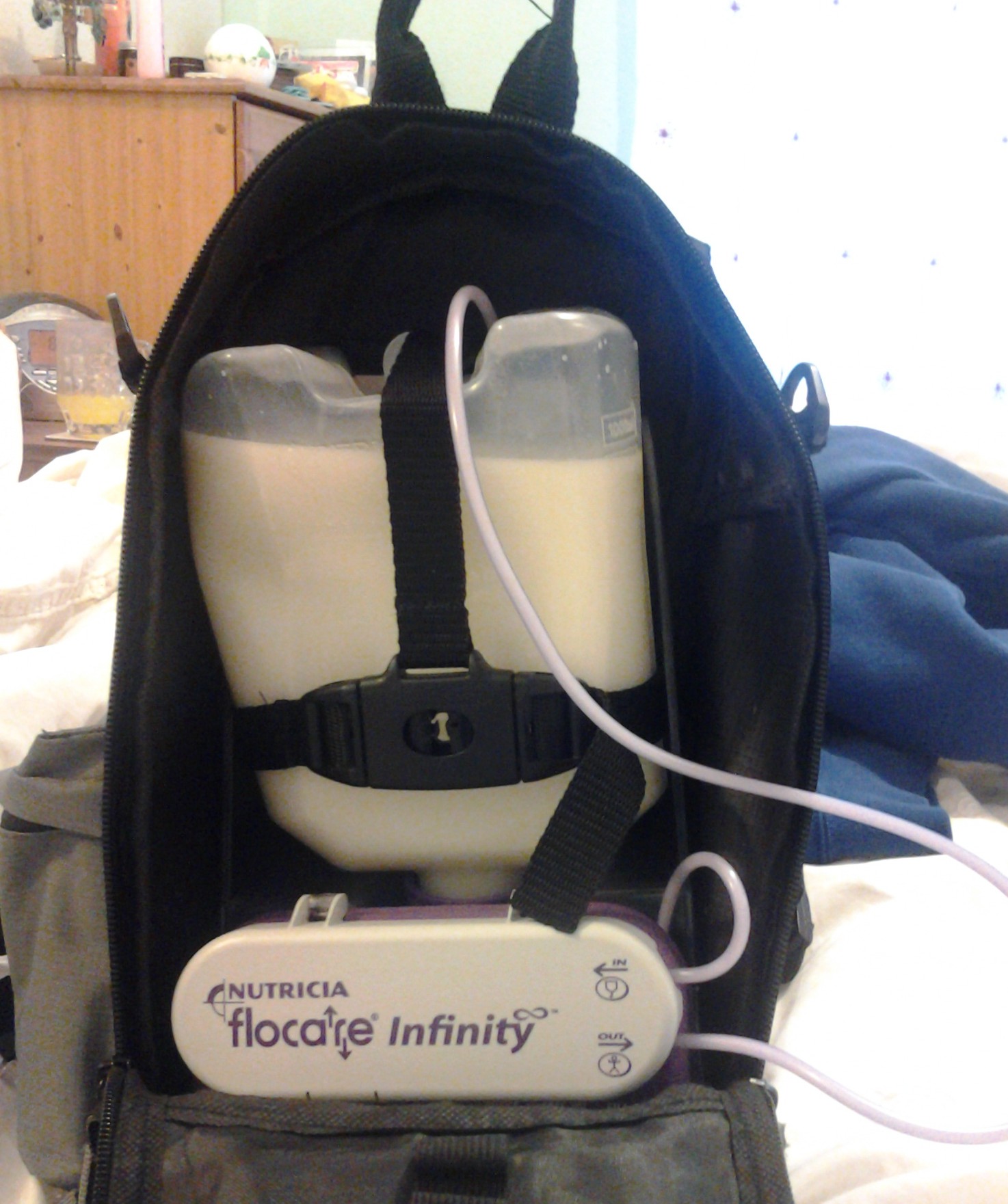
pumpHaving sussed making the elemental feeds, and NGT management having quickly become second nature, our final challenge was to learn all about the small piece of equipment that is going to become a key member of our household for the next few months – the pump.  M has the Flocare Infinity pump from Nutricia, which has proved to be easy to handle and quick to program.  I was trained in just 40 minutes whilst M was still admitted at GOSH and even though it all felt rushed, it was actually all I needed and I was just about confident enough to go home with him 2 days later.  Our excellent Nutricia nurse, from their local community nursing team, came out to train Mike the day after M was discharged and she has also held a training session at school to ensure key members of staff are up to speed with what they need to do during the school day.

The set-up is easy.  The first thing we have to do is set the volume of the feed – either 1000mls or 500mls for M – and the rate in ml/h, which we set to 150 ml/h.   The pump retains the information from the previous feed, so it is important to check that these 2 figures have been set correctly for the feed you’re giving.  I then press the “info” button, which tells me the exact dosage that was given to M in his previous feed and clear this number from the pump’s memory.  This records how much of the required volume has been given since the pump was started, so if you don’t take care to delete the previous information, you could find yourself giving a lot less than the required amount.

The pump is then attached to the feed bottle via a feeding kit, which is a length of tube that joins the bottle to the NGT via the pump itself.  We were provided with a small plastic stand, which holds the pump at the bottom with the bottle hanging upside down above it, firmly strapped in place.  The feeding kit is attached to the top of the bottle, threaded around the pump stand, carefully avoiding getting it trapped between pump and stand, and then looped around the mechanism inside the pump.  Before connecting the loose length of the feeding kit to the NGT. you need to fill the entire length of the feeding kit tube with the feed to make sure you’re not pumping air into your child.  We were shown to do this using the “fill set” button, which runs at the fastest rate possible and takes seconds to fill up.  Once this is done, it’s simply a case of attaching NGT to feeding kit tube and pressing start.  All being well, the feed is now underway and, in an ideal world, you can leave the pump alone until the feed is finished.

20150212_082048

However, reality is very different and you will quickly become attuned to the beeping of the pump alarm.  It can and will beep for any number of reasons: there’s air in the tube, the tube has become kinked or blocked on the way into the pump mechanism,  the tube between the pump and your child’s NGT has been kinked/blocked/sat on/folded tightly between your child’s fingers such that the formula has no place to go or sometimes, just because.  Sometimes the alarm is easy to resolve, simply a case of stopping the pump, removing the air/blockage/kink and restarting; but sometimes no amount of jiggling wires, shaking formula bottles or removing everything from the bag and the stand will stop that alarm sounding every 5 minutes or less.  We’ve even tried that old IT support favourite of switching it off and then on again and have had limited success in silencing the beeping for more than 5 minutes.  Both G and M know how to switch the alarm off, but both are guilty of occasionally forgetting to make note of what fault featured on the digital display, leaving it to my superior Mummy detective skills to work out exactly what might have caused the problem that time round.  Nevertheless, the odd mad beeping episode aside, the pump generally does what it should and copes in an admirable fashion with being bounced around on M’s back for 10 hours a day.

Courtesy of minionlovers.weebly.com

Courtesy of minionlovers.weebly.com

So this little purple pump has become our new best friend.  Just like a favourite fashion accessory, we rarely leave the house without it or the trusty back-pack.  M can do almost everything whilst wearing it and has become adept in the art of adapting to its very presence in his everyday routine.  And whilst it is ever-present, we’ve learnt to have a laugh and have attributed it with its very own personality.  Some of the lovely FABED family shared that naming the pump helped make the whole experience easier and more fun for their child and one Mum even said that the pump reminded them of a minion.  This latter idea made all of us smile because we knew instantly what she was referring to: the incessant beeping of the alarm which is hard to distinguish from the “Bee-do bee-do” heard from the Fireman minion who helps put out Gru’s office fire.  Of course, even though M’s pump bears more resemblance to one of the evil purple minions from Despicable Me 2, bent on a path of destruction, it’s hard work and support in providing M with the means to have the nutrition he needs is far more comparable to their loveable yellow counterparts.

Disclaimer:  I am not a medical expert and this blog does not constitute medical advice. I have detailed how we have been taught to run M’s pump by the professionals involved in his care. Please note that any questions concerning a feeding pump and the associated kit should always be directed to your medical team.

A Super Tubie of my Own

Courtesy of feedingtubeawareness.com

Courtesy of feedingtubeawareness.com

This week is #feedingtubeawarenessweek, a week that our family is embracing with every ounce of our being this year.  Last year I wrote about our 2 previously brief encounters with a NG-tube, knowing that there was an ever-present chance that M might end up needing one at some as-yet-unspecified point in the future.  Just 12 months on and the state of M’s health due to his EGID means that a NG-tube is now part of our everyday family life.  The aim of the campaign this year is to dispel the myths and misconceptions that surround tube feeding and to show that adults and children can live their lives and have fun with the tube in place.  A tube is often the path to improved health and development and should be embraced as such by us all.  Their theme is “The truth about tube feeding”.

Picture1M’s friends and class-mates have accepted it as very much part of who M is and have been amazing at looking out for him at every turn without leaving him out of their games.  One friend was so intrigued by the tube and how it worked that I spotted him peering up M’s nostril to see where the tube went, just before M opened his mouth wide and pointed out that the tube could also be seen at the back of his throat – how I love the honest interest of 9-year old boys!  He was more bothered by the Year 3 children at school, who he often caught staring at his tube, but he developed his own coping mechanisms and when asked what “that” was – a question often accompanied by a finger pointing towards his nose – he started telling them it was “…nothing, but a mere figment of your imagination…”, before walking off, leaving in his wake a stream of very confused 7- and 8-year olds.

In light of all this, I was chatting to M this afternoon about his tube and people’s attitudes towards it.  I was interested to find out how he feels about strangers staring and what response he would want them to give instead.  His reply fascinated me as it expressed clearly how much more awareness is needed about tube-feeding and the impact had on those living with a tube. He didn’t mind the idea of people asking me about his tube and the reasons for it, but he isn’t yet comfortable with having to deal with those questions himself.  However, the most telling statement was this one:

“Adults should know not to stare, but sometimes they do and I don’t know why”

and that, in turn, made me think about how I feel about M and his NG-tube.  Hospital, home and support groups all exist within a protective bubble, where nothing is unusual and normal is defined by each individual and their particular needs.  It’s only when you go out into the outside world that you suddenly come up against opinion and prejudice and the harsher side of life; against people who don’t understand that this tube is bringing nutrition and healing to my child and who find themselves unable to pull their eyes away from the tube stuck to the side of his small face.

Courtesy of timemanagementninja.com

Courtesy of timemanagementninja.com

We’ve been lucky and haven’t experienced negative comments or unwanted interest.  Yes, I’ve seen the intrigued looks or double-takes as passers-by register his tube, and I’ve received the sympathetic smiles from other parents as they’ve watched me attaching his pump or silencing the alarm, but nothing more.  We’ve been fortunate to have the most amazing support from the families and friends who are part of FABED, many of whom have been in the same boat at one time or another and know how it feels to be suddenly following a slightly different path through life than the one we thought we were on.

Today, I found an article written by Traci Nagy, the founder of the Feeding Tube Awareness Foundation, in 2013 to discuss the importance of feeding tube awareness and thought I’d share with you this excerpt that sums up for me just why awareness matters so much to families like mine:

“It matters that people understand something about feeding tubes other than Terry Schiavo or that silly KE diet.  It matters that they know there are well over 200 medical conditions and diseases that can lead children to need extra nutritional support through tube feeding.  It matters that they realize that these conditions aren’t always visible, and that looking “normal” doesn’t mean there isn’t more going on inside.  It matters that they know that the feeding tube can be thought of like any other medical device in that it helps you do what you can’t do on your own…for now.  It matters that they understand that the benefit is that children get the nutrition and hydration they need to grow, develop and thrive.”

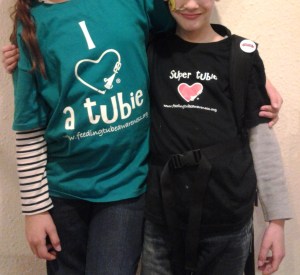
20150208_181917So, this week we’re the family proudly sporting the “I love a Tubie” t-shirts accompanied by the live-wire that is our very own “Super Tubie”.  Stop and say hello and don’t be afraid to ask me questions, but let M get on with whatever he’s doing.  We’re hoping to raise awareness and are happy to start in our community, after all, we know that every journey begins with a single step.

Managing a NG-tube

Formula made, it’s time to move on to what was, to me, the most daunting part of our NG-tube (NGT) journey and the bit that scares other people the most – the NGT itself.  Whilst it now feels like second nature, this was the biggest hurdle I had to overcome in my quest to become confident in managing M’s enteral feeding at home.  Let’s start with the very basics of what a NGT is and the job that it does.

The tube is a length of flexible material, which is inserted through the nose and travels down the oesophagus into the stomach with the purpose of allowing food and medicine to be placed directly there.  There are a myriad of medical reasons for a NGT to be passed and in M’s case, it was because he wasn’t able to drink the quantity of E028 needed each day due to being a reluctant drinker and the very unpalatable taste of the feed.  The NGT is measured against the child’s body before it’s inserted to make sure enough length is passed for its tip to sit comfortably within the stomach.  There are varying types and sizes of tube that can be used to allow for the age and size of the child, differing situations and the various medical needs.  M has a long-use “10 silk”, which he found to be the most comfortable to have in and can be left in place for up to 8 weeks before it needs to be changed.  Other tubes are more rigid and require changing on a weekly basis, something that just wouldn’t be practical given his current anxiety about having the tube passed and his allergic reactions to anaesthetic.

Once the tube has been passed and is in place, it is secured to the cheek using dressings and tape.  There are a number of these available and it really is a case of trying them out to see which works best for your child.  We quickly discovered that M has an allergic reaction to Duoderm and Micropore, two of the most commonly used dressings and so we’ve had to work out a method of fixing the tube to his cheek that won’t cause his face to become red and inflamed.  For us that proved to be a small strip of Tegaderm, which I then decorate using an amazing product I found on an US website called Feeding Friends.  These stickers are printed on medical tape and add some fun to the prospect of having a NGT on permanent show.  By sticking one over the top of the Tegaderm strip, M’s skin doesn’t react and he loves nothing more than choosing which friend will grace his cheek each time.  I change his tape approximately every 3 days, though we find that if it gets too wet in the bath or shower, then we need to replace it more often.

So far, so good and nothing too scary you may think, but now comes the most difficult bit, making sure that the NGT is still in the right place before starting a feed.  This is known as “aspirating” the tube and requires you to draw an amount of liquid up the tube to check that its tip is still sitting in the stomach and hasn’t become dislodged or moved during the time off the pump.  We were told to use nothing smaller than a 20mls syringe to aspirate the tube and are provided with 60mls syringes by our home delivery team.  Remembering to “kink”, or create a block in, the NGT before you start – this ensures that no air can go down the tube whilst you fiddle around with it – carefully attach the syringe to the end of the NGT and pull back on the plunger with – in my experience – your fingers tightly crossed that you can draw some of the liquid out from the stomach.  Depending on the time of day and what your child has been up to beforehand or even what, if anything, they’ve had to drink, this can prove to be something of a challenge.  It is possible for the tip to become stuck to the stomach wall, which creates a vacuum when you try to pull upon the syringe. I’ve found that sometimes it will “pop” free and a sudden flood of liquid will rush into the syringe and at other times, your gentle tugging will be met with nothing but stubborn resistance and a failure to draw even a millilitre out from the stomach.

The key thing to remember at this point is NOT TO PANIC. The first time it happened, I desperately scrabbled around in the depths of my memory to recall what advice the GOSH nurses had given, all the time attempting to resemble an oasis of calm and to impart none of my increasing anxiety to an unaware M.  There are 3 easy ways to try to resolve the problem:

  1. Give your child a glass of water to drink, wait around 15-20 minutes and then try again
  2. If the drink hasn’t helped, take a deep breath, lean your child at an angle of approximately 45° for 20 minutes before your next attempt
  3. If you still can’t aspirate the tube, get your child to lie on their left-hand side as this is where the stomach is positioned and may encourage that stubborn NGT to finally drift away from the stomach wall and allow you to test exactly where it is

If none of these has worked, or if your attempts to aspirate are causing your child discomfort, then you need to get the tube medically checked.  In our case, this meant a trip into our local A&E department, but could simply mean a phone-call to your local community nursing team or feeding team, who will be best placed to advise you on where to go and what to do next.

Courtesy of jamali4u.net

Courtesy of jamali4u.net

However, assuming you are able to aspirate the NGT with relative ease, you now need to check the pH of the liquid you’ve drawn from the tube to make sure that all is where it needs to be.  You will have been provided with pH strips as part of your enteral feeding “kit” and testing couldn’t be easier.  Simply drop some of the stomach juices on to the pads at the end of the strip and watch them change colour.  Memories of secondary school chemistry lessons come flooding back at this point and testing substances to see whether they were alkaline or acidic.  In M’s case, we are looking for a pH of 5.5 or less, indicating that the liquid drawn is acidic and therefore likely to have come from his stomach.  Always check with your nursing team what pH level is safe for your child as certain medicines are known to affect the results and an adjustment to the recommended results may be made.

Although aspirating the tube is a scary prospect, the risks associated with a misplaced tube are great.  I was lucky to be trained on all aspects of M’s NGT whilst we were in GOSH, but even then found the first few attempts a frightening prospect.  The most important lesson I learned was to “kink” his tube every time I did anything with it and now I don’t even think twice about doing it – it’s just another step in the process of starting his pump feeds. Once it’s confirmed that the NGT is correctly positioned, tube feeding can now begin, but that, I fear, is a lesson for another day!