 Today I’m celebrating a very special day, a milestone birthday of a very different kind. Google has revealed that Steve Jobs, Ben Miller and Kristin Davis were all born on this day, but as interesting as that is, I’m not really celebrating their birthdays. Today is my Godmother’s birthday, but it’s much more than that too. Today also happens to be my birthday, but, according to my birth certificate and my Mum, both of whom I trust implicitly, I’ve got another 366 days to wait until I reach my next noteworthy milestone, so my birthday celebrations this year are relatively low-key. Despite all these great reasons to celebrate, today I’m marking 30 years of one of the most significant events in my life:
30 years of living with T1D*
![IMG_0138[1]](https://7yearstodiagnosis.com/wp-content/uploads/2016/02/img_01381-e1456250298723.jpg?w=144&h=300)
This is me, the Christmas before I was diagnosed
With a less than auspicious twist of fate, my life changed completely on the day I celebrated my 9th birthday and, believe it or not, 30 years on I can say that it arguably changed for the better. Don’t get me wrong, I would give anything to not be living side-by-side with a chronic illness, but the events of that day enabled me to return to much improved health and, most importantly, haven’t stopped me doing pretty much anything I’ve wanted to since then. After months, and maybe even years, of displaying what are now the well-recognised
symptoms of undiagnosed diabetes – think excessive, unquenchable thirst; massive weight loss; increasing and unexplained lethargy and a constant need to wee – an unexpected collapse at school led to an emergency hospital admission, a fear-filled night as my parents had to face the unimaginable possibility of losing me and finally a diagnosis that would shape the way my future unfolded. Without even knowing it, and certainly with little regard for my opinion, this uninvited visitor came and took up permanent residence in my body, where it has lived in varying degrees of co-operation since the mid-1980s.
The last 30 years have seen amazing developments in the care of T1D, but the most momentous event actually happened 65 years before my own diagnosis. Before 1921, my parents’ worst fears of that night would have been realised as, until the discovery of insulin at the University of Toronto by Banting and Best,  those diagnosed with diabetes mellitus had no chance of survival and could only delay death from the illness itself by starving the body instead. Their discovery followed on from the hard work of other scientists and medics from around the world such as Oskar Minkowski, Joseph von Mehring and Paul Langerhans, for whom the cells in the pancreas were named, and I doubt that any can deny the life-changing impact that the discovery of insulin has had on those of us living with T1D.
My first decade with T1D was heavily influenced by the incredible mind of my consultant, Professor B, who was compassionate, understanding and impressively forward-thinking in his approach to my care. One great example of his progressiveness is reflected by the DAFNE (Dose Adjustment For Normal Eating) approach to T1D management, which teaches PWD** to “…match their insulin dose to their chosen food intake on a meal by meal basis…“, and which was introduced to mainstream diabetes care in 1998 as a somewhat revolutionary new step. I somewhat nonchalantly shrugged my shoulders at the announcement as I’d been following that regime for around 10 years before it was accepted as being effective by the rest of the diabetes world, all thanks to Professor B and his focus on helping to improve my teen struggles with T1D.
![IMG_0139[1]](https://7yearstodiagnosis.com/wp-content/uploads/2016/02/img_01391.jpg?w=300&h=225)
My collection of Novopens!
Likewise, within 2 or 3 years of diagnosis, my “
futuristic” disposable syringes and bottles of insulin, which had replaced the glass syringes and metal hypodermic needles of the 1950s that needed constant sterilising and re-sharpening, had themselves been replaced with one of the first models of the Novopen. This was the first insulin pen injector of its type and combined syringe, needle and insulin bottle in one unit. I worked my way through several upgrades of the Novopen and these days use a combination of a pre-filled disposable pen injector and the last pen injector that I had, a green Novopen 3, which still works in impeccable fashion nearly 20 years on from when I was first given it. Two decades on and I’m so excited to have embarked on another
adventure, this time with the relatively new innovation in diabetes care, the
Freestyle Libre system for blood glucose monitoring. Whilst I’m not at the forefront of PWDs trialling its use, I have offered to collect data concerning my usage for a research student looking to c
ompare blood glucose monitoring behaviour following the use of the Freestyle Libre, a study that I would hope would encourage some NHS funding for these short-lived sensors which really could revolutionise T1D for many.
To put the last 30 years into context, I worked out some quick statistics of what 3 decades living with T1D has meant for me:
- An average of 3-4 BGLs measured a day, sometimes a lot more and sometimes considerably less, adds up to around 43,838 blood sugar tests…
- …and assuming equal use, though the truth is anything but, each of my fingers has been pricked nearly 4,500 times.
- There’s been in the region of 41,636 injections to keep me healthy…
- …most of which have in my thighs, bum and upper arms…
- …although, after 25 years of steadfast refusal to consider anywhere else, I now inject almost exclusively in my stomach and have the bruises to prove it!
- I’ve been involved in several research projects since almost day 1, including one which resulted in the longer-acting insulin I now use on a daily basis…
- …and more medical students, visiting foreign doctors and interested consultants than I care to remember…
- …and the involvement of both G and M in current research to investigate a possible genetic marker for T1D.
- One amazingly fantastic juvenile T1D consultant, considered to be one of the top men in the diabetes world, around the world…
- …and another who I remember joining my team as a junior doctor at our local hospital and who is now a Professor in this field in that same hospital…
- ..as well as the care of another unrivalled T1D consultant during both my pregnancies to ensure the safe arrival of my babies and my continued health too.
- And there have been the inevitable times in hospital, particularly during my emotion-ridden years and fortunately only 1 major complication resulting from my teenage rebellion stage.
A cure may not yet be in sight, but with the amazing developments of the last 100 years, who knows what the next 30 years will bring?
*T1D – Type 1 Diabetes **PWD – People With Diabetes

 My starting point was actually a conversation with M as there was no need to stress about how to create a French-inspired masterpiece for him, if he’d simply be satisfied with a
 ![IMG_0207[1]](https://7yearstodiagnosis.com/wp-content/uploads/2016/03/img_02071.jpg?w=225&h=300) The coconut oil solidifies at cold temperatures and by the time I was ready to make and bake the croissants on Thursday evening, my pastry was now filled with marble-sized lumps of coconut oil that I just had to remove. Whether this made much of a difference to my final product, I really don’t know, but given that a lot of the flavour in a French pastry comes from the fat added to it, I don’t think I did myself any favours.
The coconut oil solidifies at cold temperatures and by the time I was ready to make and bake the croissants on Thursday evening, my pastry was now filled with marble-sized lumps of coconut oil that I just had to remove. Whether this made much of a difference to my final product, I really don’t know, but given that a lot of the flavour in a French pastry comes from the fat added to it, I don’t think I did myself any favours.![IMG_0209[1]](https://7yearstodiagnosis.com/wp-content/uploads/2016/03/img_02091.jpg?w=300&h=225) I popped them into the oven, set the timer and attempted to forget all about them until the bell rang. The turnovers ended up being a little overdone and I wasn’t entirely convinced by the
I popped them into the oven, set the timer and attempted to forget all about them until the bell rang. The turnovers ended up being a little overdone and I wasn’t entirely convinced by the 
 I’m sure that there will be things I’ve already forgotten and likewise, there’s no doubt that there will be more items added to my list as March passes by. Needless to say, I will be blogging about many of these occasions and just how I overcome the challenges of taking my M-friendly cooking and baking a step further than I ever imagined possible. Once all of these things are out of the way, it’ll be time for a well-deserved drink and, in case you’re wondering, mine’s a large gin!

 your family’s life on a daily basis.
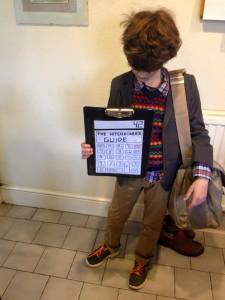
 There is nothing G loves to do more than read; she really is her mother’s daughter when it comes to that particular pastime. Whenever she has a spare 5 minutes, and even if she doesn’t, you can usually find her with a book in hand, curled up somewhere quiet in the house. In fact, if you ever need to track G down, the best place to start is her bedroom as the chances are you’ll find her on her bed, engrossed in the story unfolding before her and completely lost to the outside world. Mike and M will willingly tell you that I am no different, much to M’s disgust, so the occasional times when it’s just G and me in the house can be surprisingly quiet.
 Not long into the new term, G’s secondary school announced that they were taking part in
  the recent half-term, she penned an
 “Shipwrecked” by
![IMG_0131[1]](https://7yearstodiagnosis.com/wp-content/uploads/2016/02/img_01311-e1455811200839.jpg?w=175&h=202) But, and believe me when I say it was quite a big “but”, the sticking point sadly was the price. This type of technology is not available to anyone through the NHS as yet and funding the sensors alone would cost in the region of £100 a month. I know that you cannot put a price on good health, but as a Mum to 2 children with multiple food allergies and an already increased monthly bill due to the high costs of free from food, the challenge of finding that extra £100 each month (£125 extra earned pre-tax) felt quite daunting and I shelved any thoughts of such an investment for the time being.
But, and believe me when I say it was quite a big “but”, the sticking point sadly was the price. This type of technology is not available to anyone through the NHS as yet and funding the sensors alone would cost in the region of £100 a month. I know that you cannot put a price on good health, but as a Mum to 2 children with multiple food allergies and an already increased monthly bill due to the high costs of free from food, the challenge of finding that extra £100 each month (£125 extra earned pre-tax) felt quite daunting and I shelved any thoughts of such an investment for the time being.![IMG_0135[1]](https://7yearstodiagnosis.com/wp-content/uploads/2016/02/img_01351-e1455809989998.jpg?w=175&h=221) The concept is a simple one and reassuringly easy to use. You insert a small sensor with a thin, 5mm needle into the back of your arm and, although the initial instructions for applying it appear quite complex, it really was quick and easy to do. I didn’t find it painful at all and whilst it takes some time to get used to the constant presence of this sensor on my arm, I’ve had no problems with it. The sensor measures what is called the interstitial fluid glucose levels, which are not identical to BGLs as this is the fluid found between the cells, but are considered accurate enough for monitoring what is going on. To find out your BGL, you simply wave the scanner over your arm and it gives you the result almost instantaneously.
The concept is a simple one and reassuringly easy to use. You insert a small sensor with a thin, 5mm needle into the back of your arm and, although the initial instructions for applying it appear quite complex, it really was quick and easy to do. I didn’t find it painful at all and whilst it takes some time to get used to the constant presence of this sensor on my arm, I’ve had no problems with it. The sensor measures what is called the interstitial fluid glucose levels, which are not identical to BGLs as this is the fluid found between the cells, but are considered accurate enough for monitoring what is going on. To find out your BGL, you simply wave the scanner over your arm and it gives you the result almost instantaneously. ![IMG_0129[1]](https://7yearstodiagnosis.com/wp-content/uploads/2016/02/img_01291.jpg?w=175&h=233) The sensor continually reads the changes in the glucose levels and, as long as you scan at least once every 8 hours, the easy-to-read graphs given on the screen indicate what has happened during the times you didn’t test. As with most CGM systems (Continuous Glucose Monitoring), it is recommended that the FSL user occasionally uses a standard glucose monitor to test their blood sugars and check that reading to the one given by the FSL – my tests have shown a difference of less than 0.3 mmol, which is incredible.
The sensor continually reads the changes in the glucose levels and, as long as you scan at least once every 8 hours, the easy-to-read graphs given on the screen indicate what has happened during the times you didn’t test. As with most CGM systems (Continuous Glucose Monitoring), it is recommended that the FSL user occasionally uses a standard glucose monitor to test their blood sugars and check that reading to the one given by the FSL – my tests have shown a difference of less than 0.3 mmol, which is incredible.![IMG_0128[1]](https://7yearstodiagnosis.com/wp-content/uploads/2016/02/img_01281-e1455811252823.jpg?w=175&h=246) and am able to discreetly test whenever I want or feel the need. The amount of information available is vast and you can look at enough graphs, bar charts and log books to satisfy even the biggest techno-geek. It has become strangely addictive to do and has already started to give me an even greater understanding of what my T1D is doing than I’ve ever had before. The non-invasive nature of the testing means that it would be easy for a parent to do during the night with no fear of disturbing their child’s sleep, and similarly for Mike to do if he ever feels that my blood sugars are dropping overnight – no need to wake me to ask me if I’m going hypo and then having to survive the often stroppy response his concerns are rewarded with, whether they are or not – yes I am precious about my sleep! I also have no doubt that it would appeal to every tech-savvy under-18 out there, which would no doubt reduce the chances of non-compliance and teen rebellion that so many young T1Ds experience,
and am able to discreetly test whenever I want or feel the need. The amount of information available is vast and you can look at enough graphs, bar charts and log books to satisfy even the biggest techno-geek. It has become strangely addictive to do and has already started to give me an even greater understanding of what my T1D is doing than I’ve ever had before. The non-invasive nature of the testing means that it would be easy for a parent to do during the night with no fear of disturbing their child’s sleep, and similarly for Mike to do if he ever feels that my blood sugars are dropping overnight – no need to wake me to ask me if I’m going hypo and then having to survive the often stroppy response his concerns are rewarded with, whether they are or not – yes I am precious about my sleep! I also have no doubt that it would appeal to every tech-savvy under-18 out there, which would no doubt reduce the chances of non-compliance and teen rebellion that so many young T1Ds experience,![IMG_0130[1]](https://7yearstodiagnosis.com/wp-content/uploads/2016/02/img_01301-e1455811224240.jpg?w=175&h=179) thereby similarly reducing the risk of complications from poor control. I really can’t speak highly enough of my experience so far with the Freestyle Libre and wouldn’t hesitate to recommend it to every T1D out there. It has been a struggle to find a down-side other than the price, which is due to the £50 sensors needing to be replaced every 14 days. My personal solution to that is to fund 1 sensor a month for the time being, or at least until the point I finally win that elusive lottery jackpot!
thereby similarly reducing the risk of complications from poor control. I really can’t speak highly enough of my experience so far with the Freestyle Libre and wouldn’t hesitate to recommend it to every T1D out there. It has been a struggle to find a down-side other than the price, which is due to the £50 sensors needing to be replaced every 14 days. My personal solution to that is to fund 1 sensor a month for the time being, or at least until the point I finally win that elusive lottery jackpot!

 especially if they would recommend them to others or, indeed, warn other food allergy sufferers against going there. Needless to say, as soon as I first heard about CIET?, I contacted Nicky to find out how I could become involved with her new venture and am proud to be one of the allergy ambassadors and partners delighted to be working with CIET? as much as I can. It really is a 5-star website and I wish them every success for the future.
 he same is true when it comes to feeding tubes as sadly misconceptions are rife and the reasons behind a tube can be as complex and individual as there are stars in the sky. Even with children or adults living with the exact same condition, their symptoms and need for additional nutrition can be vastly different.
 7 years to diagnosis