
With only the occasional exception of the odd batch of chicken liver pâté, M has been consuming more than his fair share of dry rice cakes on a daily basis over the last 14 months. What started as a necessity because of his limited diet and the lack of finding a delicious and safe spread to use, continued because, however I looked at it, I couldn’t see a way to create that missing spreadable element. The recent discovery of a great rice cream which could be spread a little like butter has meant that things seem to finally be on the up as it not only provides a tasty addition to an otherwise inarguably bland food, but also adds some much-needed extra calories each day.  Even better, that upward trend continued this past weekend when, as Mike prepared some toast with lemon curd for my breakfast, my mind was drawn back a few summers to when I realised that I could make dairy- and soya-free lemon curd for the children to enjoy and I wondered whether I could take that original recipe a step further and produce one that would achieve M-friendly status.
To my delight, this looked to be one of the easiest recipe adaptations I’ve had to tackle in the last 15 months as there were only 3 ingredients to be replaced and all could be done in the simplest of fashions. My coconut milk became rice cream, the cornflour mix replaced by rice flour and the safe margarine could be substituted by coconut oil. Refusing to tell either M or G what I was planning, I sent them out on an errand to buy some more lemon juice from our corner shop and achieved a much-needed break from the near constant bickering we’d been subjected to so far that day. It was a beautifully sunny spring afternoon and I knew they’d benefit, not just from the feeling they were doing something useful for Mummy, but also from some sun, fresh air and a stretch of their legs. M was somewhat confused by my request as he was insistent I had more than enough lemon juice in the fridge already, but he was readily swayed by my demand for more and the promise of a special treat if it all worked out.
The process of making the lemon curd was actually a lot easier and quicker than I remembered. I have vague memories of making “proper” lemon and raspberry curd when G was in Reception as an end of year gift for her class teachers and remember standing at the hob, stirring the hot mixture until my arm both arms felt tired. I’m not sure why this recipe and method don’t take so long, but I’m definitely grateful for anything that takes less than 30 minutes to whip up these days. To my surprise, despite their initial interest, G and M soon became distracted by other activities and so I was able to finish the preparation and get the 2 jars into the fridge without them noticing. The distraction of a dairy- and soya-free chocolate fondue for pudding – my desperate attempt to use up as much of the leftover Easter chocolate as possible as sadly it’s not been a success for M – proved invaluable and Mike and I were able to hold off the big reveal until it became Sunday teatime. ![IMG_0277[1]](https://7yearstodiagnosis.com/wp-content/uploads/2016/04/img_02771.jpg?w=300&h=225) The flavour is very sharp and not overly sweet and M has loved every mouthful, demanding it on a near daily basis for either lunch or a bedtime snack. G says she enjoys it too, though I’m certain she won’t be asking for it on anything like as regular a basis as her brother. Most importantly, it provides a break from the dry mouthfuls of rice cakes that M has become accustomed to and that, in my world, is absolutely priceless.
The flavour is very sharp and not overly sweet and M has loved every mouthful, demanding it on a near daily basis for either lunch or a bedtime snack. G says she enjoys it too, though I’m certain she won’t be asking for it on anything like as regular a basis as her brother. Most importantly, it provides a break from the dry mouthfuls of rice cakes that M has become accustomed to and that, in my world, is absolutely priceless.
 I made some MEWS-free
 ![IMG_0256[1]](https://7yearstodiagnosis.com/wp-content/uploads/2016/03/img_02561.jpg?w=300&h=225) After some frantic, yet focused internet research, I found that it was theoretically possible to replace the yeast with a mixture of baking powder and lemon juice and so decided to give it a go.
After some frantic, yet focused internet research, I found that it was theoretically possible to replace the yeast with a mixture of baking powder and lemon juice and so decided to give it a go. Do you remember that long,









 I have to confess to keeping it simple on the big day itself as M had huge ambitions for the day of his party and so a cake-stand full of
  Party booked and themed party favours ordered, next came the matter of the cake. For once I decided to learn from previous experiences and didn’t leave decorating the cake to the last moment as I usually do. The prospect of a 2am finish really didn’t appeal, especially if I was battling with creating the perfect bearded dragon cake topper and so planned to start a week earlier, with the hope of finishing at a much more reasonable time the night before. I found some images on-line and, with “Les Miserables” blaring in the background, carefully copied the individual body parts before attempting to put them together. Given Leo’s rather vivid orange skin tones, I chose to make a bright orange dragon and whilst it might not have been the most realistic coloured one, I was thrilled with my crafted copy. I carefully covered and stored it away from peeking eyes, determined that M would be left guessing until the last possible moment.
 we decided to hold a small event on Sunday afternoon for G and invited her 2 friends to M’s party in the morning as well as 1 of his to hers in the afternoon. Given it was a very much belated birthday celebration, of course we needed more cake and I decided a batch of
  Sunday dawned with the most glorious weather and an anxious countdown to the party starting by M. The 8 boys and 3 girls spent their time racing around our back garden, bouncing on the trampoline and admiring the varied animals that arrived to entertain. M, of course, held all that he was allowed and G beat her fears to hold the tarantula, despite shaking hands and the occasional tear. The cakes were greatly received and M declared my bearded dragon the “best cake ever!”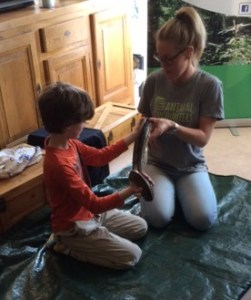



 I’m sure that there will be things I’ve already forgotten and likewise, there’s no doubt that there will be more items added to my list as March passes by. Needless to say, I will be blogging about many of these occasions and just how I overcome the challenges of taking my M-friendly cooking and baking a step further than I ever imagined possible. Once all of these things are out of the way, it’ll be time for a well-deserved drink and, in case you’re wondering, mine’s a large gin!
 Today I’m celebrating a very special day, a milestone birthday of a very different kind. Google has revealed that
 ![IMG_0138[1]](https://7yearstodiagnosis.com/wp-content/uploads/2016/02/img_01381-e1456250298723.jpg?w=144&h=300)
 those diagnosed with diabetes mellitus had no chance of survival and could only delay death from the illness itself by starving the body instead. Their discovery followed on from the hard work of other scientists and medics from around the world such as
 ![IMG_0139[1]](https://7yearstodiagnosis.com/wp-content/uploads/2016/02/img_01391.jpg?w=300&h=225)

 There is nothing G loves to do more than read; she really is her mother’s daughter when it comes to that particular pastime. Whenever she has a spare 5 minutes, and even if she doesn’t, you can usually find her with a book in hand, curled up somewhere quiet in the house. In fact, if you ever need to track G down, the best place to start is her bedroom as the chances are you’ll find her on her bed, engrossed in the story unfolding before her and completely lost to the outside world. Mike and M will willingly tell you that I am no different, much to M’s disgust, so the occasional times when it’s just G and me in the house can be surprisingly quiet.
 Not long into the new term, G’s secondary school announced that they were taking part in
  the recent half-term, she penned an
 “Shipwrecked” by
![IMG_0131[1]](https://7yearstodiagnosis.com/wp-content/uploads/2016/02/img_01311-e1455811200839.jpg?w=175&h=202) But, and believe me when I say it was quite a big “but”, the sticking point sadly was the price. This type of technology is not available to anyone through the NHS as yet and funding the sensors alone would cost in the region of £100 a month. I know that you cannot put a price on good health, but as a Mum to 2 children with multiple food allergies and an already increased monthly bill due to the high costs of free from food, the challenge of finding that extra £100 each month (£125 extra earned pre-tax) felt quite daunting and I shelved any thoughts of such an investment for the time being.
But, and believe me when I say it was quite a big “but”, the sticking point sadly was the price. This type of technology is not available to anyone through the NHS as yet and funding the sensors alone would cost in the region of £100 a month. I know that you cannot put a price on good health, but as a Mum to 2 children with multiple food allergies and an already increased monthly bill due to the high costs of free from food, the challenge of finding that extra £100 each month (£125 extra earned pre-tax) felt quite daunting and I shelved any thoughts of such an investment for the time being.![IMG_0135[1]](https://7yearstodiagnosis.com/wp-content/uploads/2016/02/img_01351-e1455809989998.jpg?w=175&h=221) The concept is a simple one and reassuringly easy to use. You insert a small sensor with a thin, 5mm needle into the back of your arm and, although the initial instructions for applying it appear quite complex, it really was quick and easy to do. I didn’t find it painful at all and whilst it takes some time to get used to the constant presence of this sensor on my arm, I’ve had no problems with it. The sensor measures what is called the interstitial fluid glucose levels, which are not identical to BGLs as this is the fluid found between the cells, but are considered accurate enough for monitoring what is going on. To find out your BGL, you simply wave the scanner over your arm and it gives you the result almost instantaneously.
The concept is a simple one and reassuringly easy to use. You insert a small sensor with a thin, 5mm needle into the back of your arm and, although the initial instructions for applying it appear quite complex, it really was quick and easy to do. I didn’t find it painful at all and whilst it takes some time to get used to the constant presence of this sensor on my arm, I’ve had no problems with it. The sensor measures what is called the interstitial fluid glucose levels, which are not identical to BGLs as this is the fluid found between the cells, but are considered accurate enough for monitoring what is going on. To find out your BGL, you simply wave the scanner over your arm and it gives you the result almost instantaneously. ![IMG_0129[1]](https://7yearstodiagnosis.com/wp-content/uploads/2016/02/img_01291.jpg?w=175&h=233) The sensor continually reads the changes in the glucose levels and, as long as you scan at least once every 8 hours, the easy-to-read graphs given on the screen indicate what has happened during the times you didn’t test. As with most CGM systems (Continuous Glucose Monitoring), it is recommended that the FSL user occasionally uses a standard glucose monitor to test their blood sugars and check that reading to the one given by the FSL – my tests have shown a difference of less than 0.3 mmol, which is incredible.
The sensor continually reads the changes in the glucose levels and, as long as you scan at least once every 8 hours, the easy-to-read graphs given on the screen indicate what has happened during the times you didn’t test. As with most CGM systems (Continuous Glucose Monitoring), it is recommended that the FSL user occasionally uses a standard glucose monitor to test their blood sugars and check that reading to the one given by the FSL – my tests have shown a difference of less than 0.3 mmol, which is incredible.![IMG_0128[1]](https://7yearstodiagnosis.com/wp-content/uploads/2016/02/img_01281-e1455811252823.jpg?w=175&h=246) and am able to discreetly test whenever I want or feel the need. The amount of information available is vast and you can look at enough graphs, bar charts and log books to satisfy even the biggest techno-geek. It has become strangely addictive to do and has already started to give me an even greater understanding of what my T1D is doing than I’ve ever had before. The non-invasive nature of the testing means that it would be easy for a parent to do during the night with no fear of disturbing their child’s sleep, and similarly for Mike to do if he ever feels that my blood sugars are dropping overnight – no need to wake me to ask me if I’m going hypo and then having to survive the often stroppy response his concerns are rewarded with, whether they are or not – yes I am precious about my sleep! I also have no doubt that it would appeal to every tech-savvy under-18 out there, which would no doubt reduce the chances of non-compliance and teen rebellion that so many young T1Ds experience,
and am able to discreetly test whenever I want or feel the need. The amount of information available is vast and you can look at enough graphs, bar charts and log books to satisfy even the biggest techno-geek. It has become strangely addictive to do and has already started to give me an even greater understanding of what my T1D is doing than I’ve ever had before. The non-invasive nature of the testing means that it would be easy for a parent to do during the night with no fear of disturbing their child’s sleep, and similarly for Mike to do if he ever feels that my blood sugars are dropping overnight – no need to wake me to ask me if I’m going hypo and then having to survive the often stroppy response his concerns are rewarded with, whether they are or not – yes I am precious about my sleep! I also have no doubt that it would appeal to every tech-savvy under-18 out there, which would no doubt reduce the chances of non-compliance and teen rebellion that so many young T1Ds experience,![IMG_0130[1]](https://7yearstodiagnosis.com/wp-content/uploads/2016/02/img_01301-e1455811224240.jpg?w=175&h=179) thereby similarly reducing the risk of complications from poor control. I really can’t speak highly enough of my experience so far with the Freestyle Libre and wouldn’t hesitate to recommend it to every T1D out there. It has been a struggle to find a down-side other than the price, which is due to the £50 sensors needing to be replaced every 14 days. My personal solution to that is to fund 1 sensor a month for the time being, or at least until the point I finally win that elusive lottery jackpot!
thereby similarly reducing the risk of complications from poor control. I really can’t speak highly enough of my experience so far with the Freestyle Libre and wouldn’t hesitate to recommend it to every T1D out there. It has been a struggle to find a down-side other than the price, which is due to the £50 sensors needing to be replaced every 14 days. My personal solution to that is to fund 1 sensor a month for the time being, or at least until the point I finally win that elusive lottery jackpot!
 7 years to diagnosis