Tag Archives: NHS

The Bionic Woman

For the last 6 days Mike has taken to calling me the “bionic woman”. Needless to say, I have not recently had a skydiving accident which has led to bionic modifications to my broken body resulting in amplified hearing, a right arm with the strength of 10 men and the ability to run at speeds over 60mph; in fact, there has been no incident of note and my 1 broken body part, my pancreas, remains well and truly broken. Rather there has been a conscious decision on my part to finally fully embrace a relatively new technological development that I hope will make a significant difference to my diabetes care.

I first became aware of this new bit of kit through M’s school friend, F and his fantastic parents, L and I. I can’t remember quite how we got onto the subject, but I’m reasonably certain that it had something to do with school Sports Day, the challenge of T1D vs. the active child and watching L check his blood sugars simply by waving a black box over his arm. To be fair, M had been wittering on telling me for quite some while about the “white, circular sensor-thingy” attached to F’s arm that enabled him to test his blood glucose levels (BGLs), but the lack of clarity in his description combined with my own lack of relevant knowledge meant that I had absolutely no idea what M was talking about and had dismissed the subject without really giving it a second thought. However, my interest was piqued through that chance encounter on the school field and it led to the opportunity for an enlightening conversation about what this thing was.

The Freestyle Libre (FSL) is marketed as a “flash glucose monitoring system” with a tagline of:

FL

and I was intrigued enough by this to want to find out more and discover whether this might be for me, or not. I read their website, researched on-line for users’ reviews, joined the FB forum for FSL users and wondered if it was too good to be true. I’ll be honest, when I first looked into whether it would be a benefit to me and my T1D care, I loved how easy it appeared to be and, having spoken at length to L and I on more than 1 occasion, could see just how revolutionary it could be, especially for children with T1D.IMG_0131[1] But, and believe me when I say it was quite a big “but”, the sticking point sadly was the price. This type of technology is not available to anyone through the NHS as yet and funding the sensors alone would cost in the region of £100 a month. I know that you cannot put a price on good health, but as a Mum to 2 children with multiple food allergies and an already increased monthly bill due to the high costs of free from food, the challenge of finding that extra £100 each month (£125 extra earned pre-tax) felt quite daunting and I shelved any thoughts of such an investment for the time being.

However, even though the price was making me think twice, I was reluctant to dismiss the option out-of-hand and, given the lengthy UK waiting list, decided to add my name and wait to see what happened in the meantime. The daily events of life with M and G quickly overtook everything else and the FSL soon dropped far down my list of priorities, though it was never far from my thoughts. I’m not exaggerating when I say months passed, but at long last, in January 2016, I saw the message I’d been waiting for: the news that monitors and sensors were once again readily available in the UK and I decided to bite the bullet and order a starter pack to finally see if the FSL’s claims were all true.

IMG_0135[1]The concept is a simple one and reassuringly easy to use. You insert a small sensor with a thin, 5mm needle into the back of your arm and, although the initial instructions for applying it appear quite complex, it really was quick and easy to do. I didn’t find it painful at all and whilst it takes some time to get used to the constant presence of this sensor on my arm, I’ve had no problems with it. The sensor measures what is called the interstitial fluid glucose levels, which are not identical to BGLs as this is the fluid found between the cells, but are considered accurate enough for monitoring what is going on. To find out your BGL, you simply wave the scanner over your arm and it gives you the result almost instantaneously. IMG_0129[1]The sensor continually reads the changes in the glucose levels and, as long as you scan at least once every 8 hours, the easy-to-read graphs given on the screen indicate what has happened during the times you didn’t test. As with most CGM systems (Continuous Glucose Monitoring), it is recommended that the FSL user occasionally uses a standard glucose monitor to test their blood sugars and check that reading to the one given by the FSL – my tests have shown a difference of less than 0.3 mmol, which is incredible.

I can’t begin to tell you how impressed I am with this small device. It really was easy to understand how to use it and the whole family – Mike, G, M and even my Mum – have taken their turn in testing my BGLs for me. Everyday I sit with the scanner amongst the rest of my accountancy paraphernalia in front of me on my desk IMG_0128[1]and am able to discreetly test whenever I want or feel the need. The amount of information available is vast and you can look at enough graphs, bar charts and log books to satisfy even the biggest techno-geek. It has become strangely addictive to do and has already started to give me an even greater understanding of what my T1D is doing than I’ve ever had before. The non-invasive nature of the testing means that it would be easy for a parent to do during the night with no fear of disturbing their child’s sleep, and similarly for Mike to do if he ever feels that my blood sugars are dropping overnight – no need to wake me to ask me if I’m going hypo and then having to survive the often stroppy response his concerns are rewarded with, whether they are or not – yes I am precious about my sleep! I also have no doubt that it would appeal to every tech-savvy under-18 out there, which would no doubt reduce the chances of non-compliance and teen rebellion that so many young T1Ds experience,IMG_0130[1] thereby similarly reducing the risk of complications from poor control. I really can’t speak highly enough of my experience so far with the Freestyle Libre and wouldn’t hesitate to recommend it to every T1D out there. It has been a struggle to find a down-side other than the price, which is due to the £50 sensors needing to be replaced every 14 days. My personal solution to that is to fund 1 sensor a month for the time being, or at least until the point I finally win that elusive lottery jackpot!

 

12417922_946040332153817_2856366599477784994_n

But that wasn’t part of the plan

Without doubt, December whirled past in something of a blur. As I’ve already posted, we had been waiting for an admission to GOSH since last July and naturally it came when we were least expecting it. This admission had been planned by M’s dedicated dietician, who was hugely concerned by the continuing lack of progress we were making when it came to successfully reintroducing food back into his diet and she was keen to challenge him within the hospital setting so that they could see exactly what we were experiencing at home. Our initial discussions all those months ago were in terms of weeks: a lengthy admission, perhaps up to 6 weeks, to fully understand how M’s bowel and bplanody respond when food is eaten; a daunting prospect when you have another child to love and nurture at home as well as a job to hold down.

Move forward 3 months and we reached our October outpatients appointment with no admission in sight and, due to the lack of long-term gastro beds at GOSH, no clear indication of when that elusive bed might eventually become available. Cue the recommendation of a radical rethink and a change of plan to a one week admission, followed by a series of further 1-week stays, scattered here and there throughout the year as and when there was a bed. The gastro team, keen to get him in before Christmas, felt this was our best chance of getting a bed any time soon and so we rolled with the punches and agreed to this amended plan, still not quite clear as to when the admission would actually happen. Over the following weeks, I spent valuable time fine-tuning the details with M’s dietician, agreeing what foods we would choose for challenges during our stay and discussing what the medical team were hoping to achieve through this process. The hardest part remained the lack of a long-term plan. The truth is that M’s continued problems with so many of the foods we’ve tried to introduce is baffling his doctors and until this admission was under our belt, they just didn’t know in which direction we’d be heading next.

By the time M was admitted on December 3rd, the plan had been tweaked again and unsurprisingly would continue to be so during the length of our stay. That one week admission suddenly became a 2-week stay and the 2 foods we had agreed to trial: potato and sweet potato, suddenly became 4: potato, egg, banana and salmon. I had already expressed some concerns about the plan to challenge him with 2 foods in a week and the increase to 4 over a 10-day period was now ringing some serious alarm bells in my head. Mike and I knew full well that the chances were that I would be bringing home a less-than-stable M just in time for Christmas and were resigned to rolling our sleeves up and spending the holidaysSmall-Changes working hard to bring him back to a healthy position ready for the new school term. We weren’t happy about this situation, but felt there was really no alternative; we had to give their plan a try in order to find some answers.

Despite those misgivings, the ones I had fully voiced to everyone and anyone who would listen from the minute I first met with M’s consultant and dietician when we arrived at GOSH and that I continued to express through every step of the following 10 harrowing days, we set off on this plan with the hope that we would find another safe food for him and perhaps even start to understand what has been troubling his gut for so many years.

What wasn’t part of the plan was the continued reluctance of the medical teams in hospital to listen when I told them M was beginning to show signs that all was not well with the food challenges and that he was reacting to the foods;

the plan didn’t anticipate the reality of M’s bowel being so unable to cope that it refused to work properly by the time we were 10 days into the 2-week admission;

and it definitely didn’t include 10 litres of Klean-prep (the worst bowel prep known to man) being continuously pumped into his tiny body over a 6-day period in an attempt to clear the resulting chronic impaction.

Nowhere in the master plan had I seen fair warning that, by day 14, I would be rendered utterly helpless and only able to sit, holding his hand and massaging his aching limbs, as M was left bent double from the cramps that were consistently hitting an 11 on the pain scale, where 10 was classed as the worst pain imaginable.

dancing-in-rain

Somehow we limped through endless hours of pain and frustration and dashed hopes, and we survived. Somehow we talked and ranted and sobbed and challenged until finally the medics acknowledged that things had gone horribly wrong, and we survived. Somehow we managed to stand strong and stay strong and stand our ground and refused to compromise on what we knew was in M’s best interest, and we survived. Somehow we rode out the fiercest storms and learned to dance in the rain, and we survived. Somehow we found enough humour in each day to keep the smiles on our faces and to laugh the smallest of giggles, and we survived. Somehow we got through the unexpected and started to find our way back to our normality, and we survived.

But that wasn’t part of the plan.

Quick update

Stocks-Update-1With 2 weeks left to the end of term, there’s so much going on that I’ve barely got time to sit down and commit any useful thoughts to paper, so I’m afraid this post is just going to be a quick update.  We’ve just had our first appointment in the new “Complex gastro and nutrition” clinic that our consultant and lovely specialist dietician have started at GOSH.  The thinking behind this new clinic is that for children like M, who have a chronic gastro condition such as EGID as well as significant, complex and multiple food allergies, there needs to be regular meetings with both a gastro consultant and a dietician to ensure that everyone is singing from the same song sheet when it comes to treating the health of that child.

Hospital appointments always induce mild nerves in me, but this time round I felt more apprehensive than usual.  We are now into month 8 of the NG-tube, when the initial plans were that M would have it for no more than 3 months at most and I was concerned that there might be discussion about removing the tube in the near future.  M’s health has been so significantly improved since we went elemental in December that I don’t want to rock the boat any more than is necessary until we have a huge improvement with his diet.  generic round label_1265358343With only 4 foods on our “safe” list out of 12 tried so far, it has been a much longer process to reintroduce foods back than any of the medics expected, although, to be honest, Mike and I had always anticipated it taking a full year, if not longer.  At the moment, M is coping well with his tube and is keen to keep trying new foods, so there are no concerns that the presence of the tube is having a detrimental effect on him in any way.

So, in a snapshot, the outcome of our appointment was this:  that on almost every level, his health is remarkably stable right now and even his hay fever isn’t causing too many issues this year; but the area of most concern continues to be his ever-growing list of multiple food allergies.  Our dietician is very worried that M is struggling to tolerate so many foods and now refers to him as one of her “biggest, but loveliest challenges”.  The process of reintroduction has been so slow that until we have at least another 2 or 3 back in his diet, we cannot change the amount of E028 he’s having via his tube and so the tube obviously needs to stay in place.  We have chosen the next 5 foods to try – white fish, pear, GF oats, venison and coconut – and will also be doing some mini-challenges to see if we can have some more spices and flavourings to add into my recipes.  I will continue to remain in regular phone contact with her throughout these trials and we will keep persevering with the food challenges until our next scheduled appointment in around 4 months time.

“So much time…

...and so little to do. Wait a minute. Strike that. Reverse it…”

                                                          – Willy Wonka, “Charlie and the Chocolate Factory” (Roald Dahl)

This past week has been busy and there’s still lots more to do, not least of which is a proper blog post.  However, the reality that is choir rehearsals,..SATS revision,..sunflower growing,..Anglo-Saxon house building,..SATS revision,..CAMHS appointments,..food-trialling,..SATS revision and May Bank holiday trips to Legoland Windsor for “Star Wars Day” as well as time spent prepping for EGID awareness week with Powerpoint presentations to perfect and conversations with local media to be had, means that this week’s posts have gone by the wayside, so instead here’s a small photo round-up to give you a taster of all the fun we’re having:

Back to work for a rest

take_a_breakI’m sure I’m not the only working parent in the world who gets to the end of the latest school holiday with a sense of it being time to head back to work for a much-needed rest.  The last 2 weeks have been undeniably busy, with a mix of work, play, holiday clubs, hospital appointments and tourist attractions to more than occupy our time.

Surprisingly, the first hospital visit of the Easter holidays was with G, who tumbled from her scooter and ended up with a painful wrist that needed a x-ray.  Despite her best efforts to fracture her left wrist with 4 weeks to go to her SATS, G managed nothing more than a severe sprain, though she has also gained a ban from scooters, trampolines, trees and any form of gymnastics until those exams are done and dusted.  Fortunately G is right-handed, so even these desperate measures didn’t get her out of the revision homework set for her time off school.  We are extremely proud of the effort that she has made with her studies during the holidays as she did some work every day with relatively little fuss and it’s nice to know that the end is finally in sight!

2053064-alpha_flightLess surprisingly, our next 2 hospital visits were both with M.  The first was his scheduled tube change at our local hospital and it went just as smoothly as the last one.  Despite the continued problems we’ve experienced with the gastro team, the nursing team in the CIU (Clinical Investigations Unit) are amazing and have worked hard with us to find an approach to the tube change that makes allowances for M’s anxiety.  The play therapists are on hand straight away to provide a much-needed distraction from all that’s going on by entertaining M with a bubble-popping game on the i-pad or a lengthy discussion about the Canadian Marvel superhero team, Alpha Flight.  Our now-experienced team of Gill and Jo sort us a bed in a quiet area of the unit and encourage M to take some deep breaths of entonox before we even start to discuss the tube change itself.  This time the job was done in an amazing 20 minutes, which included M removing his old tube himself, me counting to 10 in an array of foreign languages and only a fraction of the negotiations we’ve had to endure from M in the past.

622d9490d50f3993393fa0084b4793e8We also spent a few days in London following M’s first outpatient check-up with his GOSH consultant since he had his NG-tube and started the elemental feed.  I’m delighted to announce that, at long last and after an anxious few weeks, M has not only regained his pre-admission weight, but has also managed to put another kilogram on.  Whilst we still haven’t progressed any further than his 3 safe foods, the move to elemental has done exactly what we needed it to and M is unquestionably the healthiest he has ever been in the last 9 years.  The next step is an important one: to find more foods that he can eat without compromising this new-found good health.  We are moving from a pure gastro clinic to a new one for those with “complex food needs”, which will mean he is seen regularly by both his consultant and our specialist dietitian, who will then work together, and with us, to plan the next steps on our new journey.  The future is most definitely bright!

Managing a NG-tube

Formula made, it’s time to move on to what was, to me, the most daunting part of our NG-tube (NGT) journey and the bit that scares other people the most – the NGT itself.  Whilst it now feels like second nature, this was the biggest hurdle I had to overcome in my quest to become confident in managing M’s enteral feeding at home.  Let’s start with the very basics of what a NGT is and the job that it does.

The tube is a length of flexible material, which is inserted through the nose and travels down the oesophagus into the stomach with the purpose of allowing food and medicine to be placed directly there.  There are a myriad of medical reasons for a NGT to be passed and in M’s case, it was because he wasn’t able to drink the quantity of E028 needed each day due to being a reluctant drinker and the very unpalatable taste of the feed.  The NGT is measured against the child’s body before it’s inserted to make sure enough length is passed for its tip to sit comfortably within the stomach.  There are varying types and sizes of tube that can be used to allow for the age and size of the child, differing situations and the various medical needs.  M has a long-use “10 silk”, which he found to be the most comfortable to have in and can be left in place for up to 8 weeks before it needs to be changed.  Other tubes are more rigid and require changing on a weekly basis, something that just wouldn’t be practical given his current anxiety about having the tube passed and his allergic reactions to anaesthetic.

Once the tube has been passed and is in place, it is secured to the cheek using dressings and tape.  There are a number of these available and it really is a case of trying them out to see which works best for your child.  We quickly discovered that M has an allergic reaction to Duoderm and Micropore, two of the most commonly used dressings and so we’ve had to work out a method of fixing the tube to his cheek that won’t cause his face to become red and inflamed.  For us that proved to be a small strip of Tegaderm, which I then decorate using an amazing product I found on an US website called Feeding Friends.  These stickers are printed on medical tape and add some fun to the prospect of having a NGT on permanent show.  By sticking one over the top of the Tegaderm strip, M’s skin doesn’t react and he loves nothing more than choosing which friend will grace his cheek each time.  I change his tape approximately every 3 days, though we find that if it gets too wet in the bath or shower, then we need to replace it more often.

So far, so good and nothing too scary you may think, but now comes the most difficult bit, making sure that the NGT is still in the right place before starting a feed.  This is known as “aspirating” the tube and requires you to draw an amount of liquid up the tube to check that its tip is still sitting in the stomach and hasn’t become dislodged or moved during the time off the pump.  We were told to use nothing smaller than a 20mls syringe to aspirate the tube and are provided with 60mls syringes by our home delivery team.  Remembering to “kink”, or create a block in, the NGT before you start – this ensures that no air can go down the tube whilst you fiddle around with it – carefully attach the syringe to the end of the NGT and pull back on the plunger with – in my experience – your fingers tightly crossed that you can draw some of the liquid out from the stomach.  Depending on the time of day and what your child has been up to beforehand or even what, if anything, they’ve had to drink, this can prove to be something of a challenge.  It is possible for the tip to become stuck to the stomach wall, which creates a vacuum when you try to pull upon the syringe. I’ve found that sometimes it will “pop” free and a sudden flood of liquid will rush into the syringe and at other times, your gentle tugging will be met with nothing but stubborn resistance and a failure to draw even a millilitre out from the stomach.

The key thing to remember at this point is NOT TO PANIC. The first time it happened, I desperately scrabbled around in the depths of my memory to recall what advice the GOSH nurses had given, all the time attempting to resemble an oasis of calm and to impart none of my increasing anxiety to an unaware M.  There are 3 easy ways to try to resolve the problem:

  1. Give your child a glass of water to drink, wait around 15-20 minutes and then try again
  2. If the drink hasn’t helped, take a deep breath, lean your child at an angle of approximately 45° for 20 minutes before your next attempt
  3. If you still can’t aspirate the tube, get your child to lie on their left-hand side as this is where the stomach is positioned and may encourage that stubborn NGT to finally drift away from the stomach wall and allow you to test exactly where it is

If none of these has worked, or if your attempts to aspirate are causing your child discomfort, then you need to get the tube medically checked.  In our case, this meant a trip into our local A&E department, but could simply mean a phone-call to your local community nursing team or feeding team, who will be best placed to advise you on where to go and what to do next.

Courtesy of jamali4u.net

Courtesy of jamali4u.net

However, assuming you are able to aspirate the NGT with relative ease, you now need to check the pH of the liquid you’ve drawn from the tube to make sure that all is where it needs to be.  You will have been provided with pH strips as part of your enteral feeding “kit” and testing couldn’t be easier.  Simply drop some of the stomach juices on to the pads at the end of the strip and watch them change colour.  Memories of secondary school chemistry lessons come flooding back at this point and testing substances to see whether they were alkaline or acidic.  In M’s case, we are looking for a pH of 5.5 or less, indicating that the liquid drawn is acidic and therefore likely to have come from his stomach.  Always check with your nursing team what pH level is safe for your child as certain medicines are known to affect the results and an adjustment to the recommended results may be made.

Although aspirating the tube is a scary prospect, the risks associated with a misplaced tube are great.  I was lucky to be trained on all aspects of M’s NGT whilst we were in GOSH, but even then found the first few attempts a frightening prospect.  The most important lesson I learned was to “kink” his tube every time I did anything with it and now I don’t even think twice about doing it – it’s just another step in the process of starting his pump feeds. Once it’s confirmed that the NGT is correctly positioned, tube feeding can now begin, but that, I fear, is a lesson for another day!

The 3rd and final step

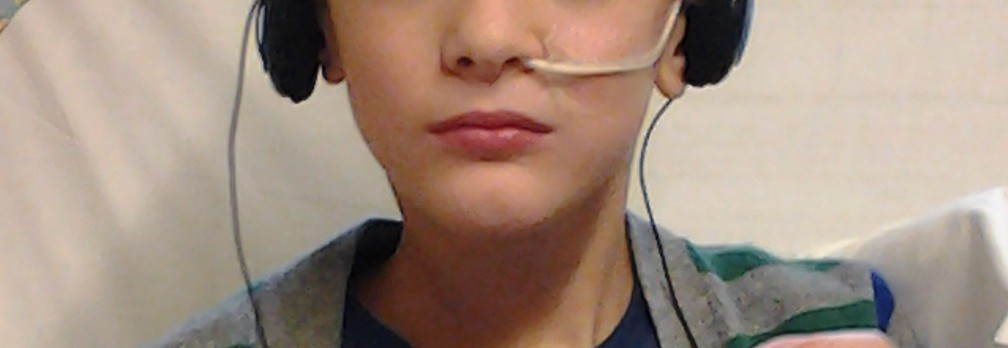
M and his tube at GOSH

M and his tube at GOSH

With steps 1 and 2 complete, we were now onto the third step, the one which is going to have the biggest impact on M’s life for the next few months.  NG-tube in place, dis-impaction done and pellet study under way, it was now time to move M to an “elemental” diet, one which sees all foods removed from his diet and replaced by a nutritionally complete feed that consists of amino acids, carbohydrates, fats, vitamins and minerals.  The ideal would be for M to drink the 1.8 litres of this feed that he needs each day to have the right amount of calories and nutrients for his age, weight and height, but I knew we had no chance of getting him to do that.  Not only is he a reluctant drinker at the best of times, meaning it would be nigh impossible to get nearly 2 litres of liquid into him on a daily basis, but the feed is truly revolting to taste and even adding generous quantities of approved flavouring was never going to be enough to convince him to let more than a minimal amount pass his lips.  The only alternative was to feed him via his NG-tube, which meant an intensive few days in hospital for us as we worked out how best to give the feeds, the timings and rates that he could tolerate and I was trained on how to manage his tube.

The original plan proposed by the dietitians was that M receive six 300mls feeds a day via the gravity-feeding method, which meant that we would attach a large syringe to the end of his tube and gradually add the 300mls over the duration of the feed to ensure he took the full amount.  The principle of gravity feeding is that you can adjust the speed of the feed as the flow of the liquid is driven by the height of the syringe and the effect of gravity:  the higher the syringe, the faster the flow. The dietitian was keen that the feed be given over around 20 minutes, but it quickly became obvious that this just wasn’t going to be a method that would suit M.  Within 5 minutes of his very first feed starting, he turned pale and grey and complained that his stomach was hurting. The nurse giving the feed adjusted how high the syringe was held, but no matter how the syringe was positioned, things didn’t get better and by feed number 2, the nurses were adamant that this just wasn’t going to work for him, something I wholeheartedly agreed with.  At this point, we were only giving him 200mls instead of the full 300mls, but even that was proving too much for M’s sensitive digestion, so the dietitian finally had to agree to what the nurses were telling her and everything was changed yet again.

M's rather snazzy new pump

M’s rather snazzy new pump

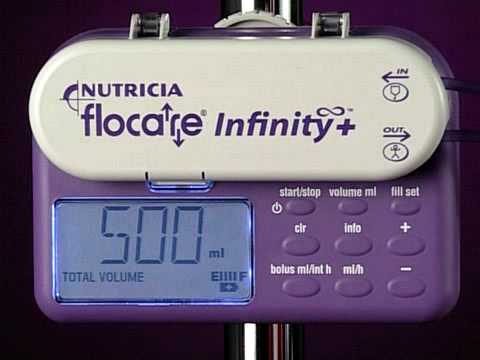
Our new routine saw the feed mixed to a higher concentration, meaning that we only needed to get 1.5 litres into him a day and we were introduced to the wonders of a pump.  The pump means that the rate of giving the feed can be at a speed that best suits M and can easily be tweaked as each individual situation requires.  There was a lot to learn in the few days we had as I needed to know and be confident in how to check that his tube was correctly positioned, what to do if it appeared to have moved, how to prepare the elemental feeds and how to attach and properly operate the pump.  There was also the added complexity that the pumps used on ward by GOSH were not the same as the one approved in our community and whilst the principle was the same, the processes were slightly different.  However, by the time discharge finally happened, I was as au fait with this new part of our life as I could hope to be, felt that we could cope at home and, more crucially, had enough medical supplies to see us through the next few days.

M and his tube at home

M and his tube at home

Since that first day, now over a month ago, that original regime has been changed and tweaked more times that I care to imagine.  The suggestion of 6 feeds being administered at separate 30 minutes periods throughout the day were impossible for M to manage as he wasn’t able to tolerate the 250mls over either the initial proposed 30 minutes, nor our second attempt of an hour.  It also quickly proved impractical as any issues with the placement of the tube would take at least 20 minutes to resolve and that was time that we couldn’t expect the school to give him as he doesn’t get any individual support.  We soon realised that M wasn’t coping either physically or emotionally with the constant feeding and we have now settled on a routine that seems to work for everyone concerned.  His first feed is a 1 litre one starting at around 6.30am, which is given slowly enough to avoid too many tummy aches or occurrences of reflux and which lasts until the end of lunch-time.  The pump is disconnected at that point and M is able to enjoy an afternoon free of the encumbrance of his pump whilst at school.  The final 500mls feed begins between 4pm and 4.30pm and takes us all the way through to bedtime.

This is the routine that we will be living with for the next month or so and then the task of food reintroduction will begin.  As our local dietetics team has refused to be involved in M’s care, we will be working with the dietitians from GOSH to work out a detailed approach to trialling foods and the order we try them in.  The elemental feeding via NG-tube will continue alongside these food challenges until we have identified enough safe foods for M to eat and get all the calories and nutrients he needs to be healthy.  It’s not going to be an easy or quick task to complete, indeed there is a long and arduous road ahead, but it should be one that leads to more answers for M’s health than we’ve ever had before.

Round Two: the Pellet study and other adventures

Courtesy of 123opendata.com

Courtesy of 123opendata.com

Once the NG-tube was finally in place, M and I then had 5 long days to survive the copious amounts of Klean-prep, senna and picolax that were pumped into his system to clear his troublesome bowel.  Although we appeared to be off to a slow start, these powerful laxatives finally did their job and by late Monday afternoon, the gastro registrar was confident that we were ready to start the pellet study and a x-ray confirmed his opinion.  I had already met with one of the gastro investigation nurses, so knew that the 3 pellets, containing different shaped plastic markers, were ready and waiting on the ward for M and all we needed to work out was how best to get him to swallow them.

Over the last year, we have made huge strides in getting M to swallow tablets whole and no longer need a spoonful of Grandma’s jam to help the medicine go down as he has conquered his struggles and now merrily swallows them with just a mouthful of water to help.  However, there were 2 problems we now had to overcome:  M’s new-found fear of swallowing capsules with the NG-tube in place and the fact that these pellets are of a size that even I would struggle to take easily, let alone a small child.  The nurse suggested we resorted to mixing the markers into a couple of spoonfuls of jam and that was our first attempt.  For reasons that will remain forever unclear, M found even this method difficult to manage and instead resorted to swallowing the pellets one tiny marker at a time.  It may have taken considerably longer than anyone expected, but the pellets were taken and so round 2 of our admission was well underway.

The week should have been an easy one, as it was supposed to require nothing more of us than completing the pellet study, but unfortunately it was at this point that I had to brace myself and find the strength to weather an unexpected and turbulent storm.  Despite both Mike and I having repeatedly made clear that we have almost no support from our local hospital and their paediatric gastro team, this information appeared to have got lost along the way and I found myself embroiled in a battle to keep M in hospital once the pellet study had started.  GOSH felt sure that we would receive all the care and advice we would need from our local and nothing I said would convince them otherwise. battle I spent more hours than I care to remember fighting M’s corner and insisting that the consultants didn’t discharge him before the study was complete and the NG feeding started.  The pressure was huge, both on me – as I talked, discussed and cried my way through numerous meetings with nurses, doctors, dietitians, psychologists, PALs workers and indeed anyone else who would listen – and on Mike – as he sought to juggle the challenges of working, looking after G at home and supporting M and me whilst we were several hours away and only contactable by phone.

It quickly became evident that GOSH simply could not conceive that we could be as lacking local support as I was asserting we were and I have no doubt that they were beginning to view me as something of an overwrought, overtired, over-emotional and somewhat neurotic mother, who was unbelievably arguing to keep her child in hospital, when most other parents were trying desperately to get their children discharged before Christmas.  By the end of the week, it had all come to a head and I was at my wits’ end, but was finally vindicated late Friday afternoon, when our local dietetics team refused in no uncertain terms to take on M on a shared care basis with the GOSH dietitians – an entirely new experience for GOSH, though sadly an all too familiar one for us.

lighttunnelDespite all the heartache and distress this unnecessary battling caused, there was some really positive light at the end of the transit study tunnel.  The final x-ray on Friday indicated that M’s bowel is working more or less as it should.  It may be a little slower than ideal, but the markers had moved through M’s system and the consultant was delighted with this result, which means that the bowel is currently doing its job.  We really couldn’t ask for anything more.  So, the conclusion drawn is that it is the complex and multiple food allergies that have been causing M’s diarrhoea and other symptoms because of his underlying condition, EGID and the final step is to identify these as accurately as possible.

The First Hurdle

Our GOSH admission had three key stages, the first of which was to dis-impact M’s bowel and prepare him for a repeat pellet study.  We knew that when the original transit study was done at our local hospital 18 months ago, he was chronically impacted and there was some debate over whether the results, that suggested his transit was relatively normal, were accurate or not. My honest opinion was that he was not struggling with a slow transit colon, but the gastro team at GOSH wanted to be certain and were more than happy to admit him for this test due to the issues we’ve experienced with our unsympathetic local hospital over the last 12 months. My instinct was that nearly 9 years of unrelenting diarrhoea meant that there had to be another root cause for his problems that was still waiting to be discovered and it would just take some persistent looking to find it.

Courtesy of ebsta.com

Courtesy of ebsta.com

Unfortunately, the first hurdle – after the resolution of the whole missing bed saga – proved to be far tougher than any of us had anticipated.  After his amazing courage in facing all the health and medical challenges of the past year, and despite knowing that he needed to have a NG-tube, M showed just how stubborn he can be and steadfastly refused to co-operate with the nurses who were trying to pass the tube.  Wednesday evening saw 5 different nurses, 4 attempts, a flurry of unsuccessful negotiations and 1 small boy, who pulled the last 2 attempts out himself because, according to him, the nurses weren’t listening when he asked them to stop and then told them to go.  Having kept the other occupants of the 4-bed bay awake until past midnight with his cries and screams, we all finally admitted defeat and decided to leave it to the next day’s nursing team to remedy the situation.

Thursday morning arrived far too quickly, with a disturbed night’s sleep for M and an uncomfortable one for me.  We talked about the tube and the need to have it in place as soon as possible so that we could start on the first round of treatment, the dreaded Klean prep – a highly effective laxative that would start the process of clearing his system.  M knew and accepted all the reasons for the tube, but at the heart of the matter was the fact I had a small, scared 8 year old, who had endured a great deal since his scopes last October and was evidently close to saturation point.

Courtesy of The Royal Ballet/ROH Johan Persson

Courtesy of The Royal Ballet/ROH Johan Persson

Even the lure of tickets to go to see “Alice in Wonderland” performed by the Royal Ballet at the Royal Opera House, Covent Garden that very afternoon looked unlikely to be sufficient draw, but my boy’s love for all things theatrical combined with my own enthusiasm for going to see anything at the Royal Opera House eventually overcame his worst fears and won the day.  He agreed to let one of the doctors pass the tube and with 4 of us holding his head, arms and legs, another distracting him whilst it happened and the doctor doing the deed itself, we finally got the tube in place.  With that hurdle tackled, M and I rushed to get ourselves ready and a bag packed for our trip to the theatre.  We went by taxi with another little girl from the ward and a nurse and arrived just in time to take our complimentary seats in a box before the ballet began.  The performance was an amazing visual feast and proved to be a more than adequate distraction from all the tears and trauma of the morning.  M loved the outlandish costumes of the Mad Hatter and we had a lot of fun trying to work out which of Alice’s family and friends were depicted by each of the fantastic characters we met throughout the rest of the ballet.

Courtesy of The Royal Ballet/ROH

Courtesy of The Royal Ballet/ROH

Naturally, as I’ve come to expect when dealing with anything to do with M, nothing was as straight-forward as we might have hoped as we headed into that all important first full day of admission.  The stress of the tube placement led to him being violently sick within 10 minutes and he spent the rest of the day retching and bringing up bile, meaning the Klean prep couldn’t be started until much later in the day.  He reacted to the Duoderm, a dressing usually used to protect the fragile skin of the face by forming a barrier between the cheek and the tube and tape, which meant there was no alternative but to tape the NG-tube directly to his face.  The final straw came in the middle of the night, when after I’d finally got my tired chap to sleep, the quantity of the Klean prep being pumped in at the speed it was upset his system and he woke to be sick for the second time in less than 24 hours.

By the time Friday morning came around, we were both feeling emotionally fragile and physically exhausted and M refused point-blank to move from his bed.  We sat quietly on ward, with M plugged into the television via his headphones and I immersed myself in the escapism of a good book.  It had been a bumpy start, but finally we were on our way.


The Mystery of the Missing Bed

It sounds like one of the Enid Blyton stories that my children have been listening to at bedtime recently.  M and G have been loving the adventures of Fatty, Buster and the rest of the Five Find-outers gang, but this was a mystery set to challenge even the hardiest of intrepid adventurers.

Having received our summons to GOSH less than 24 hours earlier, and laden down with suitcase, backpacks, Lego advent calendar and the ever-present Cat, M and I found our way across London, through those infamous front doors and up to the long-term gastro ward.  We approached the nurses station and were greeted by a bemused looking senior staff nurse, who seemed uncertain as to who we were and why we were there.  I gave her M’s name and that’s when a look of complete panic swept across her face.  His name wasn’t on her master list, she hadn’t been expecting him and at that precise moment of time, there was no empty bed ready and waiting for him.

With profuse apologies and a promise to get hold of the ward administrator, the nurse in charge and the bed manager, M and I were left, with our bags, in the somewhat small and cramped playroom, whilst the mystery of M’s missing bed was investigated.  After the early start to our day and an emotional goodbye to G, I barely held it together as I called Mike with a slight hysterical edge to my voice. The play co-ordinator found a circuit board kit to entertain M and I got chatting to another patient and her Mum, who had just been turfed out their room and were waiting to hear where they were being moved to.  We all sat there for nearly 2 hours, whilst those in charge negotiated, discussed and settled the bed situation for all involved.

Courtesy of en.wikipedia.org

Courtesy of en.wikipedia.org

I might never know why the mystery of the missing bed happened or how it was resolved to everybody’s satisfaction, but I’m delighted that, thanks to the hard work of the nurses and the obviously determined look on my face that meant I wasn’t going to take no for an answer, M’s bed miraculously appeared in the “bay” and we could finally get ourselves settled in for the duration.