
This week has been a focus for raising awareness for 2 causes close to our hearts: National Eosinophil Awareness Week (NEAW) and Mental Health Awareness Week (MHAW). It somehow feels apt that these two go hand-in-hand this week as we have so often experienced first-hand how closely linked life with EGID is with the mental health well-being of all in our family. This year that is even more important as so many of us are struggling with the changes that the coronavirus lockdown has brought with it and none more so than the young people in our household.
 National Eosinophil Awareness Week: We have been very active in raising awareness about eosinophilic diseases for a number of years, but decided to start taking a step back from that last year. Eosinophilic Colitis (EC) was the initial diagnosis that we received for M all those years ago from his consultant at GOSH, but in recent times, the diagnosis criteria for this condition have faltered and existing diagnoses have been actively questioned by many within the medical community. These days conditions such as mast cell activation syndrome (MCAS) have been bandied about in relation to M, but ultimately the root cause of his health problems still remains a mystery to us all. As I’ve said so many times, having a name to put to his health issues has helped us all, even when very little is known about it, and I continue to use both his original diagnosis of EC and the newer one of MCAS when filling in paperwork or talking about M with other people.
Despite our own uncertainty about whether EGID is the correct diagnosis for M or not, I will always continue to encourage and support the fundraising and awareness-raising efforts of organisations seeking to research and understand this family of conditions more. Lockdown maybe stopping us doing anything active to raise awareness this week as we have in the past, but it’s good to be able to do my bit even from within the constraints of my own home.
 Mental Health Awareness Week: Mental health well-being has been a buzz word in our household for a number of years and never has that been more important than now as we see the impact of 9 weeks in lockdown on us all. I’m a happy introvert, who enjoys spending time in my own company and so, in many ways, lockdown life is suiting me quite well. Regular contact with my work colleagues through Zoom and conference calls, webinars and online catch-ups with other friends is keeping me in touch with the outside world, which is especially important at a time when my T1D is keeping me at home.
However, I see a greater effect on Mike and the children and I think a lot of that is due to the changes to their daily routines. I am still working 9-5 every weekday, albeit from home and more often 8-7, but the 3 of them are going through a very different experience to me. Mike was furloughed from his job as a chartered surveyor on 1 April and for someone who is very used to being out and about as he values or surveys properties every day, the restriction of staying at home has been difficult. He is also much more of a social bug than I am, so not having daily face-to-face time with anyone other than the children and me has also taken its toll. However, that being said, the online capability to chat to family and friends across the world is something he has definitely embraced, even taking part in his regular whiskey-tasting evening via Zoom the other night!
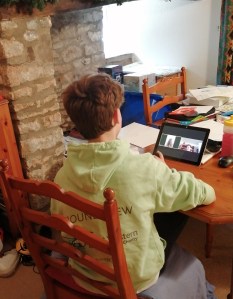
As for the children, well G and M are almost a perfect reflection of Mike and me. G is comfortable entertaining herself and being in her own company, whereas M thrives on spending time with his peers as well as being constantly active and mentally challenged by them. Both have found lockdown difficult and we have worked, and continue to work, hard together to find the best outlet for their emotions as well as effective ways to meet their social needs. Chatting on WhatsApp or connecting via the PS4 has been a good solution and both are also having tutoring sessions via Zoom or MS Teams every week. This connection with people from outside of the family has been key to giving them something that is a very faint semblance of what they’re used to experiencing daily. Keeping them in a routine has also been important as Mike and I are very conscious that their return to school in September, after the best part of 6 months home-schooling, will exhaust them physically, mentally and emotionally from the minute they step through the school doors, if not before.
 The buzzword for MHAW has been Kindness and considering what random acts of kindness you can do for others has been much encouraged. However, I think it’s key to remember that, whilst showing kindness to others in all situations is important, so is showing kindness to ourselves. We truly are living through extraordinary times and we shouldn’t feel guilty if we are not coping as well as we perhaps believe we should. Be that by taking some time to do something we love to do as an individual – bubble bath anyone? – or spending time relaxing with our family or even reaching out to a friend because we just need to talk, being kind to ourselves will improve our own well-being, which is something we all need right now.
 this year and I didn’t plait pink ribbon into G’s hair or attach awareness ribbons to their school bags. Mike and I have stuck to our commitment to eat like M for the whole week and that has certainly led to a lot of conversations with my new work colleagues about M’s diagnosis…and how to pronounce “Eosinophilic”!
 The dictionary defines change as “to make or become different” or “an act or process through which something becomes different“, but what does that really mean in the context of raising awareness about a rare disease?
 Those changes in attitude will help M feel less isolated by his health problems and more confident in being the unique individual he is despite his EGID and not because of it.
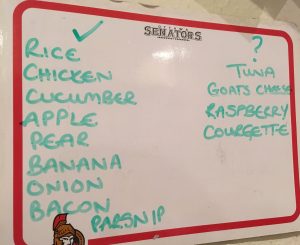 A natural consequence of our choice is that those we work and spend time with during this week will inevitably ask questions, which obviously gives us both a great opportunity to talk about EGID and start to
  This week, social media, and Facebook in particular, is swamped with the
  I hate to say no to people and always end up feeling very disingenuous as well as guilty when I come up with a reason why I don’t want to set up a regular donation on the spot.
 that effort is priceless. At the moment, we seem to be a state of status quo with M’s health which is fantastic, but there is also a sense of overwhelming ennui when it comes to our ongoing relationship with our local hospital and M’s gastro consultant. Taking the time to talk to me about life apart from M’s EGID makes a big difference and should never be seen as inconsequential. We teach M constantly that there is so much more to life than his illness and it’s important that we hold on to that truth and don’t get bogged down in the mundane.
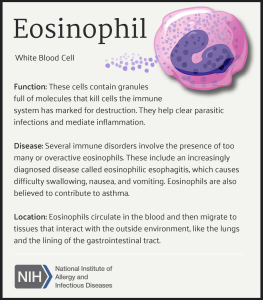 In the 5 years since that hospital appointment, we have found ourselves continually having to educate those around us, including the medics, who know little to nothing about what is becoming an increasingly controversial diagnosis, especially when it affects the lower GI tract as M’s does.
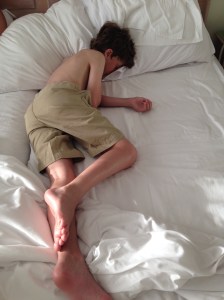 But that’s the face he presents to the outside world and reflects the attitude to his health that Mike and I have worked hard to engender within him.
 known to be in existence and 80% of these have been identified as having genetic origins. Astonishingly, approximately 5 new rare diseases are described in medical literature every week.
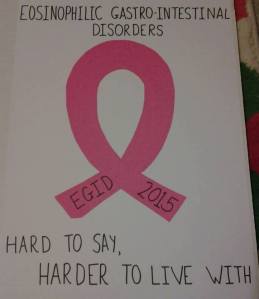 Imagine being told that your child has a chronic illness that neither you, nor most of the medical professionals you’ll end up meeting from that point on, can pronounce – or have even heard of until that moment. Imagine finding out that that illness is rare: that around 1 in 10,000 people are diagnosed with the most common form, but that your child has one of the rarest forms and that there is little research into it. Imagine learning that even the medical community struggles to reach a consensus about this rare disease and whether it really exists or is simply part of a much bigger picture – and having to live with the reality of this rare disease and its effects on your family’s life on a daily basis.

![IMG_0308[1]](https://7yearstodiagnosis.com/wp-content/uploads/2016/04/img_03081-e1464812058488.jpg?w=300&h=139) With hopefully only another 2 weeks or so to go until the leg might finally reappear from underneath the protective plaster, I thought it about time I give you all a proper update.
With hopefully only another 2 weeks or so to go until the leg might finally reappear from underneath the protective plaster, I thought it about time I give you all a proper update. M’s leg was finished, rather than before, although that day’s orthopaedic technician did offer him the alternative of pink camouflage with sparkles whilst she was checking that stock levels were enough to cover his entire leg. 6 weeks later, and following regular fortnightly fracture clinic appointments with x-rays, the bone growth was considered enough to move M to a
 ![IMG_0479[1]](https://7yearstodiagnosis.com/wp-content/uploads/2016/06/img_04791.jpg?w=225&h=300) M requested a “70s Disco” theme for reasons that will later become clear, and believe me when I say that the bright orange and neon yellow stripes with added silver glitter certainly meets his somewhat unusual brief.
M requested a “70s Disco” theme for reasons that will later become clear, and believe me when I say that the bright orange and neon yellow stripes with added silver glitter certainly meets his somewhat unusual brief.![IMG_0506[1]](https://7yearstodiagnosis.com/wp-content/uploads/2016/06/img_05061-e1465074621823.jpg?w=260&h=300) The crutches have taken longer to adjust to, not least because M now needs to start putting some weight on to his leg, something he has been very reluctant to do. We finally seem to be breaking through that last mental barrier as he builds his confidence by beginning to stand unaided, though his walker is always close on hand should he need it.
The crutches have taken longer to adjust to, not least because M now needs to start putting some weight on to his leg, something he has been very reluctant to do. We finally seem to be breaking through that last mental barrier as he builds his confidence by beginning to stand unaided, though his walker is always close on hand should he need it.![IMG_0439[1]](https://7yearstodiagnosis.com/wp-content/uploads/2016/06/img_04391-e1464811428943.jpg?w=226&h=300) He has not missed a single day of school due to his broken leg, other than for necessary appointments and that is due to the willingness of the Headteacher and his teaching team to accommodate M’s needs in a safe way and involve him in the classroom as best they can.
He has not missed a single day of school due to his broken leg, other than for necessary appointments and that is due to the willingness of the Headteacher and his teaching team to accommodate M’s needs in a safe way and involve him in the classroom as best they can.![IMG_0499[1]](https://7yearstodiagnosis.com/wp-content/uploads/2016/06/img_04991.jpg?w=225&h=300) Stagecoach school are performing a 70s tribute routine in a local carnival parade in the middle of June. He has once again been to every Stagecoach session this term, and so have I, and knows both the songs and the dance routine by heart, even though dancing it has been an impossibility. There is every chance that his cast may actually be off his leg by the time the parade happens, but we wanted to show wiling and be prepared “just in case”. Given the length of the parade route, M will unfortunately still be restricted to his wheelchair as his leg won’t be strong enough to walk its length, but we have some other suitably funky 70s ideas in mind to pimp both his costume and his wheelchair to fit the party vibe!
Stagecoach school are performing a 70s tribute routine in a local carnival parade in the middle of June. He has once again been to every Stagecoach session this term, and so have I, and knows both the songs and the dance routine by heart, even though dancing it has been an impossibility. There is every chance that his cast may actually be off his leg by the time the parade happens, but we wanted to show wiling and be prepared “just in case”. Given the length of the parade route, M will unfortunately still be restricted to his wheelchair as his leg won’t be strong enough to walk its length, but we have some other suitably funky 70s ideas in mind to pimp both his costume and his wheelchair to fit the party vibe! That incomparable insight is what almost makes the challenges of M’s health worthwhile, for whilst I would give anything for him not to have to live with a rare illness like
  My blog has simply been an effective way to put all of our experiences into one place, hopefully with some useful pointers for others in the same shoes and, by doing that, to create my very own, very personal resource.
 7 years to diagnosis