I’m writing tonight’s post in the peace and quiet of the hotel room in North London that has been my home for the last 2 days. It feels a little surreal to be away from my sound proof bubble at home, where I desperately try to ignore the perpetual chaos of family life that swirls around me and I can’t quite get used to being able to write completely uninterrupted by demands for food or drink or the need to referee between any 2 of the other 3 members of my household. It’s no exaggeration to say I’ve been counting down to these days away for months and have had to work incredibly hard to not spill the beans about my involvement with this year’s Free From Food Awards, #FFFA16. I feel incredibly honoured to be included on the judging panel and have enjoyed every moment of this experience.
 For those of you who are not in the know, the #FFFA are the brainchild of Michelle Berriedale-Johnson and were launched in 2008 to celebrate excellence and encourage innovation within the free from food industry. Each year a group of judges from across the allergy and free from community are invited to taste a variety of new free from products and rate them on quality, usefulness, innovation and nutritional value. The foods are all tasted “blind” in the first instance, with names and packaging removed so that the products really are assessed on their own individual merits. Then follows an active discussion as each individual judge is asked to help reach a group consensus on the category winner and which other products deserve to be shortlisted, commended or given a highly commended award. Given the judges have a variety of backgrounds from free from food professionals to health professionals and from allergy sufferers to allergy bloggers as well as the occasional “normal” person to compare each item to their non-allergy counterpart, you really do get a rounded point of view about what makes the highest quality free from product. Believe me when I say that any manufacturer who wins a category is producing something that has impressed across the board.

This is what judging confectionery looked like!
I was keen to judge the Breakfast and Tea-time categories as I felt these were areas where it would be amazing to find some new foods to tempt G and was delighted to be included not just on those panels, but on those for Confectionery and Meaty & fishy ready meals too. The ready meals was a real added bonus for me as, whilst I cook from scratch 95% of the time, the option to have some good gluten- and dairy-free meals stowed in my freezer for those occasions when a quick meal is needed for G was incredibly attractive. The number of entries was overwhelming to a #FFFA16 newbie and I was extremely grateful to Ruth at What Allergy who had advised me to skip breakfast that first morning to ensure I had space for all the foods I’d be trying. With 36 breakfast products, 22 confectionery items, 32 meaty & fishy ready meals and 26 tea-time treats to taste over around 12 hours, no wonder I left London feeling extremely well fed.
Even better I found some great new-to-us foods that I thought G might like to try and these are my top picks from each category:
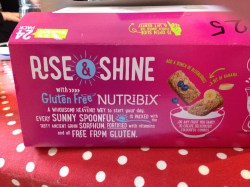 Breakfast: Nutribix – a great alternative to the well-known breakfast brand, Weetabix. These were MEWS-free, taste delicious and would definitely provide a hearty, healthy and filling breakfast. I particularly liked that they were so reminiscent of their wheat-filled counterpart, a cereal that G had loved when she was tiny in the days before we knew she needed to be gluten-free.
 Confectionery: Eskal Chocolate Wafer Rolls – I have to be honest and say there was a whole host of amazing chocolates for this category, which left me in some of a chocolate-induced haze by the time we got to the end of the judging session. However, these wafer rolls were the stand-out product for me as they were light whilst still being indulgent, deliciously tasty and would make a great accompaniment to a bowl of ice-cream for that extra-special twist. The only downside is that they currently contain soya, especially as they are amazingly gluten-, dairy- and egg-free.
- Meaty & Fishy Ready Meals: I can’t begin to tell you how impressed I was with the vast range of free from ready meals that we got to taste and, to my delight, this category produced 2 top picks for me. The first is one that G will love and that would have ticked so many boxes for M pre going elemental. Tesco is adding a gluten-, dairy-, egg- and soya-free scampi to their own brand Free from range, which I’m sure will prove to be a huge success with many allergy families.
![IMG_0094[1]](https://7yearstodiagnosis.com/wp-content/uploads/2016/02/img_00941.jpg?w=225&h=300) I’m so excited for it to hit our shelves in the next couple of months and can’t wait for G to try it. My other choice is something I know G won’t want to try, but it ticked so many boxes for me as it was tasty, free from and could be prepared in the microwave in less than 5 minutes, truly the quintessential ready meal. Better Than Rice Chicken Massaman Curry introduced konnyaku rice to me, which has a completely different texture to normal rice and I’m looking forward to trying it out with M. He might not be able to eat the rest of the dish, but with such a limited diet, this new rice will bring an interesting twist to mealtimes.
I’m so excited for it to hit our shelves in the next couple of months and can’t wait for G to try it. My other choice is something I know G won’t want to try, but it ticked so many boxes for me as it was tasty, free from and could be prepared in the microwave in less than 5 minutes, truly the quintessential ready meal. Better Than Rice Chicken Massaman Curry introduced konnyaku rice to me, which has a completely different texture to normal rice and I’m looking forward to trying it out with M. He might not be able to eat the rest of the dish, but with such a limited diet, this new rice will bring an interesting twist to mealtimes.
- Teatime: By the time my fellow judges and I reached this final category in my judging timetable, I was definitely suffering from a little food fatigue. As M calculated for me when I got home, I had tried over 100 different free from offerings in my 2 days away and had enjoyed a good many of them.
 The teatime category was again filled with a delicious array of biscuits and cakes, but there was one product that for me stood head and shoulders above the rest: the amazing Borough 22 doughnuts. These were impressively gluten-, dairy-, egg- and soya-free and also vegan, but most definitely not flavour-free and were the biggest hit of my #FFFA16 experience. I know that doughnuts are one of those indulgences that so many allergy sufferers really miss and these will more than ably fill a definite gap in the market. Not only did I get to savour them, but even better, the #FFFA16 team offered me the remaining 6 doughnuts to take home for G and my girl has been delighted to receive this treat.
My thanks go to Michelle, Cressida and the rest of the team at the #FFFA16 for their welcome and commitment to encouraging development in the free from community. I loved every moment of my time as a judge and have met some great individuals who work in different aspects of the allergy world and were a lot of fun to work/eat/disagree with over the 2 days. The shortlist of contenders for the final awards will be published on February 10th and the winners announced at the awards ceremony in April. I can’t wait to see who won in each category and share some more of these innovative products with you.

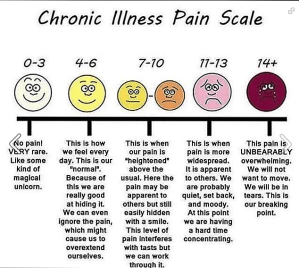 G’s godmother shared this pain scale image with me and I love the wording that is attached to it as it sums up to a tee how M has described his levels of pain over the years. From the magical unicorn of no pain at all which happens occasionally, to the breaking point of inconsolable sobbing and unbearable pain that little can ease, I’ve seen M pass through every stage of this chart on all too regular a basis. I doubt the colours, images or facial expressions would appeal overly to him, but it helps to clearly explain how he copes to those who need to know.
 A fellow
  This third one I discovered through Twitter and was posted up by @2tubies, whose 6-year old son helped make his own pain chart for the school environment with the help of the school SENCo and his Mum. They used Lego figurines to depict how he might be feeling and offered some easy solutions for his symptoms. This solution-based approach is one that I find works well with M and have started using it more and more over the years. I rarely give M the option of staying home from school when he’s feeling unwell, but will instead list out those solutions I think might ease not only his pain, but also the whirlwind of emotions that is so frequently tied into what he’s feeling on a physical level. Whilst he was still being tube-fed, I would always start with the offer to slow down or even stop his pump for a limited amount of time and then followed that up with pain relief or a hot water bottle. My final question has always been what M thinks will help him the most and given he has a clear idea of what I’m suggesting, then we have always been able to find a solution that works for us both. Whilst giving these choices verbally works well at home, I imagine that presenting them in a pictorial fashion would make great sense in the school setting.
 At G’s secondary school, they have included traffic light coloured pages in the back of the pupils’ planners and the children are encouraged to use them by putting the relevant colour facing up on the desk if they need some help during a lesson, but are too worried or nervous to ask. For some children, a “traffic lights” approach using counters or cards can also be effectively used to indicate how they are feeling in any given situation, where red can indicate their sense of losing control or not coping with the environment surrounding them. The opportunity to be tactile with the counters may also help children with sensory issues order their thoughts and be more able to express them when asked. Even if the child is not able to share what’s troubling them, a clear plan of how the teacher or adult in charge should respond to each colour will change that child’s perceptions and experiences away from home. Similarly, M’s school uses a “Fist to 5” approach to their work, where fist indicates a lack of understanding and the need for some help, and 5 means they are confident and happy to carry on on their own.
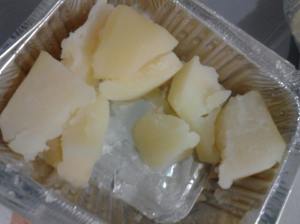 believe me he went at it with gusto, even eating 6 roast potatoes at one sitting. Within the first 24 hours he started to show reactions to the potato – severe reflux, tummy aches, a constant need to wee and he started to soil again, something he really struggled with on an emotional level. The ward doctors refused to believe he could be reacting so quickly and their repeated mantra to me soon became “it’ll take 4-6 weeks for him to show a reaction” and “he just needs to push through this“. As each food was introduced, things got worse and worse as he was now completely incontinent, a position we hadn’t found ourselves in for a year. All the signs of his bowel starting to shut down were there as he was weeing for Britain, his appetite was dropping off and his energy levels started to wane and I kept saying that these indicated he was failing the foods, only to be told that it wasn’t possible. They were palpating his tummy twice a day and insistent it felt fine and every conversation ended with “it’ll take 4-6 weeks..yada yada yada…” – by now you get the picture! By day 8, they finally agreed to x-ray and, lo and behold, he was chronically impacted. This x-ray was apparently one of the clearest they’ve ever seen showing it – solid black throughout his colon due to the blockage.
 became 6 days of powerful bowel prep continuously via M’s NG-tube plus additional senna for the last 3 of those as things simply weren’t shifting as hoped. I have honestly never seen him so ill as he was by the end of that week – bent double from the cramps, crying, refusing to move from bed or engage with anyone, lethargic and rating his pain at an 11 or 12. Throughout this time he was expected to continue all 4 foods, just in case his obvious bowel reactions were actually nothing to do with the challenges and they had introduced a daily dose of senna to keep things moving, something we hadn’t needed at all during the 12-months being tube-fed.
 M’s consultant was very determined to get the NG-tube out and at times it felt to us that it was her sole focus for the duration of the admission, which was difficult to cope with when we were needing and hoping for so much more. Achieving that has been amazing, but he hasn’t suddenly started eating a “normal” diet, in fact he’s exactly where he was before we went in, and the need for the elemental feed (E028) is still very much there. The flip-side of losing the tube is that M’s


![IMG_0063[1]](https://i0.wp.com/7yearstodiagnosis.com/wp-content/uploads/2015/12/img_00631-e1449935678682.jpg?w=257&h=240&ssl=1 "IMG_0063[1]")


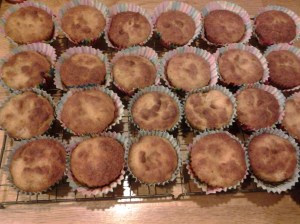 M wanted to use them to create Pudsey Bear’s face as best he could. Design done, Wednesday evening saw M whipping up the cake batter with a little supervision from me and the resulting 24 perfectly baked M-friendly
  We had already made a simple cardboard frame in the shape of Pudsey’s head to hold the cupcakes securely and,having fitted 10 cupcakes neatly into place, M got started on the icing.
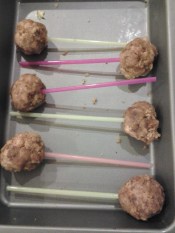 I crumbled 8 cupcakes into a bowl and was delighted to see that the grated apple and pear in the cake mix gave enough moisture to form balls. M cut up some drinking straws as I carefully moulded our cake balls and stuck them to the sticks to create the lollipop shape. My full recipe is
  It turned out to be a later night than planned, but M ended up with 2 entries to the school competition he could be proud of and was delighted that nearly all of his cakes sold at the fundraiser on Friday.
 It might have been a damp, chilly October morning when we left home, but we didn’t let the weather deter us from completing our “top-secret” mission for the end of half-term – a visit to Station X, otherwise known as
  it fitted wonderfully well with some of the English home-work G had been set over half-term.
 all before ending up at the Block B Museum.
 film last year’s blockbuster, “
 Canadian Halloween experiences with cousins and friends and their outfits are still hanging up in M’s costume wardrobe as a permanent memento. It was, understandably, a big part of Mike’s childhood, but is not an occasion I ever remember marking in my own upbringing and at home, here in the UK, I can’t quite reconcile myself to the idea of sending my children out in their ghoulish fancy dress to knock on random houses in our village to ask for treats, when, for the other 364 days of the year, I’m drilling into them the mantra to not accept sweets from strangers. Whilst we might not be avid Halloween fans in our household, I know it is a custom that is becoming more and more popular around the country.







 7 years to diagnosis