Tag Archives: Dyspraxia

It takes a village

village

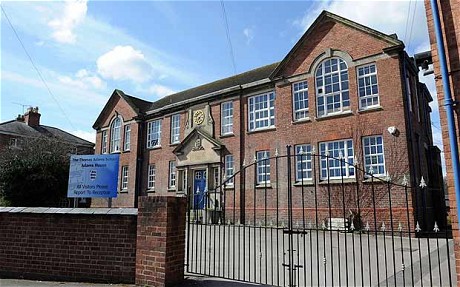
Do you know that quote?  There’s a chance you might associate it with American presidential hopeful, Hillary Clinton and her 1996 book of the same title, but in fact it comes from an Igbo and Yoruba (Nigeria) proverb and has a sentiment that is echoed by numerous other African sayings.  It recognises the great value of having community involvement in a child’s upbringing, not just for the child and immediate family, but for the extended family and local community too.  As I have mentioned so many times before, we are incredibly fortunate to have an amazing community surrounding us, who are unbelievably supportive, and none more so than our fantastic village school.

Since day one, when G first headed in through their gates, we knew that this was a place that would offer our children not just a great education, but also a safe and secure place to grow and develop, all within walking distance of our home.  The children have had the opportunity to build strong friendships with others living nearby that will hopefully continue into their teenage years and beyond.  In the 2 years that M has been there, we’ve seen time and time again just how invaluable the school community is, not just to M, but to G and to Mike and me too. The impact of M’s ever-changing health has been particularly profound in the last couple of years and there is no doubt in my mind that the unfailing support of their school has been a steadying force for us all.

Without the readiness of the Head and other key members of staff to accommodate M and all his needs, we would have struggled to keep his education a priority this year and I doubt I would have been able to continue working.  Their willingness to have M in school as normal and to learn the intricacies of his NG-tube and feeding regime has allowed me to stay in my job, confident in the fact that this is a group of people dedicated to including M in every planned activity and who have taken on that intense in loco parentis responsibility without a second thought. This year in particular has tested their mettle with the demands of not just feeding tubes and complex allergy requirements, but of occupational therapy, dyspraxia and dyslexia added to the mix too.  His teacher, Mrs M, has been amazing and she approaches every new challenge with great positivity and an unparalleled sense of humour. www.amazon.comEven the minor hiccups encountered along the way – non-stop beeping, blocked tubes, leaking pumps and soaking wet clothes to name but a few – haven’t derailed her and that attitude has helped M cope remarkably well with all the changes this year has thrown at him.  I cannot thank her enough for being the rock that M has needed during school hours.

Equally, Miss K, G’s lovely Year 6 teacher has been a real blessing to us as a family and to G in particular.  She has encouraged G every step of the way and helped build her confidence throughout the year.  M’s hospital stay in December was difficult for G as he and I disappeared off to London for 2 weeks and couldn’t be around to help celebrate her 11th birthday or enjoy the end of term build-up to Christmas.  What made a big difference was Miss K, who was fully aware of all that was going on, made herself available to G whenever necessary, understood that emotions were high and made allowances when needed, and stayed in regular e-mail contact with me during our stay and also during the Christmas holidays, so she was as prepared for where things stood with M as the rest of us.  She is moving on from the school at the end of this term and I, for one, will miss her, especially as I was hoping she would be M’s teacher for his Year 6 year.

It’s not just the teaching staff who have done their utmost to give us the support we depend on, but the parents and children too and this past week I was left speechless by the thoughtfulness and compassion of M’s class.  Following his presentation during EGID awareness week, this group of enthusiastic 9 year-olds discussed different ways they could support him and focused their attention on the fact that he has to wear a backpack all morning, which contains his pump and his “food”. This is what happened next:

“We decided, as a class, that we would all wear a backpack for a morning so that we are able to understand a little of what M has to go through each day. Therefore, on Friday 10th July, it would be great if all of 4M could wear their backpack to school and keep it on for the whole morning!  If you can make it weigh about 2 and a half kilograms that will be amazing as that is the weight that M carries around each day.”

20150710_111650On Friday I had the privilege of going into school to see this amazing group plus teacher and teaching assistants with their backpacks on and to express my thanks, not just to the children, but to Mrs M and the school for encouraging and allowing them to show their support in this tangible way. His classmates have adapted well to M’s tube and accept it as an essential part of him.  They’ve asked questions and been interested in the whys and wherefores about it and then just forgotten all about it and carried on with day-to-day life, which is exactly what M has needed.

There have also been shows of support from parents, including one from a Mum I’d never met before and doubt I’d recognise again.  We were travelling back home late from our last GOSH appointment after a long, hot day in London and arrived back at our local train station.  As we reached the stairs of the railway bridge, I became aware of a fellow passenger catching up with us and smiled with her as she chuckled at the inane chatterings of my night-owl.  I paused to let her go past, but she slowed her pace to match mine and started an unexpected conversation:

“I just wanted to tell you that my children are at the same school as your son and came home and told us all about his presentation. They both raved about how amazing it was and how much they had learned from watching it and asking him questions.  I just wanted to tell you how impressed they both were, especially as they now understand a little more of what he’s having to cope with and we all think he’s incredibly brave.”

The conversation carried on until we reached our cars and said a quiet good-night. This for me is the advantage of having not just a child who stands out from the crowd because of his tube,Colorful solidarity design tree but also a community who is brave enough to have the confidence to speak out words of encouragement to a near-stranger because of a shared experience and the desire to add their voice to offer support.

From helping take G to school early in the morning to having my tubie home for tea; and from working hard with M to improve his handwriting to encouraging G to reach her potential and aim for the stars, our school, its outstanding teachers and the families who go there have helped us out along the way. This academic year has been a tough one, but we’ve survived all the bumps in the road with the loving support of the truly exceptional community that we live in.
A day in the life of my tube-fed child

Ever wondered how having a tube impacts on everyday life?  Here’s a little insight into a typical day in the life of my tube-fed child:

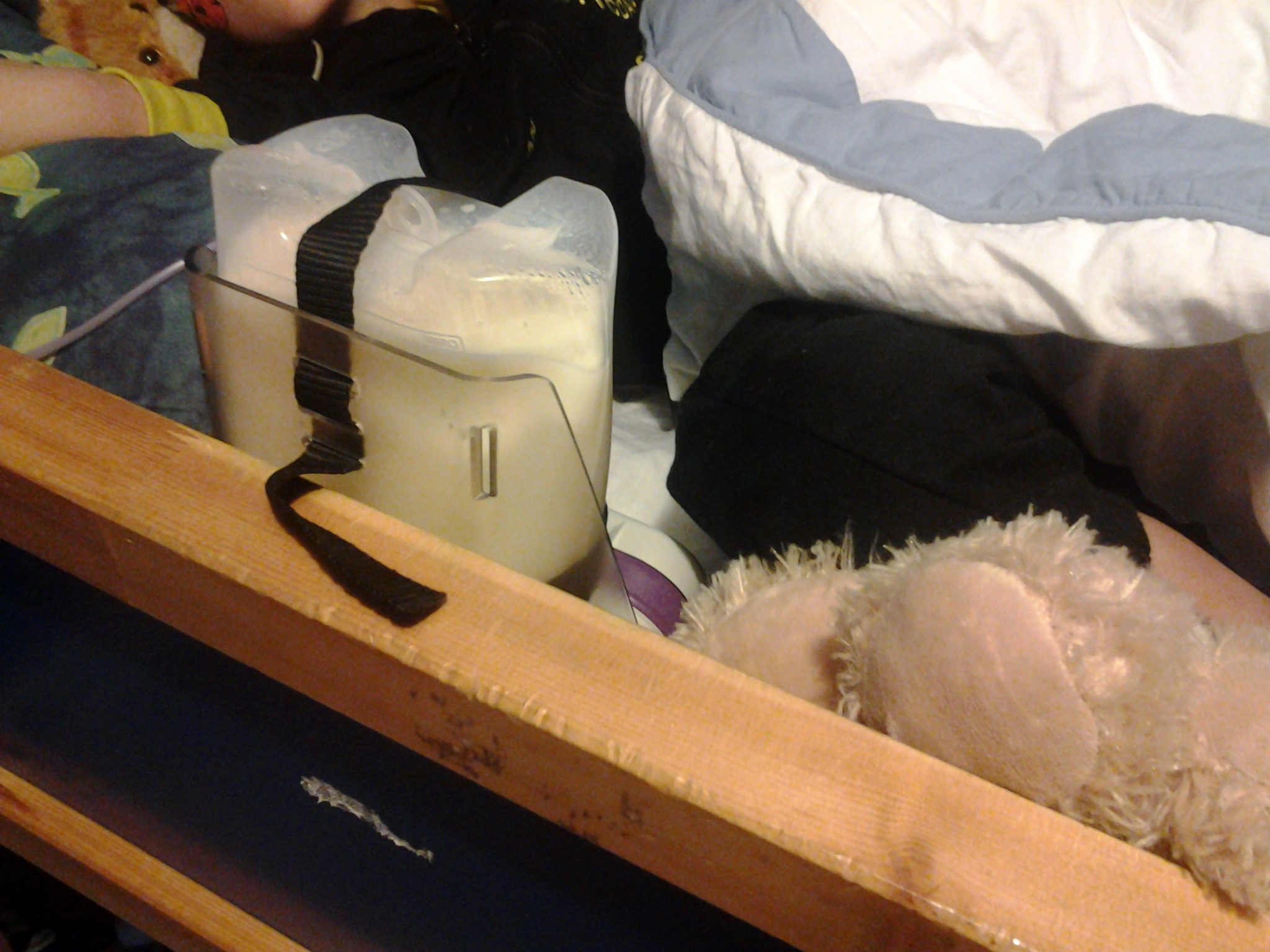
20150212_0801256am – 8am –  Whilst we try to leave M sleeping as late as possible, our day starts much earlier.  Mike’s alarm sounds at 6am and then follows a perfectly honed routine of taking M’s 1000mls feed out of the fridge, warming it in a bowl of boiling water, aspirating his tube (hopefully with as few interventions as possible), fitting the bottle, feeding kit and pump together and then starting the feed itself at as close to 6.30am as can be managed.  Allowing M to continue to snooze for another hour or so, with his pump fully supported and protected in his bed and the tube taped securely to his back to avoid accidents, is necessary for all our sanity, not least because he still hasn’t mastered falling asleep much before 11pm each night.  Once M’s feed is started, it’s the turn of the rest of us to get up and make sure we’re washed, dressed and eating breakfast before I wake M at 8am.

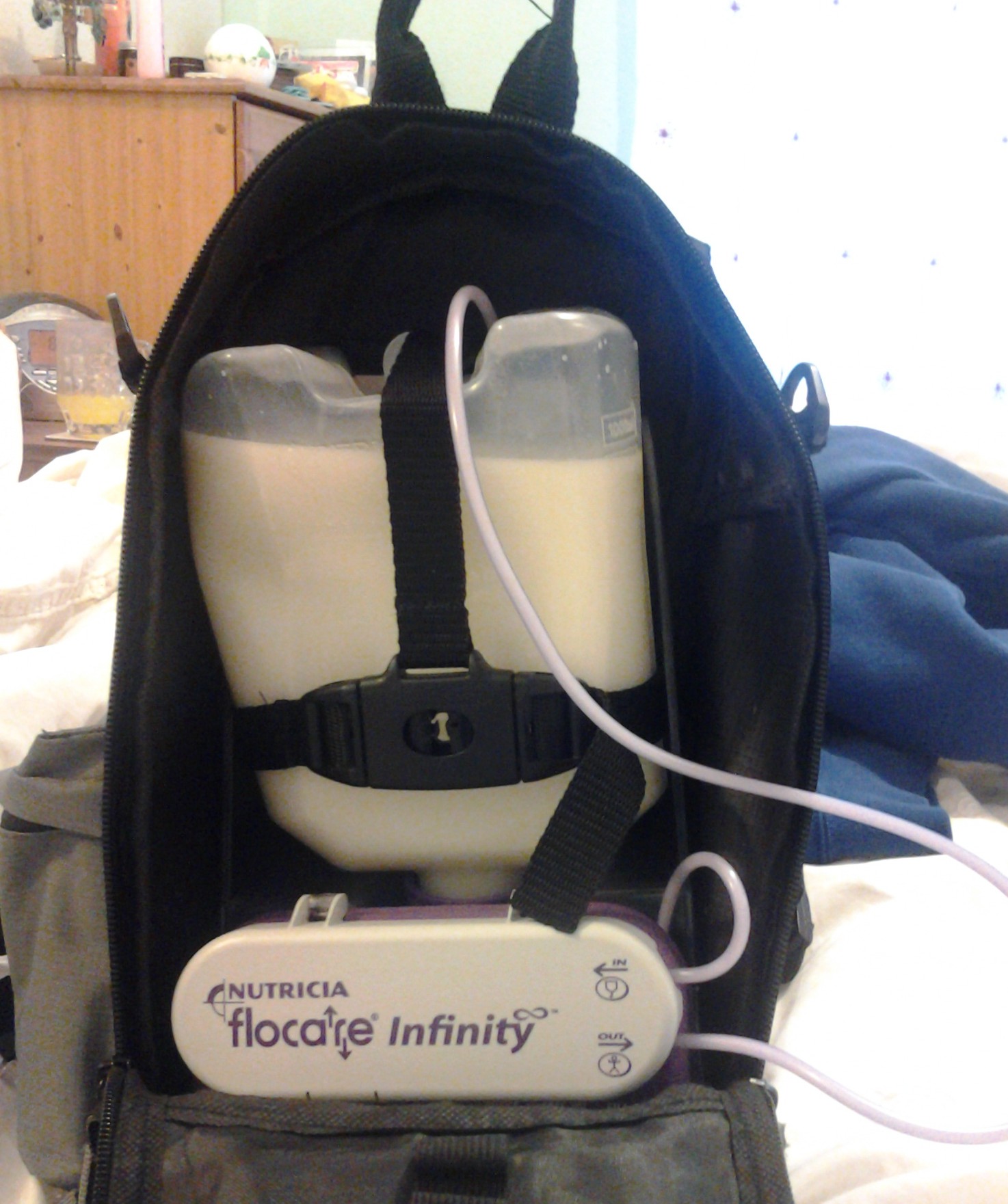
20150212_0820488am – 8.30am – This 30-minutes window is dedicated to M – getting him up, washed and into his school uniform, whilst negotiating his tube and the pump without too much interruption to the feed going in.  M is evidently a natural contortionist and has not only worked out how to thread his pump and tube through the neck of his clothes whilst still attached, but also how to do it the right way round – no mean feat for a child with dyspraxia and a challenge that has been known to flummox this Mummy more than once.  However, on school mornings I take the easier option of stopping his pump for 5 minutes and disconnecting his tube to allow him freedom of movement and giving me time to put the pump-stand securely into his back-pack.

20150212_0823258.30am – 9.30am – Pump attached and back-pack secured ready for school, we head out of the door and race off to meet up with the walking bus to get G and M to school on time.  Depending on the day, we have to make sure we have the correct selection of bags and other extraneous items with us – school bag, packed lunch for G, water bottles for both, cello or clarinet plus music, PE kits, swimming bag, my packed lunch, my “M” bag (containing spare NG-tube, spare feeding kits, pH strips, 60mls syringe, cooled water for the flush, spare tape and his lunch-time medicine), the 500mls feed for the days when my Mum picks up from school, handbag, office keys, house keys and car keys; oh and mobile phone, mustn’t forget the all important mobile phone!  Once at school, G and M go their separate ways with their friends, I pass on any useful information to key members of staff and then head off back to my car for the 5-minute commute to my office.

9.30am – 1.30pm – Fingers crossed this 4-hour slot should be a quiet one.  Whilst I’m busy working away in my office and partaking in the occasional cup of tea, M is enjoying a morning at school with his backpack firmly attached to his back at all times.  We’ve worked with the school to make some adaptations to allow him to participate fully in all lessons and he’s finally garnered the confidence to run around with his friends at play-time.  He will sometimes request a break from the pump if his tummy starts to ache and the school have been trained to know how to switch his feeds and the pump on and off.  This 1000mls feed takes nearly 7 hours to give and so I head back up to school for the end of lunchtime play to switch the feed off, disconnect M from the pump and flush his NGT through.  The last few weeks I have been working alongside 4 members of staff, who are now fully trained and proficient in M’s needs and they will be taking this role on fully after half-term, meaning less disruption to my working day.  Pump and backpack abandoned and medicines administered, M now has the rest of the school-day “pump-free” and I head back to my office.

Courtesy of telegraph.co.uk

Courtesy of telegraph.co.uk

3.30pm – End of school and on to the next part of our day.  On the days when G and M go back to my Mum’s house after school, she first drops M at my office, where I reconnect him to the pump and the 500mls feed begins before I send them on their way and carry on with my work.

4pm – 5pm – If I’ve been the one to meet them at the school gates, then this signifies the busiest part of my day so far.  We start with music practice for both children before they’re allowed to even consider asking for time to play on their tablets or to watch TV.  As the gentle strains of music float down the stairs to the kitchen, I’m busy prepping everything for the hour ahead.  I take the 500mls bottle out of the fridge and start heating it up, ready for a 4.30pm start time.  I boil the kettle to make the feeds for the next day, running between kitchen and dining room to gather up all the necessary sterile medical supplies from the stockpile we have hidden in there.

Courtesy of shutterstock.com

Courtesy of shutterstock.com

I prepare the 2 mixes of medicine for M to take the following day and store both those and the feeds on the top shelf of the fridge.  In between the kettle boiling and the feeds being made, I will hopefully have managed to check M’s NGT placement and will get the feed started on time.  Next it’s on to making packed lunches for G and me for the next day, alongside prepping dinner for G and almost inevitably dealing with the requests for a drink, a snack and tablet time from both children.  If I’m lucky, I’ll also have managed to wash the syringes and medicine pots, washed the empty feed bottles for the recycling, pulled out G and M’s homework books and might even have had time to take my work shoes off and pull my slipper boots on!

Midnight music practice is the way to go!

Midnight music practice is the way to go!

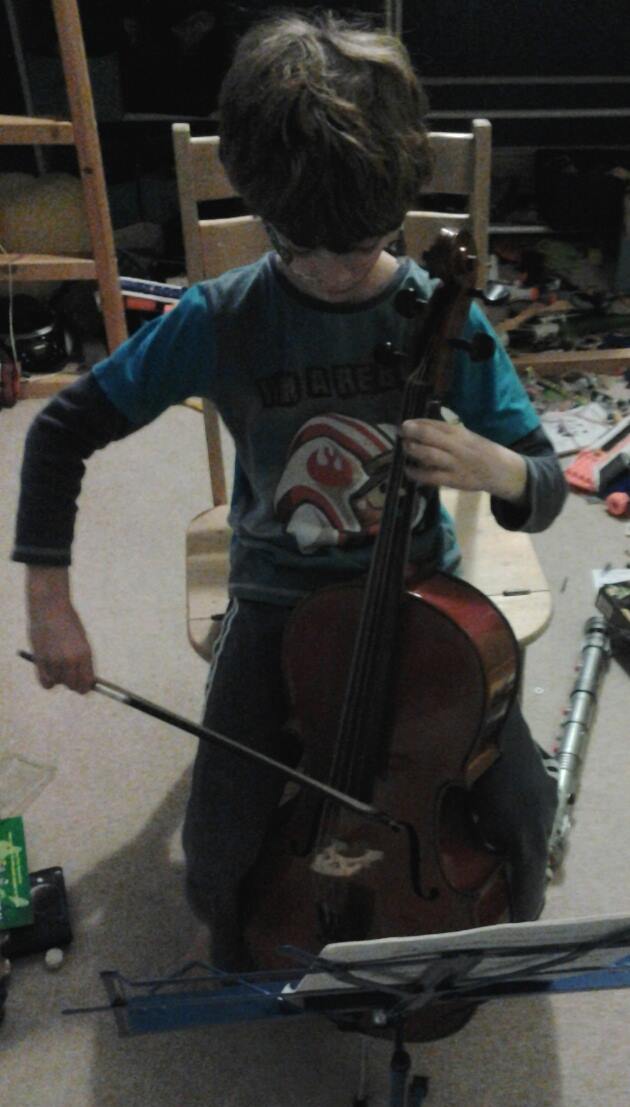
5pm – Bedtime! – The rest of the evening is spent convincing M and G to do homework, hearing them read, monitoring their screen time, peace-keeping, deciding on dinner for Mike and me and any one of a million other tasks that parents across the world are having to complete on a school night.  Friday nights include a 3-hour stint at Stagecoach for G, M and currently for me too as I need to be on hand to tape down his NGT for dance, attach him to his pump during singing and drama and just generally monitor that nothing goes wrong whilst he’s there.  Twice a week that list includes choir rehearsals for me as well as the monthly PTA meetings and the not-so-regular book club meetings I enjoy (assuming I’ve found time to read the book!).  We start the bedtime routine at around 7.30pm and insist that lights are out for G by 9pm.  M then spends the next few hours until somewhere around 11pm reading books, playing his cello, composing music on his ukulele, playing games and listening to music.  He will finally go to sleep once I’m upstairs and going to bed myself and, if Mike is lucky and times it perfectly, by the time he’s put M’s pump on to charge, tidied up the kitchen, put the cats out, set the alarm and come up himself, M will be fast asleep alongside me and it’s a simple case of moving him back to his own bed.  On a good night, we might then get 6 hours of uninterrupted sleep until our day starts all over again.

School – the hospital way

One of my favourite memories of our pre-admission waiting time is when I asked M to tell my Mum what was going to happen once he was in hospital.  I had, of course, expected him to explain, in depth, all he knew about the NG-tube and the pellet study, but roared with laughter when he said, in a small voice lacking in any great enthusiasm, “…hospital school…”

indexThe first few days of our stay were dominated by the administration of  the huge amounts of powerful laxatives and M felt so unwell that he refused to move from his bed.  By the end of that first Sunday, however, the tedium of not being allowed off hospital premises had taken its toll and he was keen to head off to school on Monday morning.  The hospital school accepts that the children may not be able to attend a “full” day there and is happy for any child to be there for as long as they are able to manage.  Each day is split into 2 sessions:  10am to 12.30pm and 2pm to 3.30pm.  They cover the basics of maths, literacy and science, but also throw in other subjects such as IT, art and even PE.

indexI discussed with the teacher there all of M’s needs concerning his dyspraxia and dyslexia and we talked about all he’d been learning so far at his home school.  He was one of just 4 children in the Key Stage 2 group during his admission and was able to have a huge amount of one-to-one teaching as there were 4 teachers able to work with the group.  They tackled his lack of enthusiasm for literacy by signing him on to the “Bug Club“, an on-line learning resource which tested his reading comprehension skills.  Each time he was able to read a new passage and answer the questions correctly about what he had read, he received a virtual sticker and was moved on to the next text.  He was set up with his own username and password to monitor the development he was making in class and what’s even better is that they have given us all the details needed for continuing with it at home.

M's amazing chocolate Christmas creation

M’s amazing chocolate Christmas creation

Every morning, M was keen to get up, get ready and get down to the classroom for the start of the school day.  I have never seen him so keen to arrive at school and start working! He had a busy week there and he enjoyed every single moment of it.  From History with the Victoria and Albert Museum to Cookery with the Executive Head Chef of the Hilton Hotel, it was a school week unlike any other.  He even took part in the school’s carol concert in the GOSH chapel, where he read part of the Christmas story.  It proved to be a great distraction from everything else that was going on medically and an amazing opportunity for those children who have to stay in hospital.

Here’s to 2015

That’s another year done, more adventures experienced and new lessons learned.  We’re starting 2015 with a positive outlook – the switch to NG-tube and elemental feeding has already started to see some health improvements for M and we finally have a plan for moving forward that will be looking for the root cause for some of his health problems.  Both children are happy and settled at school and G is looking ahead to moving into secondary school in September. We’ve met and made friends with several of the lovely FABED families and have been able to help raise funds and awareness for this charity and the condition it supports.  I’m not sure what 2015 holds for us all, but, if nothing else, I’ve learned to hold tightly to my hat as it’s certain to be a bumpy ride!

Wishing you all a happy, ssuccessful and peaceful 2015.  May your wishes and dreams be fulfilled. 


Merry Christmas!

May your Christmas be filled with love and laughter; times of happiness and of reflection; family and friends…

20141222_193603[1]

…and may 2015 be a year that brings new hope, understanding and peace.

20141225_012022[1]

Christmas decorations with a M twist

Whilst we are processing all that has happened in the last 3 weeks – think hospital admission (M), 11th birthday (G), 15th wedding anniversary (Mike and me), Carol services x 4 and metres of wrapping paper – I thought I’d share some quick snaps from a Christmas project that M undertook before he headed into GOSH.

20141126_204723[1]The challenge came from school – to create a unique Christmas tree decoration for a competition – and M knew exactly what he wanted to make.  A couple of weeks earlier, we had been watching a Christmas film (don’t ask me which one as I honestly have absolutely no idea, other than it starred Tori Spelling and was loosely based on the Dickens classic “A Christmas Carol”) and he had been fascinated to see the children threading popcorn into a garland to hang onto the tree.  He was adamant that this was what he wanted to make for the school competition, so Mike popped a saucepan of corn kernels and M and G sat down at the coffee table to start their threading.

20141126_204743[1]Bedtime arrived quickly and M asked if he could continue the job upstairs once he was ready for bed.  As M is rarely asleep much before 11pm on any given night, I swiftly agreed, knowing that this would be a great activity to keep him occupied and stop him bothering G too much, as well as a sneaky way to get 20141127_084222[1]another finger exercise to improve his fine motor skills into his day.   Whilst M was upstairs threading his garland, I was downstairs looking for simple instructions on how to make loom band candy canes to add an extra festive twist.


Six feet and six candy canes later, the garland looked amazing and M was proud to enter it into the competition.

20141127_084149[1]


(Oh, and that Christmas film we’d watched? – A Carol Christmas.  Well, I couldn’t leave you wondering!)

Beating the Bullies – Anti-bullying Week 2014

November’s proving to be a busy month, what with Armistice Day (11th), Children in Need (14th), World Prematurity Day (17th) and this week it’s the turn of Anti-bullying week (17th-21st).  The aim of the week is to raise awareness of bullying and encourages children, young people, schools, parents and carers to come together and work towards stopping bullying for all.  There are no official statistics about the prevalence of bullying across the UK, but recent reports state that almost 45,000 children spoke to ChildLine about bullying during 2013, a worryingly high number and one that’s unlikely to scratch the surface of the problem.

Bullying is defined as Repeated incidents of physical or mental abuse (teasing, taunting, name calling, threatening, isolating) of a weaker person by a stronger person.”  Stronger is not necessarily defined by size, but also includes those who are more confident or more able to pinpoint a weakness in the person they are victimising. The sad reality is that this naturally makes disabled children or those with special educational needs a prime target for bullies and they are more likely to experience bullying in school and in the wider community that other groups.  The focus of this year’s campaign is to eradicate bullying for these vulnerable individuals in particular.

This focus has struck a particular chord with me this week as M has been dealing with some bullying over the last few weeks at school.  Some of the boys in his class have been teasing him about his allergies by saying that they are allergic to him and then pretending to be physically sick. This has had a knock-on impact in the playground, where the same children have then been avoiding playing with him, leaving him feeling isolated and on his own.  He has some good friends, who have stuck by his side and defended him when he’s felt unable to do it himself; and his big sister has lent her support too by watching out for him whenever she can and inviting him, and his friends, to join in games that she’s playing with hers.

Unfortunately, M’s complicated needs – dyspraxia, dyslexia, EGID and food allergies – make him an obvious candidate for attention from bullies, who only need the smallest difference to focus in on and attack. We’ve taught him to stand up for himself without being aggressive or rude, to ignore whenever possible the comments made and to walk away when the going gets tough; but it’s not an easy issue to tackle.  Right now, he’s anxious about their response when he finally has his tube fitted and is even worrying about how things will go next year, once G has moved on to secondary school.  Don’t get me wrong, his teacher and the school have been proactive in dealing with the bullies, but they can’t take away his fears or his belief that he’s not being heard.

Sadly he’s not on his own.  Children with complex medical needs can feel isolated by their illness as they struggle with feeling different and the questions of why they can’t be like their friends or why they are so frequently absent from school.  Even those with better known conditions, such as T1D or asthma, may have limited contact with others of the same age who are dealing with the same issues and I can only imagine how much harder it is for those with rare illnesses, who may know no-one else with the same diagnosis in their area.  A lack of true understanding about their medical needs and the impact on their everyday life can add to their frustration and the sense of being on their own.  Adding bullying to that already tumultuous mix is often a burden too many and these children may head into a downwards spiral that can result in poor self-confidence, depression and even self-harm.

What can we do?  I don’t have an easy answer to that difficult question.  As a parent I can educate my children to respect the differences of their peers and not to belittle those who don’t conform to society’s notion of “normal”.  I can encourage them to enjoy friendships with everyone and not just those who have similar interests or hobbies.  I can teach them that sometimes they won’t see eye to eye with their classmates and that those differences of opinion is what will challenge and shape their own beliefs.

And as a parent to children who stand out from the crowd, I can help them find their feet in our world, to stand strong when challenged and to see the value in their very uniqueness.

Time for a Dyspraxia update

Over the last 18 months since we received a diagnosis of dyspraxia and visual dyslexia for M, he’s been making some progress and it was good to have a review this week with his Occupational Therapist to see just how far he’s come and what he should be aiming to achieve next.  When he was first assessed, it was noted that he had significant issues with his upper body strength, which was leading to weaknesses with his fine and gross motor skills.  He struggled to hold his cutlery or pencils correctly, couldn’t tie his shoelaces, wouldn’t tackle riding his bike and had handwriting that, at best, bore a passing resemblance to ancient hieroglyphics, assuming they’d been scrawled out by a spider meandering meaninglessly across the page.

20141104_184432

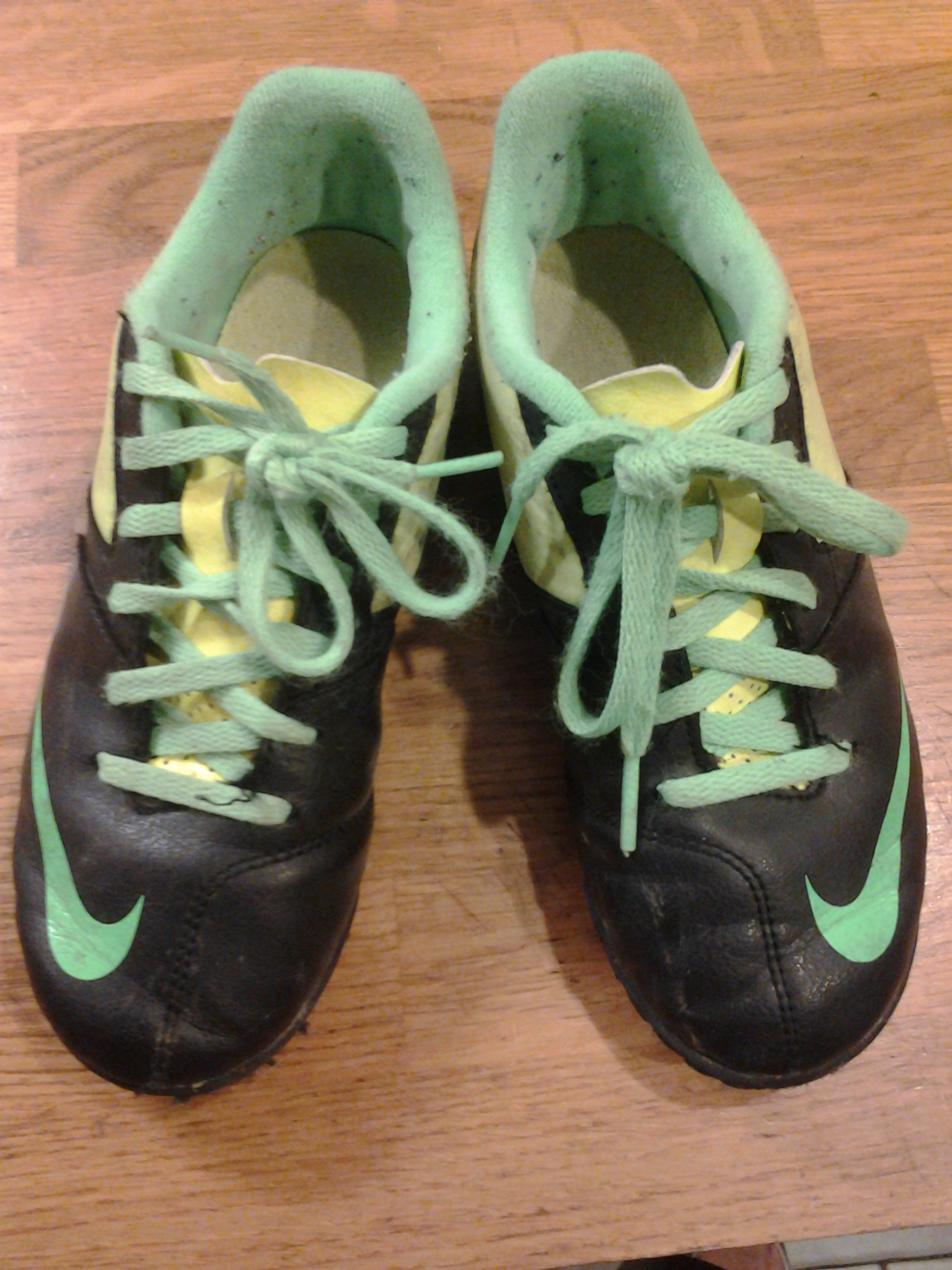
Shoes tied by M

Meal-times have become easier, thanks to the sets of caring cutlery I invested in soon after we met his OT for the first time.  M has grown in confidence as he’s mastered the co-ordination needed to cut up his food himself, although constant reminders to actually use his cutlery are still a main feature at our dinner table!  After a year of having to ask for help to tie the laces on his football boots, M decided he was going to crack that challenge over the summer and having so determined, succeeded quicker than any of us expected, himself included, and was rewarded by 2 new pairs of trainers – with laces – whilst we were out in Florida.  As for the bike, well it’s still something of a no-go area for M right now, but the draw of being able to cycle to his godmother’s house along our local cycle-path, may be all the impetus for learning that we’re going to need this autumn.

However, the one skill that still needs a lot of work is that of his handwriting and was the key area for my discussion with his OT yesterday.  Over the last few weeks, I have been trying to track down some additional support with his literacy skills as we have become increasingly concerned that his school-work will start to suffer if an improvement isn’t made soon.  I contacted both our local Dyslexia Centre and the local branch of Dyslexia Action, to find out what support might be available to M and similar answers came back from both.  There was an opportunity for weekly, 1 hour small group sessions to develop his writing and literacy skills, but although it sounded good, there inevitably was a downside.  The sessions are only run during the day, Monday to Thursday, which would mean that he would need to miss around 2 hours of school a week, by the time you allowed for pick-up and travel.  As the helpful Dyslexia Action representative warned me, “You’ll have to get the school on board first, as they may be reluctant to allow him to miss that much school each week.”

I mused over the decision and discussed it at length with Mike.  Whilst we both know that the time is critical for M right now and he really needs that support, we are also waiting for an admission to GOSH, which will mean at least a week off school.  On top of all his other regular appointments, I felt that it was just too much time absent from his friends and his learning and so decided to put this plan on a back-burner for the time being until we have some more information about the admission.

At this point, like some sort of guardian angel, his OT expressed her own increasing concerns about his handwriting skills and suggested the perfect solution to our dilemma.  She has offered to visit M in school for an hour a week for 6 weeks and will work with him and a member of staff, teaching him how to properly form cursive handwriting and write in a size that makes his writing legible.  handwritingShe will make sure he is sitting correctly, holding his pencil in the right way and knows how each letter should be formed.  His class teacher has said that M is reluctant to use cursive writing, believing that he needs to print instead, so the OT will show him some examples of work from other children she has worked with to convince him that this is the way to go.

I am so delighted that this is being offered by an OT who is as concerned about M’s handwriting and the impact on his learning as we are and, what’s more, wants to actively do something about it. As well as teaching M the skills he needs, she will also be teaching the member of staff about what he needs to be doing in class and how they can encourage him to continue the good work once her 6 weeks are up.  M’s SENCo, who also just happens to be his class teacher this year, has already agreed that the school are happy to accommodate the OT’s visits and now I’m just waiting for confirmation of when the sessions will start.

‘looming marvellous!

I know, without a shadow of a doubt, that G & M are not the only children across the UK, or indeed the developed world, who are currently obsessed with the latest craze to sweep the nation:  Loom-bands.  Every day as the children walk up to school with their friends, we pass child after child sporting an armful of bracelets made from these brightly coloured elastic bands.  Mike and I even have our own growing collection, consisting of bracelets and rings made by both G and M, in a variety of colours and patterns.

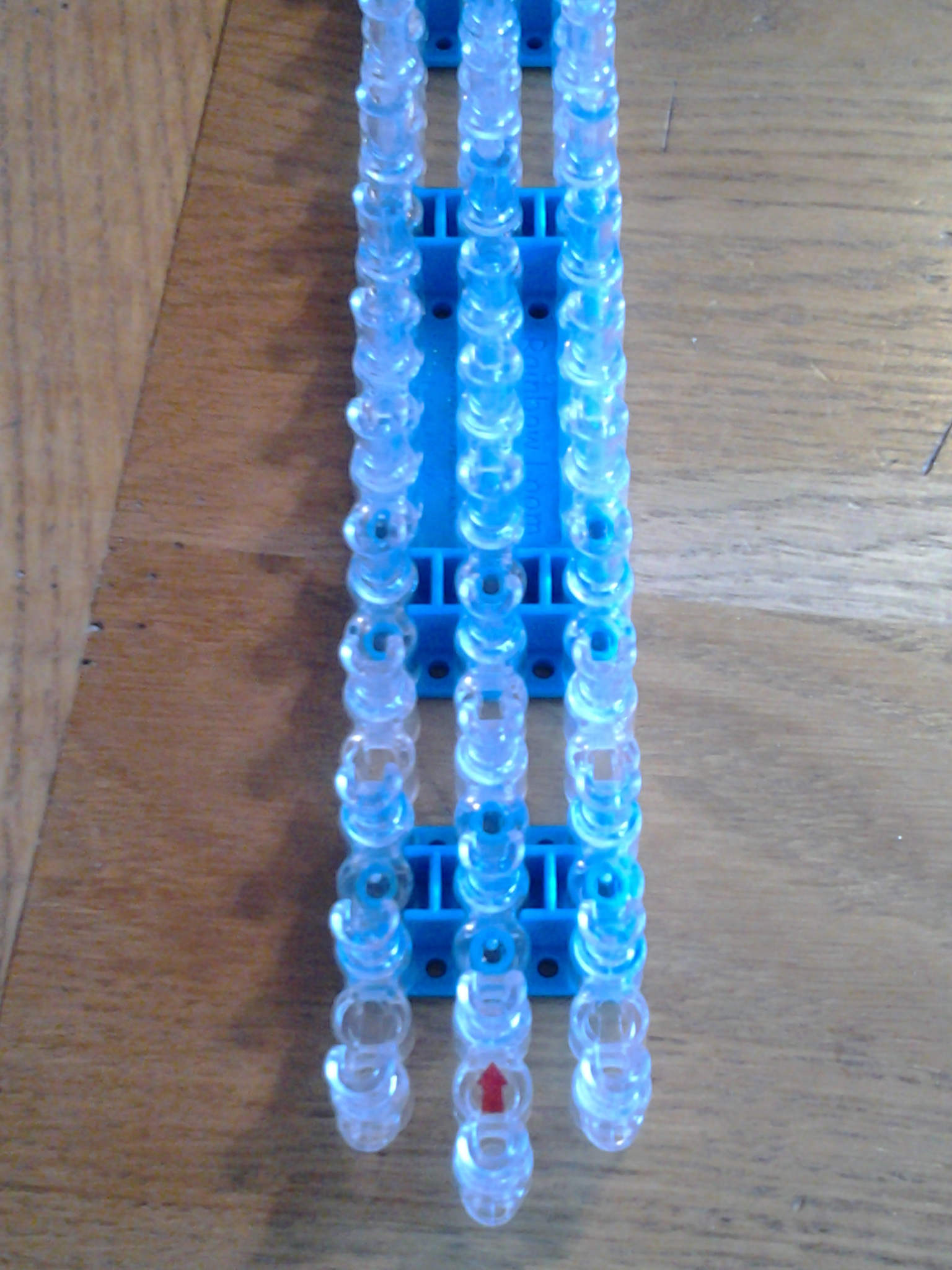
For the uninitiated amongst you, and I know there will be a few, you can create a range of unique jewellery, or charms, or just about anything else you think you might like, from relatively little.  All you need is:

one of these....

one of these….

...a lot of these...

…a lot of these…


…a vivid imagination and an endless supply of patience.

From the simple single-loom bracelet (where we unwittingly started before I knew that each pattern had a name) to the Starburst and the Inverted Fishtail, my children have been kept occupied for hours designing and making a constant stream of new creations for us to admire.  I have discovered loom-bands lurking in unexpected places and have had to think on my feet to enable emergency repairs when, at the last moment, a previously undiscovered fatal flaw threatens the final piece of art.

Just some of the children's creations

Just some of the children’s creations

I love this latest craze.  It’s not prohibitively expensive as you can pick up a bag of 600 bands and 24 s-clips for under £1; it appeals to both boys and girls, with M and his friends spending time during their mid-morning or lunch-time break to teach each other new techniques; and my pair are spending time after school to work on their bands together, rather than spending the time arguing.

Even better, it is proving to be a great way for M to hone his fine motor skills, which is such a critical part of the occupational therapy for his dyspraxia.  Putting the bands onto the loom is tricky and he has to focus on what he is doing to make sure they go in the right places.  M has also taught himself how to make some of the different patterns using just his fingers, which is really challenging the strength and mobility of his fingers and hands.  We’re yet to see whether this activity improves his pencil grip and his motor skills, but I’m grateful we’ve found something he loves to do which should prove to be extremely beneficial.

20140630_194813               20140630_194827


Rainy days and Mondays

I suspect we must be like every other family when it comes to unexpected free time or the need to find rainy day activities.  We have lots of discussions about what we could do, followed by M complaining that “there’s nothing to do” or “I’m bored” or “you won’t let me do what I want anyway, so there’s no point in asking” and eventually finishing with a decision that at least 3 of the 4 of us agree on, sometimes, if we’re lucky.  This past weekend was no exception.  Amazingly, there was no football training or game for M, no parties for either child and no school events to contend with as it was the start of the May half-term.

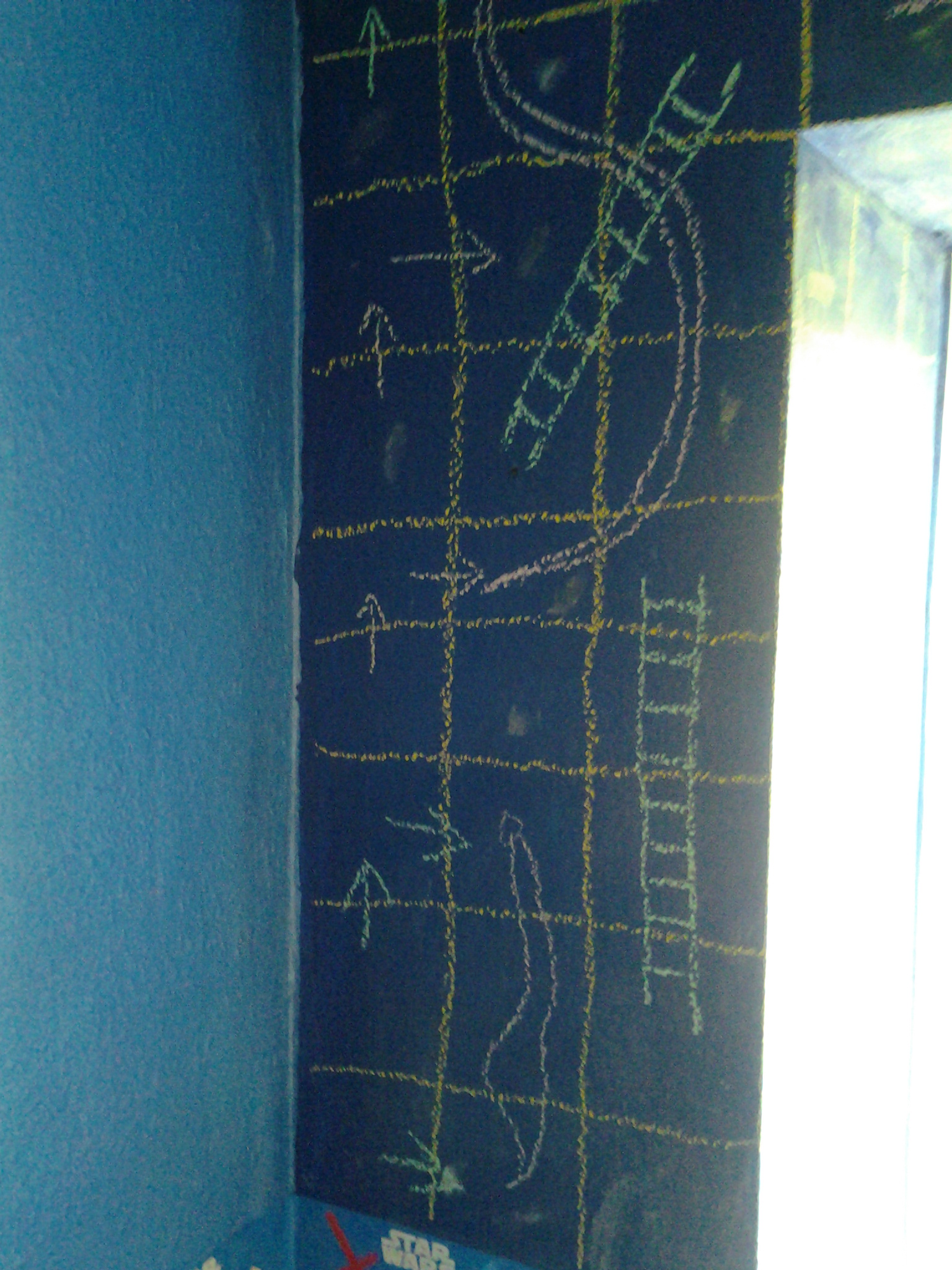
20140428_130100Chalk Wall Snakes & Ladders – this was invented by M and Mike and has been the source of hours of fun for all the family.  One wall of M’s bedroom is painted with blue chalkboard paint and they decided to create a gigantic Snakes & Ladders board on the wall.  It featured some individual-looking snakes as well as ladders of varying lengths and can be changed and adapted as the fancy takes M.  Once designed, they played the game using a dice and coloured chalk to mark their progress on the board.

bananagramsBoard games – I doubt we’re the only family in the world to indulge in a board game or 2 on a weekend afternoon.  The kids have been obsessed with two games recently: the Game of Life: Fame edition, where you’re a fledgling celebrity trying to make it big; and Bananagrams, a game that’s similar to scrabble, but each player works individually to create a crossword grid from their tiles.  The latter has become a new and firm favourite in the household, although M struggles sometimes with the challenge of creating words from his letters.  Even though he won’t always play on his own, he is always more than happy to give suggestions to anyone else playing.

20140419_123713 20140419_123737

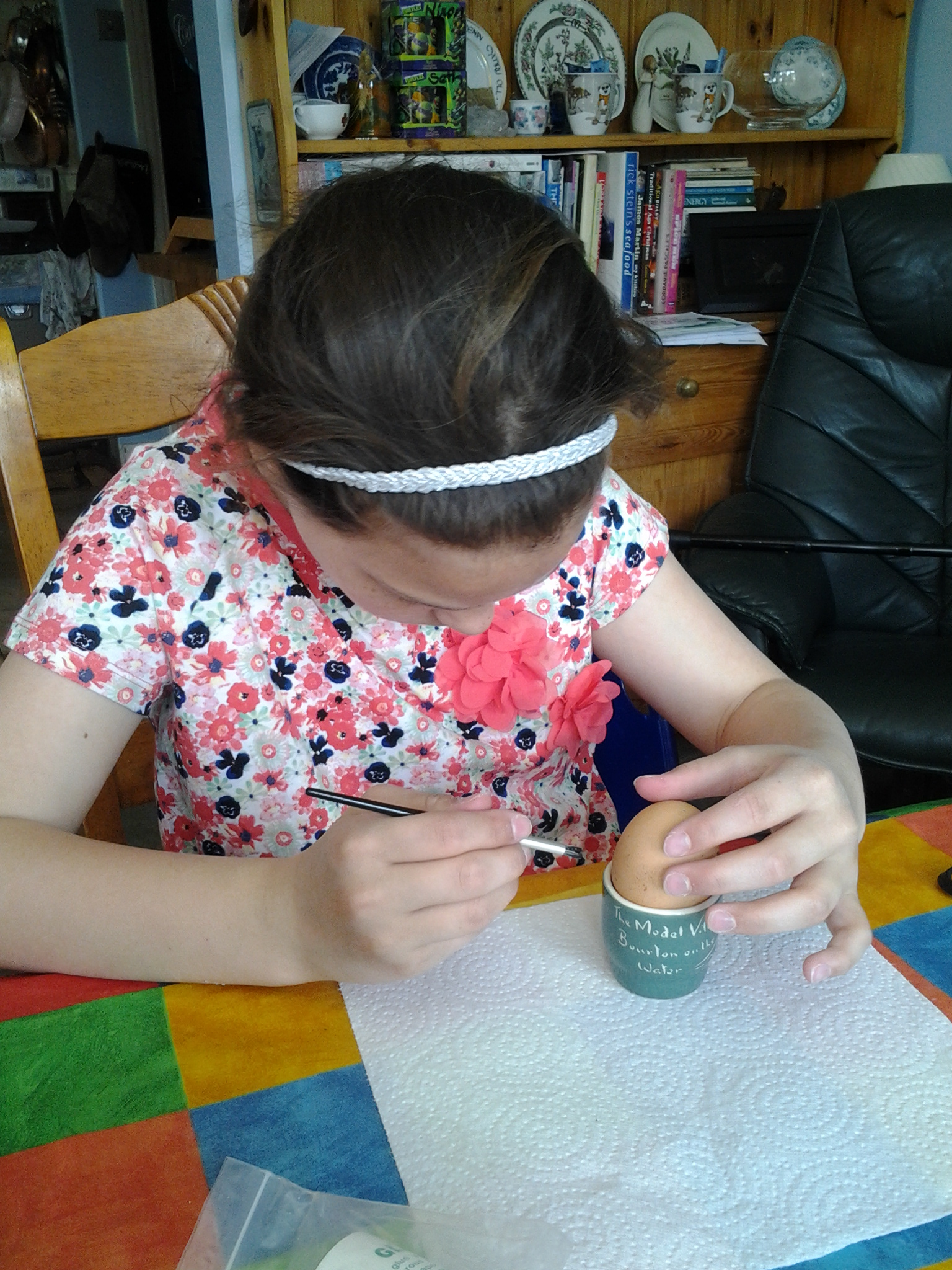
Egg painting – this is an activity usually associated with Easter as the photos show, but I see no reason why you couldn’t do this at any time of the year.  M was fascinated in seeing how exactly you blew the eggs, whilst G quickly learnt just how delicate the resultant egg-shells were.  They were occupied for a good half an hour or so before they had had enough and had run out of eggs to decorate.  G decided to go for 3 unrelated designs for her eggs, whilst M themed his eggs around a Matador, bull and red cape – don’t ask me, I have no idea where he gets his ideas from, though I’m guessing it must be something to do with his father.  Mike identified the eggs from 3,300 miles away via Skype:  I can only assume he saw something I didn’t.

lightsabersLight Saber battles – nothing overly original, though G, M and Mike appear to have created their own battleground, almost Hunger Games style, called “Schwing Schwang”.  This involves each having their own Light Saber of different colours and indulging in a series of highly complex fight moves as well as striking what I can only describe as their best battle poses. This is all accompanied by hysterical giggling from G and ear-piercing shrieks from M.

spacehopperWashing Line volley ball – This offering is an alternative to regular volley ball.  It involves the use of the washing line strung up between the garage and house, a space-hopper and a sense of humour.  We played in teams, had 5 lives each and had to catch and throw the space-hopper from side to side without dropping it or letting it bounce out of the poorly indicated boundary lines. Challenging, but great fun for a sunny afternoon.

popcornFamily film night (or morning, or afternoon) – Finally, there’s sometimes nothing to beat sitting down as a family to watch a film together.  Our biggest problem was agreeing on which to film to watch, with M and G inevitably choosing the same 5 films over and over again, whilst any suggestion from Mike or me to watch something different usually ended in tears.  So, I came up with a rota system that keeps everyone happy and has seen the children enjoying some films that they never thought they’d like.  Now we take it turns to choose the film and no one film is allowed to be chosen again until we have worked through everybody’s turn twice.  I drew up a grid on a piece of paper that lives near the TV and faithfully record who has chosen the film and what it was.  So far we’ve enjoyed a mixture of Disney, Pixar and classic films and would be hard pressed to say which has been our favourite.