Back in November, I offered my help to PINNT to write an article for a nutritional magazine on the subject of being a parent to a tube-fed child. I wanted to share our experiences of the last 12 months and, upon reading the questions asked, I felt it was a real opportunity to reach out and teach the medical professionals who work with families like ours. The potential impact of this article is huge as the magazine has a UK readership of over 13,000 health professionals and is the only nutrition magazine that reaches across the nutrition profession.
 In addition to virtually every practising dietician in the UK, it is mailed directly to all senior gastroenterologists, all nutrition nurse specialists and all nutrition pharmacists, as well as lecturers, industry professionals, consultant dieticians and students.
For day 3 of Feeding Tube Awareness week, I thought I’d include the transcript of my article here:
In addition to virtually every practising dietician in the UK, it is mailed directly to all senior gastroenterologists, all nutrition nurse specialists and all nutrition pharmacists, as well as lecturers, industry professionals, consultant dieticians and students.
For day 3 of Feeding Tube Awareness week, I thought I’d include the transcript of my article here:
When did you first learn that your child would need to be nutritionally supported by enteral nutrition?
After four years of increasing food exclusions and a raft of daily medicines, M was still massively symptomatic from his EC and the decision was taken in November 2014 to move him to an elemental feed. His NG tube was passed in early December.
Reflecting back to this stage in your life, what thoughts and emotions were going through your head?
The possibility of a move to enteral feeding had been on my radar for over a year and I had become increasingly certain that it was the best way to try to ease the ongoing symptoms and pain that he was experiencing. The heartbreak of holding my sobbing child at 3am, with tears streaming down my own face, as I struggled to find the words to bring him the comfort that nothing else could bring at that moment in time, had left me willing to try anything to ease his pain.
It took Mike longer to come to terms with the prospect of feeding M via a tube, but by the time we agreed with his consultant that we needed to give it a go, we both felt that it was the chance to give M and his body some much-needed relief. The short-term plans we’d been following for the past three years had been all well and good, but we now needed a longer-term care plan put into place as we just couldn’t keep limping from one appointment to the next with different problems constantly cropping up and nothing really being resolved. The consultant warned us that the enteral nutrition might not be the answer we were looking for, but we were desperate enough to still want to try it and stubborn enough to believe it would be what M needed.
At the time of your child commencing on enteral nutrition, what support and information where you provided with from health professionals, and did you feel this support and information was enough?
 We weren’t provided with any information about enteral feeding beforehand from the health professionals involved in M’s care and I found most of our information came from online support groups, such as PINNT and FABED. Disappointingly, we then had very limited support from the hospital as the dietician and consultant were both keen to get him discharged as soon as possible and ignored my concerns that we had no local support from our home hospital. Fortunately the nursing staff helped me fight his corner and made sure that both Mike and I were relatively confident in how to manage his tube and work his feeding pump before we went home. M was discharged just 10 days before Christmas and I was really concerned that we would have difficulties accessing any support over the festive period – it was thanks to the wonderful support group parents, the hospital nursing team (who gave me their direct phone number on the ward) and our community nurse that we not only survived, but managed to enjoy Christmas as a family in our own home.
Since being on enteral nutrition what type of long-term care and support has your child received from hospital/community health professional team?
We have a somewhat complex 3-tiered support system in place:
- The overall plans for his enteral feeding and the slow re-introductions of food into his diet are managed by his consultant and dietician at Great Ormond Street. I speak to his dietician every 3 weeks to review what’s going on and tweak his care; and we see them both every 3-4 months.
- His tube changes are done every 6-8 weeks at the CIU (Clinical Investigations Unit) at our local hospital, who have listened to his needs and help make the appointments run as smoothly as possible with the involvement of play therapists to help distract him.

- Our community nurse has helped provide training as needed and is regularly in touch to help and advise as we need.
It may be a somewhat “clunky” approach, but nearly one year on, it’s close to a well-oiled machine and works for us.
How has having a child being fed via enteral nutrition affected your family unit as a whole (thinking about siblings, time in hospital, holidays, etc.)?
Having a child with a chronic illness affects family dynamics and adding enteral feeding to the mix just meant a few additional, albeit significant tweaks for us. The regular hospital appointments do interrupt our daily routine, so I work hard to make sure that life is as stable and as “normal” as possible the rest of the time. M obviously has to take time off school for his appointments, so I try to make sure that he doesn’t miss more than is necessary. I do worry that G gets side-lined at times as our focus so often has to be on M and managing his feeding needs. 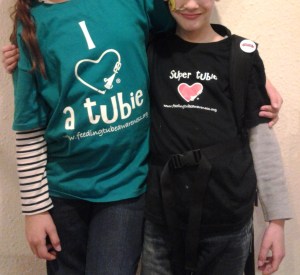 We’ve encouraged her to get involved as much as possible and as much as she wants, and she is now very capable of helping with his feeding pump. She’s recently started horse-riding, which is something M doesn’t do and gives me some time to spend just with her. As for our holidays, in the past we often went abroad, but didn’t feel confident enough to try it this first year with his tube. Instead we went to Cornwall this summer, with our car packed full of all the necessary medical equipment and enjoyed an amazing week away. We’re now feeling much more able to cope and are hoping to go to Portugal next summer.
When thinking about nursery/schooling, have you come up against any barriers or obstacles (if applicable)?
The impact of M’s ever-changing health has been particularly profound over the last couple of years and there is no doubt in my mind that the unfailing support of their school has been a steadying force not just for G and M, but for the family as a whole. They were willing to have M in school as normal within days of coming home from hospital and 5 members of staff were trained on the intricacies of his tube and feeds so that he could take part in every planned activity with confidence. The positive attitude of the teaching and support staff has also rubbed off on the children and his classmates have been brilliant at accepting his tube at face value and now don’t even seem to see it.
How and when did you first hear about PINNT?
I first became aware of PINNT through the EGID support group, FABED, and other parents of children receiving enteral nutrition, who all recommended PINNT as a great source of support. I then had an invitation to our local PINNT group’s next meeting.
How has PINNT supported you?
Whilst we were waiting for M to be started on enteral nutrition, I researched and read as much as I could about elemental feeding and NG tubes – most of that information was on the PINNT website and explained it in a really accessible way. I love getting the newsletters and reading about people on all forms of enteral feeding. Similarly Mike has found huge reassurance in learning that there are people out there who have not only lived on enteral feeding for years, but have thrived on it and that moving M to it could be a positive step. It helps knowing that we’re not on our own and that there is always somewhere to get advice and support from those living on enteral nutrition whenever we need it.
If there was one piece of advice you could provide other parents with, who have a child commencing on enteral nutrition, what would this be?
When you first hear that your child needs to start on enteral nutrition, it’s almost inevitable that you will feel a great sense of failure and a huge fear about what the months ahead will bring. It’s so important to remember that enteral feeding doesn’t mean you failed your child, but that their health needs mean they need that extra boost to get them through each day. After nearly a year on his NG-tube, M has become the fun-loving, caring and somewhat cheeky little boy we all knew was hiding somewhere inside him. Feeding him via his tube has become second nature to us and it hasn’t stopped him, or the family, doing anything we’ve wanted to. The best news is that we’ve just enjoyed the most “normal” year of our lives ever.
If there was one recommendation that you could make to health professionals, involved in the care of patients on enteral nutrition, in order to improve patient care, what would this be?
I wrote this impassioned plea to medical professionals in my blog earlier this year and feel it encapsulates what I want to say to all healthcare providers:
For most of us, you are our firefighters and the people we are forced to depend on in our darkest moments. We need you to be strong, focussed and the experts that we are not, BUT we also need you to be gentle, compassionate and understand that you are holding the future of our most precious possessions in your hands. Don’t dismiss our concerns, but believe that we know our children best and have an insight or opinion that is just as valid as your professional one. Don’t belittle our emotions, but be empathetic when they overcome us and when we need a shoulder to cry on more than anything else in that moment. Be honest, but in the kindest way, knowing that your words have the power to break us when we least expect it. Most of all, understand that we are constantly living in fear about our children’s health and life and future, so they don’t have to.
 *I can’t let today’s post pass without a nodding acknowledgement that it is, in fact, Shrove Tuesday; the day when many of us enjoy a pancake or two before the start of Lent. I can’t even remember whether we managed to eat pancakes last year as M had only just started to trial foods after his 8 weeks on E028, but there’s a sneaking recollection that maybe my Mum cooked some for G, whilst the rest of us ignored the day to the best of our ability. I’m excited that this year I will once again be able to cook pancakes for the whole family and, just in case you need an allergy-friendly recipe to cook for your loved one, I’ve got the perfect one here. Enjoy!

 Today I’m celebrating a very special day, a milestone birthday of a very different kind. Google has revealed that Steve Jobs, Ben Miller and Kristin Davis were all born on this day, but as interesting as that is, I’m not really celebrating their birthdays. Today is my Godmother’s birthday, but it’s much more than that too. Today also happens to be my birthday, but, according to my birth certificate and my Mum, both of whom I trust implicitly, I’ve got another 366 days to wait until I reach my next noteworthy milestone, so my birthday celebrations this year are relatively low-key. Despite all these great reasons to celebrate, today I’m marking 30 years of one of the most significant events in my life:
![IMG_0138[1]](https://7yearstodiagnosis.com/wp-content/uploads/2016/02/img_01381-e1456250298723.jpg?w=144&h=300)
 those diagnosed with diabetes mellitus had no chance of survival and could only delay death from the illness itself by starving the body instead. Their discovery followed on from the hard work of other scientists and medics from around the world such as Oskar Minkowski, Joseph von Mehring and Paul Langerhans, for whom the cells in the pancreas were named, and I doubt that any can deny the life-changing impact that the discovery of insulin has had on those of us living with T1D.
![IMG_0139[1]](https://7yearstodiagnosis.com/wp-content/uploads/2016/02/img_01391.jpg?w=300&h=225)


![IMG_0131[1]](https://7yearstodiagnosis.com/wp-content/uploads/2016/02/img_01311-e1455811200839.jpg?w=175&h=202) But, and believe me when I say it was quite a big “but”, the sticking point sadly was the price. This type of technology is not available to anyone through the NHS as yet and funding the sensors alone would cost in the region of £100 a month. I know that you cannot put a price on good health, but as a Mum to 2 children with multiple food allergies and an already increased monthly bill due to the high costs of free from food, the challenge of finding that extra £100 each month (£125 extra earned pre-tax) felt quite daunting and I shelved any thoughts of such an investment for the time being.
But, and believe me when I say it was quite a big “but”, the sticking point sadly was the price. This type of technology is not available to anyone through the NHS as yet and funding the sensors alone would cost in the region of £100 a month. I know that you cannot put a price on good health, but as a Mum to 2 children with multiple food allergies and an already increased monthly bill due to the high costs of free from food, the challenge of finding that extra £100 each month (£125 extra earned pre-tax) felt quite daunting and I shelved any thoughts of such an investment for the time being.![IMG_0135[1]](https://7yearstodiagnosis.com/wp-content/uploads/2016/02/img_01351-e1455809989998.jpg?w=175&h=221) The concept is a simple one and reassuringly easy to use. You insert a small sensor with a thin, 5mm needle into the back of your arm and, although the initial instructions for applying it appear quite complex, it really was quick and easy to do. I didn’t find it painful at all and whilst it takes some time to get used to the constant presence of this sensor on my arm, I’ve had no problems with it. The sensor measures what is called the interstitial fluid glucose levels, which are not identical to BGLs as this is the fluid found between the cells, but are considered accurate enough for monitoring what is going on. To find out your BGL, you simply wave the scanner over your arm and it gives you the result almost instantaneously.
The concept is a simple one and reassuringly easy to use. You insert a small sensor with a thin, 5mm needle into the back of your arm and, although the initial instructions for applying it appear quite complex, it really was quick and easy to do. I didn’t find it painful at all and whilst it takes some time to get used to the constant presence of this sensor on my arm, I’ve had no problems with it. The sensor measures what is called the interstitial fluid glucose levels, which are not identical to BGLs as this is the fluid found between the cells, but are considered accurate enough for monitoring what is going on. To find out your BGL, you simply wave the scanner over your arm and it gives you the result almost instantaneously. ![IMG_0129[1]](https://7yearstodiagnosis.com/wp-content/uploads/2016/02/img_01291.jpg?w=175&h=233) The sensor continually reads the changes in the glucose levels and, as long as you scan at least once every 8 hours, the easy-to-read graphs given on the screen indicate what has happened during the times you didn’t test. As with most CGM systems (Continuous Glucose Monitoring), it is recommended that the FSL user occasionally uses a standard glucose monitor to test their blood sugars and check that reading to the one given by the FSL – my tests have shown a difference of less than 0.3 mmol, which is incredible.
The sensor continually reads the changes in the glucose levels and, as long as you scan at least once every 8 hours, the easy-to-read graphs given on the screen indicate what has happened during the times you didn’t test. As with most CGM systems (Continuous Glucose Monitoring), it is recommended that the FSL user occasionally uses a standard glucose monitor to test their blood sugars and check that reading to the one given by the FSL – my tests have shown a difference of less than 0.3 mmol, which is incredible.![IMG_0128[1]](https://7yearstodiagnosis.com/wp-content/uploads/2016/02/img_01281-e1455811252823.jpg?w=175&h=246) and am able to discreetly test whenever I want or feel the need. The amount of information available is vast and you can look at enough graphs, bar charts and log books to satisfy even the biggest techno-geek. It has become strangely addictive to do and has already started to give me an even greater understanding of what my T1D is doing than I’ve ever had before. The non-invasive nature of the testing means that it would be easy for a parent to do during the night with no fear of disturbing their child’s sleep, and similarly for Mike to do if he ever feels that my blood sugars are dropping overnight – no need to wake me to ask me if I’m going hypo and then having to survive the often stroppy response his concerns are rewarded with, whether they are or not – yes I am precious about my sleep! I also have no doubt that it would appeal to every tech-savvy under-18 out there, which would no doubt reduce the chances of non-compliance and teen rebellion that so many young T1Ds experience,
and am able to discreetly test whenever I want or feel the need. The amount of information available is vast and you can look at enough graphs, bar charts and log books to satisfy even the biggest techno-geek. It has become strangely addictive to do and has already started to give me an even greater understanding of what my T1D is doing than I’ve ever had before. The non-invasive nature of the testing means that it would be easy for a parent to do during the night with no fear of disturbing their child’s sleep, and similarly for Mike to do if he ever feels that my blood sugars are dropping overnight – no need to wake me to ask me if I’m going hypo and then having to survive the often stroppy response his concerns are rewarded with, whether they are or not – yes I am precious about my sleep! I also have no doubt that it would appeal to every tech-savvy under-18 out there, which would no doubt reduce the chances of non-compliance and teen rebellion that so many young T1Ds experience,![IMG_0130[1]](https://7yearstodiagnosis.com/wp-content/uploads/2016/02/img_01301-e1455811224240.jpg?w=175&h=179) thereby similarly reducing the risk of complications from poor control. I really can’t speak highly enough of my experience so far with the Freestyle Libre and wouldn’t hesitate to recommend it to every T1D out there. It has been a struggle to find a down-side other than the price, which is due to the £50 sensors needing to be replaced every 14 days. My personal solution to that is to fund 1 sensor a month for the time being, or at least until the point I finally win that elusive lottery jackpot!
thereby similarly reducing the risk of complications from poor control. I really can’t speak highly enough of my experience so far with the Freestyle Libre and wouldn’t hesitate to recommend it to every T1D out there. It has been a struggle to find a down-side other than the price, which is due to the £50 sensors needing to be replaced every 14 days. My personal solution to that is to fund 1 sensor a month for the time being, or at least until the point I finally win that elusive lottery jackpot!

 especially if they would recommend them to others or, indeed, warn other food allergy sufferers against going there. Needless to say, as soon as I first heard about CIET?, I contacted Nicky to find out how I could become involved with her new venture and am proud to be one of the allergy ambassadors and partners delighted to be working with CIET? as much as I can. It really is a 5-star website and I wish them every success for the future.
 he same is true when it comes to feeding tubes as sadly misconceptions are rife and the reasons behind a tube can be as complex and individual as there are stars in the sky. Even with children or adults living with the exact same condition, their symptoms and need for additional nutrition can be vastly different.
 When you are tube-fed, I think it’s only natural to expect the support of your nearest and dearest, especially in the case of the tube-fed child. In a recent interview about her MS diagnosis, actress
  Young Carers groups try to meet on a regular basis to give the youngsters a much-needed break from the day-to-day, the opportunity to meet other young carers who will truly understand the pressures and strains they are under and the chance to have fun and be a child. Depending on the location, and sadly on the funding available, these organisations may offer evening clubs, weekends away, days out and even holidays as well as friendly advice, information and counselling to both the young carer and their family. In our area, there is also a school worker who runs lunchtime clubs at some of the local secondary schools, hold awareness assemblies and will act as an advocate for the child if needed.
 She and a close friend in a not-too-dissimilar position have since met with this teacher a couple of times and have been given more information about our local young carers group as well as a list of useful contact names and numbers.
 “…to celebrate and recognise the unspoken and often forgotten support that siblings provide to loved ones suffering.” This is just one person’s small step to make a difference to these unfailing supporters, but with the help of projects like The Forgotten Ones and Young Carers, we can all help support our sick children and their unsung heroes.
 going to make me feel better and I was very worried that I would be teased at school about it.
 Last summer, my classmates decided to wear a 2.5kg backpack for the morning so that they could understand exactly what I go through each day. The whole class did it as well as our teacher and the other teaching assistants.
 He loves to run around and be on the go and into everything all of the time. I mean it. M just doesn’t stop, ever. He’s always given 110% to whatever activity he’s doing, even if it meant trying to finish a swimming lesson white as a ghost and with a temperature of 39.5°, or running the magic mile on the first day back at school after a week off vomiting and barely able to move from his bed or the sofa. Whilst you might often find G curled up in a chair or on her bed reading a favourite book, the only time you’re likely to find M doing the same is at 11pm when he’s waiting for me to come to bed before settling down himself, and even then you’re just as likely to find him playing his cello, or perfecting his dance routine, or building with his Lego.
 If anyone was going to describe the last decade of my life, the one indisputable conclusion they’d end up reaching is that it’s been anything but boring. Thanks to a pair of children who have thrown more than their fair share of life challenges into the mix, we’ve weathered more storms than I ever believed possible and, for the most-part, we’ve come out the other side still smiling and relatively unscathed. We’ve survived a lot of challenges, met a whole host of amazing people and learned a great deal along the way; and if I had to pick just one lesson that constantly resonates, I’d have to say that we now know to never take things for granted as they can change at the drop of the proverbial hat. Two years ago I
  We all felt the benefits of that visibility to start with and I no longer felt the underlying pressure to defend the true extent of M’s illness and food allergies whilst my outwardly healthy-looking youngster was intent on tearing around practically making a mockery of every problem and pain we said he was suffering.
 7 years to diagnosis