
May 22: U is for Unite
Over the years, our primary focus for “unite” has been on spending the week, or a part thereof, “Eating like M“. Mike and I are embracing it fully again this year, much to M’s delight, but I have to wonder whether following his restricted diet for 7 days really does enough to show him that we’re standing in unity alongside him. 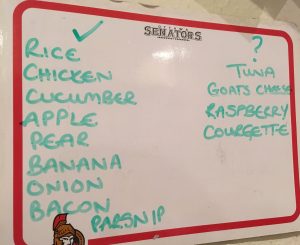 A natural consequence of our choice is that those we work and spend time with during this week will inevitably ask questions, which obviously gives us both a great opportunity to talk about EGID and start to educate the uninitiated, but I keep returning to the question of whether M truly feels a benefit from us standing shoulder to shoulder with him for such a short time.
Of course, the truth is that, for us, every day living with EGID, even though we are not living with the diagnosis and reality of it ourselves, is a day spent supporting M through what has been some of the toughest times he’s had to face in his 12 years. We have lived through and survived the most difficult challenges, but we are still not really living in unison with him. My 30+ years of living with my own chronic illness, Type 1 diabetes, means that I do perhaps have more of an idea of the experiences and angst that he faces each day than others and I know that that truth has brought M some comfort in his darkest moments. I can’t make EGID disappear, or allow him to eat completely normally once again – or, at least, not without some pretty catastrophic reactions that would take their toll and require a huge amount of time to recover from – but I can offer a level of understanding and empathy to him, along with an ever-ready cuddle, kiss and encouraging words from Mum, which may or may not be gratefully received depending on the occasion.
 This week, social media, and Facebook in particular, is swamped with the CURED banner for NEAW, which promotes worldwide unity in the EGID community, with all of those living with EGID holding hands and pulling together to seek a cure. It is an image that has resonated with me, especially given the ongoing tumultuous relationship between EGID and the medical profession here in the UK. Despite M’s objections to the word CURED (which actually stands for the Campaign Urging Research for Eosinophilic Disease) because, as he rightly points out, “…there isn’t a cure yet for EGID and this makes it seem as if there is…“, he too is a fan of the sense of inclusion rather than isolation that is reflected in the words. The realisation that EGID affects others just like him across the world is sinking in and we all find some comfort in the truth that other countries are investing in the area of gastro research, which includes seeking a deeper understanding about EGID and how it works.
Whether its eating like M this week, or sharing the same meals with him at different times throughout the year; supporting M when life isn’t going as smoothly as it could, or cheering him on when he’s talking EGID to those around him; or actively helping both him and G when they’re fundraising for the charities that have worked tirelessly to support them over the years, all of it is standing in unison with M during NEAW and for the rest of the year. Because unity is not just for a day or a week or even a year, but it’s for a lifetime and it’s a commitment I’m willing to make to the EGID community, not just to him.
The question is, are you?


 That incomparable insight is what almost makes the challenges of M’s health worthwhile, for whilst I would give anything for him not to have to live with a rare illness like
  My blog has simply been an effective way to put all of our experiences into one place, hopefully with some useful pointers for others in the same shoes and, by doing that, to create my very own, very personal resource.
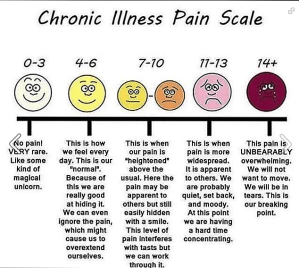 G’s godmother shared this pain scale image with me and I love the wording that is attached to it as it sums up to a tee how M has described his levels of pain over the years. From the magical unicorn of no pain at all which happens occasionally, to the breaking point of inconsolable sobbing and unbearable pain that little can ease, I’ve seen M pass through every stage of this chart on all too regular a basis. I doubt the colours, images or facial expressions would appeal overly to him, but it helps to clearly explain how he copes to those who need to know.
 A fellow
  This third one I discovered through Twitter and was posted up by @2tubies, whose 6-year old son helped make his own pain chart for the school environment with the help of the school SENCo and his Mum. They used Lego figurines to depict how he might be feeling and offered some easy solutions for his symptoms. This solution-based approach is one that I find works well with M and have started using it more and more over the years. I rarely give M the option of staying home from school when he’s feeling unwell, but will instead list out those solutions I think might ease not only his pain, but also the whirlwind of emotions that is so frequently tied into what he’s feeling on a physical level. Whilst he was still being tube-fed, I would always start with the offer to slow down or even stop his pump for a limited amount of time and then followed that up with pain relief or a hot water bottle. My final question has always been what M thinks will help him the most and given he has a clear idea of what I’m suggesting, then we have always been able to find a solution that works for us both. Whilst giving these choices verbally works well at home, I imagine that presenting them in a pictorial fashion would make great sense in the school setting.
 At G’s secondary school, they have included traffic light coloured pages in the back of the pupils’ planners and the children are encouraged to use them by putting the relevant colour facing up on the desk if they need some help during a lesson, but are too worried or nervous to ask. For some children, a “traffic lights” approach using counters or cards can also be effectively used to indicate how they are feeling in any given situation, where red can indicate their sense of losing control or not coping with the environment surrounding them. The opportunity to be tactile with the counters may also help children with sensory issues order their thoughts and be more able to express them when asked. Even if the child is not able to share what’s troubling them, a clear plan of how the teacher or adult in charge should respond to each colour will change that child’s perceptions and experiences away from home. Similarly, M’s school uses a “Fist to 5” approach to their work, where fist indicates a lack of understanding and the need for some help, and 5 means they are confident and happy to carry on on their own.
 The sad reality is that M has been living with the symptoms of EC for so long that he doesn’t always realise when something he’s feeling isn’t usual and we have often discovered a symptom months, or even years after it first started to happen. These problems are frequently something we could have helped resolve sooner and it is never clear just how long M has been coping with it on his own.
 It wasn’t until they needed to start adding senna to the klean-prep to clear his system that we learned that M had not been 100% open about what was going on. The conversation had turned to whether he would willingly take the senna by mouth or if it was best pushed down his tube, when M casually commented that it didn’t really matter as he would end up tasting it either way. A little gentle prodding by his nurse soon revealed that the reflux had in fact been ongoing since the food challenges began and during that middle week of our stay, he had been experiencing the vile taste of the bowel prep in his mouth on a very regular basis.
 She quickly established that M differentiates between a “pain” and an “ache”, which meant that unless he was asked the right question, M would proffer surprising answers.


 7 years to diagnosis