
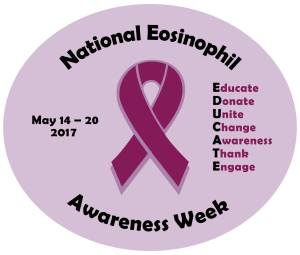
 2017 marks our 5th National Eosinophil Awareness Week and yet, in many ways and for many reasons, this year may be one of our quietest yet. One of those reasons is that over the last 12 months, we have experienced a significant shift in the way that M’s doctors view his diagnosis and that change, along with the inevitable amount of growing up that is going on in our household at the moment, means that life has become about a lot more than just the label we’ve been handed to explain his medical condition. I’ll be honest, that transitioning medical opinion has been difficult to live with because it has challenged the very way we’ve coped with the last 11 years of our life and has demanded that we examine closely all of those decisions we’ve made believing them to be in the best interests of both our children and not just M. It has made us sit back and question whether we’ve been choosing and doing the right thing.
This seismic shift that we’ve been experiencing is not isolated to our experiences or even to our part of the world, but rather appears to be part of a nationwide change in the understanding, and even the diagnosis, of Eosinophilic disorders themselves. As a parent to a child with this diagnosis, the prospect of moving away from recognising Eosinophilic Disease as a genuine medical condition is a daunting one. Whatever title you want to attach to this little-recognised health issue, the hard facts are that those diagnosed with it are struggling and suffering on a daily basis and removing the validity of its name does not, and will not, remove the reality of the problem itself. The steps we have taken over the last 4 years since diagnosis have not always been easy ones, but without a shadow of a doubt, they have been ones that have seen much improved health for M at times when we have had to make what are unquestionably the toughest of choices.
Similarly, we are not the only family who has found itself moving away from the care provided by GOSH over the last couple of years – some have moved by choice, whilst others have had little or no say in the matter. In our case, our GOSH consultant and dietitian recommended we sought local input into his care because they had reached a point where they could find no explanation for why his body reacts as it does and felt that a fresh pair of eyes might be able to give us different insight into how to go on from here. The last 8 months have been extremely challenging for us all as our local consultant has made suggestions that we are not always 100% on board with and it has taken unbelievable courage on the part of all in our family to even agree to try new things  that no-one really knows will succeed in the long run. The jury is still out on whether we are currently heading in the right direction with his care and truthfully only time will tell whether the decisions we are making this time round are the right ones or not.
Without any funded research into the complexities of gastrointestinal disorders, individuals like M will always be at the mercy of what can only be seen as an experimental approach, as diet, medicines and psychology are discussed and considered and tweaked to produce the best possible outcome on very much a “trial and error” basis. In our experience, we know that food plays a huge part in the way that M’s body behaves and the medicines he’s currently on appear to be doing their job of dampening down the body’s reactions to everything he eats. Likewise, we agree that there is a psychological element to it all and have had our concerns about the psychological impact of a chronic illness on his mental well-being. Sadly, where we have currently agreed to disagree with the medics is whether the psychology plays a bigger part than the physiology when it comes to M’s day-to-day health and responses. Yes, we know that stress can wreak havoc on the digestive system of just about everyone, but we will not be swayed in our belief that it is more than that for M. The hard facts of our 11 years with M show us that his health challenge is unquestionably a physical one and we will continue to fight for greater understanding of Eosinophilic disorders and how they affect everyday living for those diagnosed with them.
This week is about raising awareness of EGID and sharing our experiences – the good, the bad and the ugly – of living with it. For us, and for the families we’ve got to know who live with it, EGID is a part of our lives that we have to accept and learn to come to terms with, no matter what discussion is being had in the medical world. It might not be clear whether EGID is in itself the final diagnosis, or if it is simply part and parcel of a larger problem that is, as yet, unknown, but it is our reality and it shapes every step that we take.
This year we have decided to continue our support of the amazing charity, Over The Wall and their camps. If you’re able to donate even a very small amount, please follow this link to my Virgin Money Giving Page where your donation will help more children living with chronic illness like G and M by giving them and their families a chance to enjoy some much-needed time away from it all.
 If there’s one thing the last few years have taught me, it’s that it is truly worth
  Today is the start of National Eosinophil Awareness Week 2017 (#NEAW2017), our fifth year of finding new ways to talk about EGID and telling those in our community, and beyond, about this disease.
  Junior school draws to an end, the Headteacher has agreed to support our awareness-raising campaign for the final time and is helping M to host “Dress as your Hero/SuperHero” for the day on Friday May 19th.


 M and I are also big fans of sorbet and we have enjoyed some deliciously indulgent home-made lemon, orange or raspberry sorbet over the years. I even attempted a wine sorbet, thanks to the recipe book that came with my machine, but it was a disappointing disaster that really couldn’t be saved.
 Thanks to the amazing charity,


![IMG_0151[1]](https://i0.wp.com/7yearstodiagnosis.com/wp-content/uploads/2016/03/img_01511.jpg?w=380&h=380&crop=1&ssl=1 "IMG_0151[1]")
![IMG_0301[1]](https://i0.wp.com/7yearstodiagnosis.com/wp-content/uploads/2016/04/img_03011-e1461243747370.jpg?w=237&h=380&ssl=1 "IMG_0301[1]")


![IMG_0635[1]](https://i0.wp.com/7yearstodiagnosis.com/wp-content/uploads/2016/06/img_06351.jpg?w=158&h=211&ssl=1 "IMG_0635[1]")
![IMG_0850[1]](https://i0.wp.com/7yearstodiagnosis.com/wp-content/uploads/2016/07/img_08501-e1468346986785.jpg?w=82&h=211&ssl=1 "IMG_0850[1]")
![IMG_0802[1]](https://i0.wp.com/7yearstodiagnosis.com/wp-content/uploads/2016/08/img_08021.jpg?w=158&h=211&ssl=1 "IMG_0802[1]")
![IMG_0817[1]](https://i0.wp.com/7yearstodiagnosis.com/wp-content/uploads/2016/08/img_08171.jpg?w=289&h=217&ssl=1 "IMG_0817[1]")
![IMG_0980[1]](https://i0.wp.com/7yearstodiagnosis.com/wp-content/uploads/2016/09/img_09801.jpg?w=289&h=216&ssl=1 "IMG_0980[1]")


 As we counted down the days to Christmas within the confines of GOSH last year, one of the
  and M, Mike and I had great fun another evening joining the choir from All Souls Church, Langham Place as they sang their way around GOSH, serenading patients with their cheerful Christmas singing.
 Yesterday was that day and what a truly magical experience it was. A small group of just 9 of us gathered and spent the afternoon singing carols and Christmas songs to the children and their families, who are so dependent on this Hospice to provide some precious moments of respite during the year. I took the opportunity during our visit to speak to staff members, parents and even some of the children themselves and gleaned just a small insight into how important this Hospice is to them all. There were no tears yesterday; just a celebration of the individuals gathered in those rooms and an opportunity to make memories that will last a lifetime. When favourite songs were requested, we gladly sang them to bring a little extra cheer to what was already an amazing party. I gently persuaded – ok,
  perhaps, more honestly, I coerced with a cheerful smile and a little Christmas spirit – some of the footballers to join us for a rousing rendition of “The Twelve Days of Christmas”, which ended with friends, family and staff also singing along and sharing in the joy of that moment.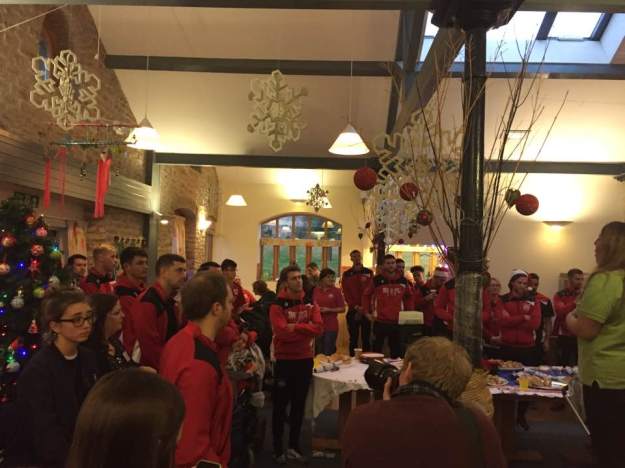


 A child with sensory issues or a reluctance to taste new foods and textures may be tempted to take a bite when faced with a Minion banana or a star-shaped piece of cheese. Of course, there’s no guarantee that your hard work will reap immediate rewards, but as with most things, a continued effort may make all the difference in the long run.
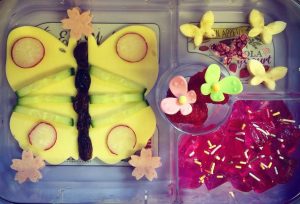 but can be used on more than one occasion. At first glance, this isn’t a cheap hobby, but by picking a few strategic pieces and taking inspiration from everything that’s available, I am sure that this would be a sound investment for anyone wanting to make their child’s lunchbox something really special. I suspect it would have even tempted my pickiest of eaters when she was a few years younger.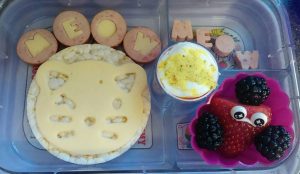



 7 years to diagnosis