
Back in November, I offered my help to PINNT to write an article for a nutritional magazine on the subject of being a parent to a tube-fed child. I wanted to share our experiences of the last 12 months and, upon reading the questions asked, I felt it was a real opportunity to reach out and teach the medical professionals who work with families like ours. The potential impact of this article is huge as the magazine has a UK readership of over 13,000 health professionals and is the only nutrition magazine that reaches across the nutrition profession.
 In addition to virtually every practising dietician in the UK, it is mailed directly to all senior gastroenterologists, all nutrition nurse specialists and all nutrition pharmacists, as well as lecturers, industry professionals, consultant dieticians and students.
For day 3 of Feeding Tube Awareness week, I thought I’d include the transcript of my article here:
In addition to virtually every practising dietician in the UK, it is mailed directly to all senior gastroenterologists, all nutrition nurse specialists and all nutrition pharmacists, as well as lecturers, industry professionals, consultant dieticians and students.
For day 3 of Feeding Tube Awareness week, I thought I’d include the transcript of my article here:
When did you first learn that your child would need to be nutritionally supported by enteral nutrition?
After four years of increasing food exclusions and a raft of daily medicines, M was still massively symptomatic from his EC and the decision was taken in November 2014 to move him to an elemental feed. His NG tube was passed in early December.
Reflecting back to this stage in your life, what thoughts and emotions were going through your head?
The possibility of a move to enteral feeding had been on my radar for over a year and I had become increasingly certain that it was the best way to try to ease the ongoing symptoms and pain that he was experiencing. The heartbreak of holding my sobbing child at 3am, with tears streaming down my own face, as I struggled to find the words to bring him the comfort that nothing else could bring at that moment in time, had left me willing to try anything to ease his pain.
It took Mike longer to come to terms with the prospect of feeding M via a tube, but by the time we agreed with his consultant that we needed to give it a go, we both felt that it was the chance to give M and his body some much-needed relief. The short-term plans we’d been following for the past three years had been all well and good, but we now needed a longer-term care plan put into place as we just couldn’t keep limping from one appointment to the next with different problems constantly cropping up and nothing really being resolved. The consultant warned us that the enteral nutrition might not be the answer we were looking for, but we were desperate enough to still want to try it and stubborn enough to believe it would be what M needed.
At the time of your child commencing on enteral nutrition, what support and information where you provided with from health professionals, and did you feel this support and information was enough?
 We weren’t provided with any information about enteral feeding beforehand from the health professionals involved in M’s care and I found most of our information came from online support groups, such as PINNT and FABED. Disappointingly, we then had very limited support from the hospital as the dietician and consultant were both keen to get him discharged as soon as possible and ignored my concerns that we had no local support from our home hospital. Fortunately the nursing staff helped me fight his corner and made sure that both Mike and I were relatively confident in how to manage his tube and work his feeding pump before we went home. M was discharged just 10 days before Christmas and I was really concerned that we would have difficulties accessing any support over the festive period – it was thanks to the wonderful support group parents, the hospital nursing team (who gave me their direct phone number on the ward) and our community nurse that we not only survived, but managed to enjoy Christmas as a family in our own home.
Since being on enteral nutrition what type of long-term care and support has your child received from hospital/community health professional team?
We have a somewhat complex 3-tiered support system in place:
- The overall plans for his enteral feeding and the slow re-introductions of food into his diet are managed by his consultant and dietician at Great Ormond Street. I speak to his dietician every 3 weeks to review what’s going on and tweak his care; and we see them both every 3-4 months.
- His tube changes are done every 6-8 weeks at the CIU (Clinical Investigations Unit) at our local hospital, who have listened to his needs and help make the appointments run as smoothly as possible with the involvement of play therapists to help distract him.

- Our community nurse has helped provide training as needed and is regularly in touch to help and advise as we need.
It may be a somewhat “clunky” approach, but nearly one year on, it’s close to a well-oiled machine and works for us.
How has having a child being fed via enteral nutrition affected your family unit as a whole (thinking about siblings, time in hospital, holidays, etc.)?
Having a child with a chronic illness affects family dynamics and adding enteral feeding to the mix just meant a few additional, albeit significant tweaks for us. The regular hospital appointments do interrupt our daily routine, so I work hard to make sure that life is as stable and as “normal” as possible the rest of the time. M obviously has to take time off school for his appointments, so I try to make sure that he doesn’t miss more than is necessary. I do worry that G gets side-lined at times as our focus so often has to be on M and managing his feeding needs. 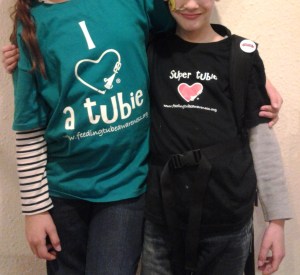 We’ve encouraged her to get involved as much as possible and as much as she wants, and she is now very capable of helping with his feeding pump. She’s recently started horse-riding, which is something M doesn’t do and gives me some time to spend just with her. As for our holidays, in the past we often went abroad, but didn’t feel confident enough to try it this first year with his tube. Instead we went to Cornwall this summer, with our car packed full of all the necessary medical equipment and enjoyed an amazing week away. We’re now feeling much more able to cope and are hoping to go to Portugal next summer.
When thinking about nursery/schooling, have you come up against any barriers or obstacles (if applicable)?
The impact of M’s ever-changing health has been particularly profound over the last couple of years and there is no doubt in my mind that the unfailing support of their school has been a steadying force not just for G and M, but for the family as a whole. They were willing to have M in school as normal within days of coming home from hospital and 5 members of staff were trained on the intricacies of his tube and feeds so that he could take part in every planned activity with confidence. The positive attitude of the teaching and support staff has also rubbed off on the children and his classmates have been brilliant at accepting his tube at face value and now don’t even seem to see it.
How and when did you first hear about PINNT?
I first became aware of PINNT through the EGID support group, FABED, and other parents of children receiving enteral nutrition, who all recommended PINNT as a great source of support. I then had an invitation to our local PINNT group’s next meeting.
How has PINNT supported you?
Whilst we were waiting for M to be started on enteral nutrition, I researched and read as much as I could about elemental feeding and NG tubes – most of that information was on the PINNT website and explained it in a really accessible way. I love getting the newsletters and reading about people on all forms of enteral feeding. Similarly Mike has found huge reassurance in learning that there are people out there who have not only lived on enteral feeding for years, but have thrived on it and that moving M to it could be a positive step. It helps knowing that we’re not on our own and that there is always somewhere to get advice and support from those living on enteral nutrition whenever we need it.
If there was one piece of advice you could provide other parents with, who have a child commencing on enteral nutrition, what would this be?
When you first hear that your child needs to start on enteral nutrition, it’s almost inevitable that you will feel a great sense of failure and a huge fear about what the months ahead will bring. It’s so important to remember that enteral feeding doesn’t mean you failed your child, but that their health needs mean they need that extra boost to get them through each day. After nearly a year on his NG-tube, M has become the fun-loving, caring and somewhat cheeky little boy we all knew was hiding somewhere inside him. Feeding him via his tube has become second nature to us and it hasn’t stopped him, or the family, doing anything we’ve wanted to. The best news is that we’ve just enjoyed the most “normal” year of our lives ever.
If there was one recommendation that you could make to health professionals, involved in the care of patients on enteral nutrition, in order to improve patient care, what would this be?
I wrote this impassioned plea to medical professionals in my blog earlier this year and feel it encapsulates what I want to say to all healthcare providers:
For most of us, you are our firefighters and the people we are forced to depend on in our darkest moments. We need you to be strong, focussed and the experts that we are not, BUT we also need you to be gentle, compassionate and understand that you are holding the future of our most precious possessions in your hands. Don’t dismiss our concerns, but believe that we know our children best and have an insight or opinion that is just as valid as your professional one. Don’t belittle our emotions, but be empathetic when they overcome us and when we need a shoulder to cry on more than anything else in that moment. Be honest, but in the kindest way, knowing that your words have the power to break us when we least expect it. Most of all, understand that we are constantly living in fear about our children’s health and life and future, so they don’t have to.
 *I can’t let today’s post pass without a nodding acknowledgement that it is, in fact, Shrove Tuesday; the day when many of us enjoy a pancake or two before the start of Lent. I can’t even remember whether we managed to eat pancakes last year as M had only just started to trial foods after his 8 weeks on E028, but there’s a sneaking recollection that maybe my Mum cooked some for G, whilst the rest of us ignored the day to the best of our ability. I’m excited that this year I will once again be able to cook pancakes for the whole family and, just in case you need an allergy-friendly recipe to cook for your loved one, I’ve got the perfect one here. Enjoy!
 The sad reality is that M has been living with the symptoms of EC for so long that he doesn’t always realise when something he’s feeling isn’t usual and we have often discovered a symptom months, or even years after it first started to happen. These problems are frequently something we could have helped resolve sooner and it is never clear just how long M has been coping with it on his own.
 It wasn’t until they needed to start adding senna to the klean-prep to clear his system that we learned that M had not been 100% open about what was going on. The conversation had turned to whether he would willingly take the senna by mouth or if it was best pushed down his tube, when M casually commented that it didn’t really matter as he would end up tasting it either way. A little gentle prodding by his nurse soon revealed that the reflux had in fact been ongoing since the food challenges began and during that middle week of our stay, he had been experiencing the vile taste of the bowel prep in his mouth on a very regular basis.
 She quickly established that M differentiates between a “pain” and an “ache”, which meant that unless he was asked the right question, M would proffer surprising answers.
 believe me he went at it with gusto, even eating 6 roast potatoes at one sitting. Within the first 24 hours he started to show reactions to the potato – severe reflux, tummy aches, a constant need to wee and he started to soil again, something he really struggled with on an emotional level. The ward doctors refused to believe he could be reacting so quickly and their repeated mantra to me soon became “it’ll take 4-6 weeks for him to show a reaction” and “he just needs to push through this“. As each food was introduced, things got worse and worse as he was now completely incontinent, a position we hadn’t found ourselves in for a year. All the signs of his bowel starting to shut down were there as he was weeing for Britain, his appetite was dropping off and his energy levels started to wane and I kept saying that these indicated he was failing the foods, only to be told that it wasn’t possible. They were palpating his tummy twice a day and insistent it felt fine and every conversation ended with “it’ll take 4-6 weeks..yada yada yada…” – by now you get the picture! By day 8, they finally agreed to x-ray and, lo and behold, he was chronically impacted. This x-ray was apparently one of the clearest they’ve ever seen showing it – solid black throughout his colon due to the blockage.
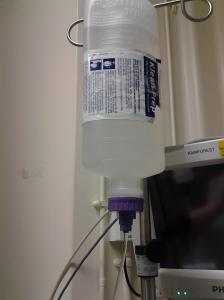 became 6 days of powerful bowel prep continuously via M’s NG-tube plus additional senna for the last 3 of those as things simply weren’t shifting as hoped. I have honestly never seen him so ill as he was by the end of that week – bent double from the cramps, crying, refusing to move from bed or engage with anyone, lethargic and rating his pain at an 11 or 12. Throughout this time he was expected to continue all 4 foods, just in case his obvious bowel reactions were actually nothing to do with the challenges and they had introduced a daily dose of senna to keep things moving, something we hadn’t needed at all during the 12-months being tube-fed.
 M’s consultant was very determined to get the NG-tube out and at times it felt to us that it was her sole focus for the duration of the admission, which was difficult to cope with when we were needing and hoping for so much more. Achieving that has been amazing, but he hasn’t suddenly started eating a “normal” diet, in fact he’s exactly where he was before we went in, and the need for the elemental feed (E028) is still very much there. The flip-side of losing the tube is that M’s
 those “virtual” friends from on-line support groups, who during the length of our admission were also admitted to GOSH. The ability to finally put faces to names, with a reasonably comprehensive background knowledge already in place and be able to spend time chatting, laughing, drinking tea and commiserating was priceless.
 Our first treat was the chance to see the final dress rehearsal of Tchaikovsky’s “Nutcracker” danced by The Royal Ballet at the Royal Opera House, Covent Garden. It came as a complete surprise on that first Monday morning and was one that M and I just couldn’t turn down. Last year, M had been given tickets to see “
 Since this time last year, the school has introduced a family session on a Friday morning, which allowed parents or carers to join their child in the schoolroom for an hour to enjoy an activity together. M and I spent the first week working with
  After one particularly long day on ward and a much-needed break from it all, I wandered back to the hospital to be greeted by the sound of carol-singing from outside the main entrance. I had been missing my weekly choir sessions at home and stopped to listen to the strains of carols that filled the air. This group had come from nearby church, St George’s Holborn to spread a little festive cheer and
  offer mince pies to anxious parents, extended families and harried medical staff as they rushed through the doors of the hospital. As I chatted to some of the members, I was invited to their Carols by Candlelight service on the evening of G’s birthday and was delighted to be able to attend, although sadly M wasn’t allowed to come with me. The service was beautiful – lit by candlelight, with smiling, welcoming faces all around me and filled with a peace that I really needed that evening. I sang every carol, grateful to be able to take part in this simple act of worship that proved to be invaluable therapy to me and which brought healing to my troubled heart.
 read at it, but the necessity of Klean prep made it impossible for him to attend. However, the one activity I put my foot down about and insisted he do was the chance to once again do some cookery with one of London’s head chefs. M loved every minute of that session and came out proudly bearing a box full of goodies from chocolate cupcakes to gingerbread angels and even 2 items he could safely eat – spun sugar and an apple swan!
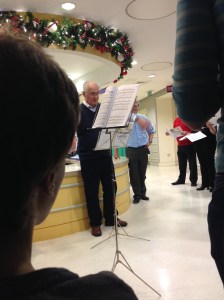 I later discovered that this group was from
  ody respond when food is eaten; a daunting prospect when you have another child to love and nurture at home as well as a job to hold down.
 working hard to bring him back to a healthy position ready for the new school term. We weren’t happy about this situation, but felt there was really no alternative; we had to give their plan a try in order to find some answers.


![IMG_0063[1]](https://i0.wp.com/7yearstodiagnosis.com/wp-content/uploads/2015/12/img_00631-e1449935678682.jpg?w=257&h=240&ssl=1 "IMG_0063[1]")


![IMG_0063[1]](https://7yearstodiagnosis.com/wp-content/uploads/2015/12/img_006311-e1449935827944.jpg?w=300&h=255) making some special cupcakes to celebrate your 12th birthday tomorrow, cakes to make up for you having to celebrate your last birthday at GOSH with M and without a cake. The ingredients are bought and hiding at the back of the cupboard, so maybe I’ll have the chance to bake them for you for Christmas because instead I’m over 100 miles and 3 hours travel time away from you.
making some special cupcakes to celebrate your 12th birthday tomorrow, cakes to make up for you having to celebrate your last birthday at GOSH with M and without a cake. The ingredients are bought and hiding at the back of the cupboard, so maybe I’ll have the chance to bake them for you for Christmas because instead I’m over 100 miles and 3 hours travel time away from you. instead we’ll be watching via FaceTime to see what goodies you’ve received with our fingers crossed that our cards have arrived from London in time.
 déjà vu (noun)
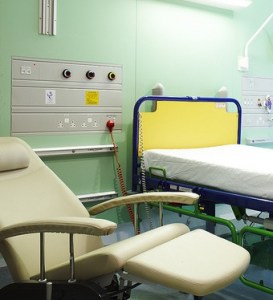 I started contacting those who needed to know – school, work, his GOSH dietician – and somehow managed to put in another couple of hours at work before heading off to pick M up from school and finish the packing job. The 4 of us eventually set off from home and hit London perfectly in time for the tail-end of rush hour traffic, meaning we finally reached our destination at around 8.30pm.
 12 NG-tubes and the accompanying tube changes, which included…
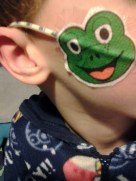 4 pump backpacks worn out and replaced (and number 5 will be needed soon);
 Nearly 1 whole school year achieved with only a few days off;



 the tube is tight enough, taped enough, in the right place enough…and not getting caught on anything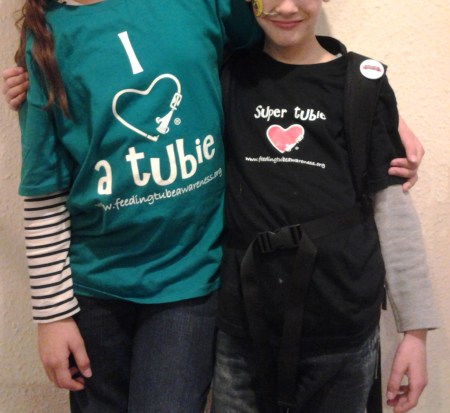
 7 years to diagnosis