Category Archives: Special Needs Parenting

A Super Tubie of my Own

Courtesy of feedingtubeawareness.com

Courtesy of feedingtubeawareness.com

This week is #feedingtubeawarenessweek, a week that our family is embracing with every ounce of our being this year.  Last year I wrote about our 2 previously brief encounters with a NG-tube, knowing that there was an ever-present chance that M might end up needing one at some as-yet-unspecified point in the future.  Just 12 months on and the state of M’s health due to his EGID means that a NG-tube is now part of our everyday family life.  The aim of the campaign this year is to dispel the myths and misconceptions that surround tube feeding and to show that adults and children can live their lives and have fun with the tube in place.  A tube is often the path to improved health and development and should be embraced as such by us all.  Their theme is “The truth about tube feeding”.
Picture1M’s friends and class-mates have accepted it as very much part of who M is and have been amazing at looking out for him at every turn without leaving him out of their games.  One friend was so intrigued by the tube and how it worked that I spotted him peering up M’s nostril to see where the tube went, just before M opened his mouth wide and pointed out that the tube could also be seen at the back of his throat – how I love the honest interest of 9-year old boys!  He was more bothered by the Year 3 children at school, who he often caught staring at his tube, but he developed his own coping mechanisms and when asked what “that” was – a question often accompanied by a finger pointing towards his nose – he started telling them it was “…nothing, but a mere figment of your imagination…”, before walking off, leaving in his wake a stream of very confused 7- and 8-year olds.

In light of all this, I was chatting to M this afternoon about his tube and people’s attitudes towards it.  I was interested to find out how he feels about strangers staring and what response he would want them to give instead.  His reply fascinated me as it expressed clearly how much more awareness is needed about tube-feeding and the impact had on those living with a tube. He didn’t mind the idea of people asking me about his tube and the reasons for it, but he isn’t yet comfortable with having to deal with those questions himself.  However, the most telling statement was this one:

“Adults should know not to stare, but sometimes they do and I don’t know why”

and that, in turn, made me think about how I feel about M and his NG-tube.  Hospital, home and support groups all exist within a protective bubble, where nothing is unusual and normal is defined by each individual and their particular needs.  It’s only when you go out into the outside world that you suddenly come up against opinion and prejudice and the harsher side of life; against people who don’t understand that this tube is bringing nutrition and healing to my child and who find themselves unable to pull their eyes away from the tube stuck to the side of his small face.

Courtesy of timemanagementninja.com

Courtesy of timemanagementninja.com

We’ve been lucky and haven’t experienced negative comments or unwanted interest.  Yes, I’ve seen the intrigued looks or double-takes as passers-by register his tube, and I’ve received the sympathetic smiles from other parents as they’ve watched me attaching his pump or silencing the alarm, but nothing more.  We’ve been fortunate to have the most amazing support from the families and friends who are part of FABED, many of whom have been in the same boat at one time or another and know how it feels to be suddenly following a slightly different path through life than the one we thought we were on.

Today, I found an article written by Traci Nagy, the founder of the Feeding Tube Awareness Foundation, in 2013 to discuss the importance of feeding tube awareness and thought I’d share with you this excerpt that sums up for me just why awareness matters so much to families like mine:

“It matters that people understand something about feeding tubes other than Terry Schiavo or that silly KE diet.  It matters that they know there are well over 200 medical conditions and diseases that can lead children to need extra nutritional support through tube feeding.  It matters that they realize that these conditions aren’t always visible, and that looking “normal” doesn’t mean there isn’t more going on inside.  It matters that they know that the feeding tube can be thought of like any other medical device in that it helps you do what you can’t do on your own…for now.  It matters that they understand that the benefit is that children get the nutrition and hydration they need to grow, develop and thrive.”
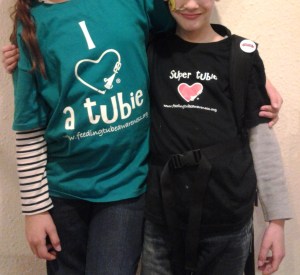
20150208_181917So, this week we’re the family proudly sporting the “I love a Tubie” t-shirts accompanied by the live-wire that is our very own “Super Tubie”.  Stop and say hello and don’t be afraid to ask me questions, but let M get on with whatever he’s doing.  We’re hoping to raise awareness and are happy to start in our community, after all, we know that every journey begins with a single step.

Managing a NG-tube

Formula made, it’s time to move on to what was, to me, the most daunting part of our NG-tube (NGT) journey and the bit that scares other people the most – the NGT itself.  Whilst it now feels like second nature, this was the biggest hurdle I had to overcome in my quest to become confident in managing M’s enteral feeding at home.  Let’s start with the very basics of what a NGT is and the job that it does.

The tube is a length of flexible material, which is inserted through the nose and travels down the oesophagus into the stomach with the purpose of allowing food and medicine to be placed directly there.  There are a myriad of medical reasons for a NGT to be passed and in M’s case, it was because he wasn’t able to drink the quantity of E028 needed each day due to being a reluctant drinker and the very unpalatable taste of the feed.  The NGT is measured against the child’s body before it’s inserted to make sure enough length is passed for its tip to sit comfortably within the stomach.  There are varying types and sizes of tube that can be used to allow for the age and size of the child, differing situations and the various medical needs.  M has a long-use “10 silk”, which he found to be the most comfortable to have in and can be left in place for up to 8 weeks before it needs to be changed.  Other tubes are more rigid and require changing on a weekly basis, something that just wouldn’t be practical given his current anxiety about having the tube passed and his allergic reactions to anaesthetic.

Once the tube has been passed and is in place, it is secured to the cheek using dressings and tape.  There are a number of these available and it really is a case of trying them out to see which works best for your child.  We quickly discovered that M has an allergic reaction to Duoderm and Micropore, two of the most commonly used dressings and so we’ve had to work out a method of fixing the tube to his cheek that won’t cause his face to become red and inflamed.  For us that proved to be a small strip of Tegaderm, which I then decorate using an amazing product I found on an US website called Feeding Friends.  These stickers are printed on medical tape and add some fun to the prospect of having a NGT on permanent show.  By sticking one over the top of the Tegaderm strip, M’s skin doesn’t react and he loves nothing more than choosing which friend will grace his cheek each time.  I change his tape approximately every 3 days, though we find that if it gets too wet in the bath or shower, then we need to replace it more often.

So far, so good and nothing too scary you may think, but now comes the most difficult bit, making sure that the NGT is still in the right place before starting a feed.  This is known as “aspirating” the tube and requires you to draw an amount of liquid up the tube to check that its tip is still sitting in the stomach and hasn’t become dislodged or moved during the time off the pump.  We were told to use nothing smaller than a 20mls syringe to aspirate the tube and are provided with 60mls syringes by our home delivery team.  Remembering to “kink”, or create a block in, the NGT before you start – this ensures that no air can go down the tube whilst you fiddle around with it – carefully attach the syringe to the end of the NGT and pull back on the plunger with – in my experience – your fingers tightly crossed that you can draw some of the liquid out from the stomach.  Depending on the time of day and what your child has been up to beforehand or even what, if anything, they’ve had to drink, this can prove to be something of a challenge.  It is possible for the tip to become stuck to the stomach wall, which creates a vacuum when you try to pull upon the syringe. I’ve found that sometimes it will “pop” free and a sudden flood of liquid will rush into the syringe and at other times, your gentle tugging will be met with nothing but stubborn resistance and a failure to draw even a millilitre out from the stomach.

The key thing to remember at this point is NOT TO PANIC. The first time it happened, I desperately scrabbled around in the depths of my memory to recall what advice the GOSH nurses had given, all the time attempting to resemble an oasis of calm and to impart none of my increasing anxiety to an unaware M.  There are 3 easy ways to try to resolve the problem:

  1. Give your child a glass of water to drink, wait around 15-20 minutes and then try again
  2. If the drink hasn’t helped, take a deep breath, lean your child at an angle of approximately 45° for 20 minutes before your next attempt
  3. If you still can’t aspirate the tube, get your child to lie on their left-hand side as this is where the stomach is positioned and may encourage that stubborn NGT to finally drift away from the stomach wall and allow you to test exactly where it is

If none of these has worked, or if your attempts to aspirate are causing your child discomfort, then you need to get the tube medically checked.  In our case, this meant a trip into our local A&E department, but could simply mean a phone-call to your local community nursing team or feeding team, who will be best placed to advise you on where to go and what to do next.

Courtesy of jamali4u.net

Courtesy of jamali4u.net

However, assuming you are able to aspirate the NGT with relative ease, you now need to check the pH of the liquid you’ve drawn from the tube to make sure that all is where it needs to be.  You will have been provided with pH strips as part of your enteral feeding “kit” and testing couldn’t be easier.  Simply drop some of the stomach juices on to the pads at the end of the strip and watch them change colour.  Memories of secondary school chemistry lessons come flooding back at this point and testing substances to see whether they were alkaline or acidic.  In M’s case, we are looking for a pH of 5.5 or less, indicating that the liquid drawn is acidic and therefore likely to have come from his stomach.  Always check with your nursing team what pH level is safe for your child as certain medicines are known to affect the results and an adjustment to the recommended results may be made.

Although aspirating the tube is a scary prospect, the risks associated with a misplaced tube are great.  I was lucky to be trained on all aspects of M’s NGT whilst we were in GOSH, but even then found the first few attempts a frightening prospect.  The most important lesson I learned was to “kink” his tube every time I did anything with it and now I don’t even think twice about doing it – it’s just another step in the process of starting his pump feeds. Once it’s confirmed that the NGT is correctly positioned, tube feeding can now begin, but that, I fear, is a lesson for another day!

Our first lesson in Elemental feeding

Courtesy of shutterstock.com

Courtesy of shutterstock.com

The last 11 years have been filled with one parenthood-survival lesson after another and it has to be said that the majority of those can be attributed to M.  I’ve now honed my parenting techniques to become, not just referee, cheer-leader, taxi-driver and chief bottle-washer, but also self-made expert in rare gastro conditions, skilled negotiator with both small children and medical professionals alike and ardent advocate for (my) children’s rights.  Our latest, and steepest, learning curve carries an uncanny echo of the challenges my own parents had to conquer nearly 30 years ago when faced with the diagnosis of my Type 1 Diabetes (T1D).  They had to learn fast all about blood sugar monitoring, counting carbohydrates and, perhaps most daunting of all, how to give insulin injections.  There could be no question of whether they felt comfortable in doing these things because they knew that their new role in my life was not just as parents, but as the front-line defenders of my everyday health.  I have hazy memories of learning to inject on an orange and know that those oranges were subject to the first faltering attempts of my whole family.

Courtesy of soteriapublishinghouse.com

Courtesy of soteriapublishinghouse.com

We’ve had to learn how to feed our child via NG-tube, a process known as enteral feeding and similarly there’s be no time to stop and question whether we were ready, willing and able to do this because M’s health demanded it of us.  Each step is not particularly complicated in itself, but the anxiety of remembering what we had to do and when was overwhelming in the first couple of weeks and I was scared of getting it wrong.  Due to a desperate need for M’s bed in the long-term gastro ward at GOSH, I had no choice but to learn as much as I could as fast as I could, so as not to be left struggling once we were back in our own home.  We have the support of an excellent nursing team from Nutricia, the company who provide M’s pump, feed and medical supplies, but that’s it.  Mike and I have quickly had to become experts in this new part of M’s journey and the extraordinary has now morphed into the routine.

For those of you who have never had to do enteral feeding, or who are learning about it for the very first time, my next couple of blog posts will cover the process in a “step-by-step” approach, which will hopefully give some useful tips on managing tube feeding.  I would also highly recommend reading this blog post by fellow blogger, MumAnnie123 – it was my “go-to” article when we were incarcerated at GOSH and gave me lots of tips and advice about maintaining my sanity as we ride the NG-tube feeding roller-coaster.  The one thing I’ve quickly learned is that everyone will have a slightly different approach, be they parents or medical staff, so make sure you follow the basic rules, adopt recommendations that meet your family’s needs and adapt to a routine that suits you and your child the best.  At the end of the day, you are the people living with the elemental feeding and need to have a system that works for you – alter the feeding routine to work with and around your life at home.

20150203_082342Following a timetable that is hugely reminiscent of our days with a baby, each day actually begins the night before, when I have to make up the bottles of M’s feed alongside the preparation of G’s packed lunch for the next day.  Each evening as I boil the kettle, I gather everything needed to make his feed – packets of the Elemental E028 powder, scoops (1 blue, 1 yellow), a 1 litre plastic measuring jug, hand whisk and 2 sterile packs containing the 500mls and 1000mls plastic feeding containers, also more glamorously named “reservoirs”.

We have a detailed “recipe” for M’s E028 feeds, which was calculated by the GOSH dietetics team to provide the calories and nutrients he requires daily based on his age, height and weight and I carefully measure the required scoops of the formula into the measuring jug.  Next comes adding the boiled water, which was surprisingly trickier than it sounds as Mike and I both made mistakes on our first weekend at home.  What hadn’t been made clear to us in the hospital was that the water added is enough to make the required amount , in M’s case 550mls, and NOT, as we both first read it, add 550mls of water to the mix.  Whilst this sounds a fairly inconsequential error, the nuance was important and the outcome was that we ended up with a lot more formula that M could drink and at a lower concentrate that he needs to remain healthy.  I add the boiled water whilst it’s still warm as I’ve found this dissolves the powder more thoroughly and a good whisk ensures that there are no lumps poured into the feed bottles.  This is important as those miniscule lumps can be enough to block the tube and cause the pump to alarm.

20150203_160111Feed mixed and bottles filled, we then store them in the fridge for up to 24 hours, following the advice of both our dietitian and the community nurse, who reassured us that this was safe to do and is a shortcut that makes my life a whole lot easier.  M hates having his E028 cold, so I make sure that the bottle is taken out of the fridge at least 30 minutes before his feed is due to start and warm it in a bowl of hot water – a great tip shared by the nurses at GOSH.  The first few days felt chaotic as I rushed around making up feed, storing bottles and trying to make sure that we were doing everything we were supposed to do.  Now I’ve found we’ve fallen into a steady rhythm as I’ve found my feet in making this process work for me and that was the key to our success.

When life gives you lemons…

120907-Lemonade-275x275

…make lemonade. Isn’t that how the saying goes? I have to confess to pondering this one in the early hours of this morning after being woken up by a somewhat distraught M who had just had a soiling accident whilst asleep. He woke me at 3.45am and 2 hours later, my mind was still buzzing and sleep seemed a thing from the dim and distant past. This doesn’t happen very often, but the impact is huge and it got me to thinking.

The impact of M’s condition has been massive on us all as a family and not just on M himself. To anyone who has a “sick” child, you will understand what I mean.

Mike and I have suddenly had to become medical experts in our own rights, despite our alternate careers as an accountant and surveyor, as who else is going to make sure that the best is done for M? I now know so much more about gastro conditions and food allergies than I ever anticipated needing to know. I’ve had to learn coping mechanisms, not just for M to deal with his frustration and anger at being ill, but to help us cope as well. The years of not having an answer have taken their toll and both Mike and I have had to re-learn who our little boy is and what makes him tick. I have to be his first line of defense wherever we are and I’m the one in his corner fighting his cause.

One of the hardest things about this illness is that there are no obvious outward signs that M is ill. He is a slight child and even when seriously underweight and struggling with full toilet-training, he has never lacked energy or enthusiasm for life. He may suffer with stomach cramps and joint aches that would floor most adults, but he just gets on with it. His complaints of aching limbs have been ignored for years as I was guilty of thinking of him as a “moaning” child, but now I know that those aches are very real and extremely uncomfortable whilst they last. He has been living the last 7 years with these as his normal, so he only stops when he’s suffering extreme moments of pain. He had then, and continues to have, the most amazing stamina and a reserve of energy that I can only envy. He is constantly on the go and has never let his health problems slow him down. In very many ways, this is his greatest strength, but also the biggest problem for us.

The lack of obvious evidence of his poor health means that people just don’t understand that he is ill and look at me in disbelief when I explain just how poorly he can be and, to be perfectly honest, I don’t blame them at all. He doesn’t look like a child who eats fresh air and frequently manages on less than 8 hours sleep a night; but he is.

I don’t think that Mike will mind me sharing that he has struggled to come to terms with M’s condition. I have an advantage in that I have grown up living with my own T1 diabetes. I know that these things can be survived and have just got on with it. Mike has found it harder and has longed for an easier fix than the road we seem to be travelling down at the moment. Of course, we now have a diagnosis and that has helped us all. Being able to put a name to the condition, even though it’s so rare that no-one ever seems to have heard of it, means that our fight has not been in vain and we can no longer be dismissed as fussy parents. This is M’s life for now and for the foreseeable future, and as his parents, our job is to ensure that he learns how to make the best of a bad situation.

M has struggled too, as you would expect and his levels of frustration at times are massive. Not only is he restricted by what he can eat and how his body reacts, but he also has to deal with the knock-on consequences. It is no longer possible for him to go home for tea with his friends, attend birthday parties, participate in cooking at school or even have a Christmas or Easter treat, without me having to provide a detailed list of what he can and can’t eat and the inevitable 20 minute discussion with the adult in charge about his condition. We encourage him to have a go at whatever he wants and refuse to let his condition dictate who he is or how he lives his life; and a big thank you has to go to my parents who brought me up with that very same approach to T1D and my life.

He acts out – he kicks and hits and shouts and bites – and sadly the people who have to survive the mood swings are us and G. G has had a hard role to play as the big sister to a poorly child. She worries about his health and I know struggles when we have to disappear off to London for the day for his hospital check-ups. But, she is also a child and has her own challenges to deal with. My children are the best of friends and would defend each other to the end; but are also the worst of enemies. It has become extremely important for us to invest as much time in G as we can and the last couple of months have enabled us to do just that far more than before. She recently took part in a music event organised by the local authority music education department and her clarinet skills were considered good enough to allow her to play with the wind band. This was something just for her and she loved every moment.

She has also been invited to join the local swimming club and that is something we are keen to encourage her to do. There was a point when we wondered a couple of years ago if she’d ever learn to swim, but she is now excelling at it and her teacher invited her to join the Club to see how she gets on. It’s an additional time commitment on a weekly basis for us as she will need to attend at least 1 extra training session a week as well as competitions, but we wouldn’t have it any other way.

I’m proud of both my children – M for his stoicism in dealing with his condition and making the most of life; and G for her continued hard work at school and at her after-school clubs. She may not like the fact that M misses school regularly to attend hospital appointments, but she admits that she wouldn’t want to have the blood tests and diet that he has. Neither child has an easy cross to bear right now, but I hope Mike and I manage to get it right enough to see them successfully and happily through to adulthood.

Reaching London

bus2

In June 2011, we all set off to London for the first of very many visits to GOSH. Walking through those doors for that very first time is an experience I’ll never forget. Having heard so much about GOSH over the years, I had never imagined that one day we would be visiting in what felt like a last-ditch attempt to help our son. I was filled with awe, hope and finally a sense that we would now know one way or another whether something could be done to help him.

It was such a momentous occasion, that we had brought G with us too, feeling that it was important for her to be part of this new journey we were embarking on. I will be forever grateful to her godfather, Uncle A, who was on hand in London and able to whisk her away for an hour to play, whilst Mike, M and I waited to meet his consultant. The only problem was that M really didn’t want to stay with us and would have much rather disappeared to the park than sit and talk to yet another doctor in yet another hospital.

We didn’t have to wait too long and we were quickly ushered into a room with Dr Hill and a member of her team. Unlike many of the other medics we’d already seen, there was no sense of there being a time limit and I was able to fully explain what had brought us to her door. We went right back to the beginning, looking at every aspect of our 5 year journey so far. She asked probing questions and actually listened to our answers; she examined M; considered his height and weight; looked at the food diary that I’d been faithfully maintaining for months, before finally sitting back in her chair.

Perhaps I’m now adding to the sense of drama, but as I look back at the moment that was about to change all our lives, I can almost taste the palpable tension in the air. You have to remember that by now, every doctor we had seen had diagnosed toddler tummy, had rejected the idea of food allergies and felt that there was nothing wrong with M at all. If I were to discover the words “Munchausen syndrome by proxy” scrawled across M’s medical notes somewhere, I really don’t think it would surprise me.

Dr Hill looked at Mike and me and stated, simply,

“Well, there’s obviously something very wrong with this little chap”.

I could have cried, or possibly kissed her at that point! From that moment on, every difficulty we had faced over the past 5 years faded and we had a sense of purpose and of how to move forward.

Whilst usually favouring an investigative set of scopes initially, as we were already old hands at working within the constraints of a restrictive diet, Dr Hill sent us to the Dietician to discuss starting M on a MEWS diet. This meant that for the next 3 months at very least, M would be Milk, Eggs, Wheat and Soya free and, for good measure, because of my own problems with potatoes, we had to take those out of his diet too. This felt like a daunting task, but I knew I would do anything I needed to to seek a resolution for M’s problems. The dietician was fantastic and spent nearly an hour talking through how I could feed my hungry child whilst excluding all these food groups. Laden down with leaflets galore, the all important follow up appointment for September and several phone numbers to give me access to the help we would need, we left GOSH and headed for a local restaurant to enjoy our last “normal” meal for a long time.

As we sat waiting for lunch to arrive, I phoned my Mum to give her the news. She now says that she could hear the relief in my voice and I’m not surprised. I felt as if a huge burden had been lifted from my shoulders, all because one individual had listened and believed what I had to say about the health of my child. There was no question about our parental instincts, simply affirmation. We were right to have pursued in our goal and though we were still to wait another 18 months to get the final diagnosis, we knew that suddenly the future looked bright.

Five consultants, four registrars…and a partridge in a pear tree!

We had reached the end of our patience with the local hospitals and doctors. M had started school the previous September and was doing well, having managed to exceed all expectations and avoid any embarrassing toileting “accidents” during school hours. Things at home however, were not getting any easier.

We had now suffered disrupted nights for 5 years thanks to M’s inability to switch off and fall asleep until past 11pm and he often woke once or twice a night and ended up in our bed. Whilst not every night was sleepless, it certainly felt that way and our sheer exhaustion was taking its toll on the whole family.

Every day was a relentless routine of regularly cleaning and changing M as he suffered from chronic diarrhoea and still hadn’t cracked full toilet training. On the best days, we had to change him 3 times, on his worst, 5 or 6 times wasn’t unusual. We had even managed to blow the motherboard of our washing machine after doing load after load of dirty washing on an almost daily basis.

He continued to eat huge amounts, complained of feeling constantly hungry and relished the fact that he was the only one of the family able to eat everything he wanted – G was still wheat, dairy and oats free, Daddy was mildly lactose-intolerant and I had discovered an arch-nemesis in the form of the simple spud! Meal-times were challenging as I cooked to manage every dietary need, but I look back on those days with fondness now as cooking daily has become even more…well…challenging.

We were also struggling with manic mood swings and temper tantrums that rocked the house when something went wrong. We now understand that M was frustrated with his inability to manage his toileting and this tipped over into every other aspect of his life, but at the time it just seemed like another behaviour that needed to be managed. And no, the old favourite of the star chart, recommended to us by every medic who’s path we crossed, did not help at all.

By May 2011, M had seen or been referred to:

  • 5 consultants
  • at least 4 registrars
  • 2 hospitals
  • 2 GPs
  • 1 school nurse
  • 1 continence clinic
  • 1 CAMHS nurse
  • and numerous other medical staff along the way

Finally at my wit’s end and obviously showing signs of strain, I sat in our GP’s consulting room and asked where we could turn to next. My mother’s instinct was still full force and despite the now numerous diagnoses of toddler tummy and the reassurances that M would grow out of it all, I knew categorically that he wasn’t getting any better and that we were now 5 years on from the initial set of problems.  I will be forever grateful to this individual who had absolute sympathy for our plight and offered to refer us to anyone, anywhere in the country.

With this in mind, we started to investigate where M could go in search of some answers and were pointed in the direction of Great Ormond Street Hospital (GOSH) in London. My Mum had been suggesting that we should go to them for a long time, but I had always ignored this advice, believing that whilst I knew something was wrong, it wasn’t serious enough to warrant a visit to those hallowed grounds. However, every other avenue open to us had been fully explored and when, at our final visit to the local Children’s Hospital, the registrar refused to perform an investigative colonoscopy on the grounds that such invasive intervention was too traumatic and unnecessary in M’s case, I knew we had to take a chance.

Mike contacted GOSH and asked for a name of a gastro-specialist that our GP could refer us to. We had to pay for the benefit of a private referral as a NHS referral could only be done through our local hospital, who still held there was nothing wrong, but we believed that this was the only way to get the answers our family so desperately needed.

Gut instinct

Buffet-Table1

Despite an appetite to rival a grown man’s, M’s weight stuck determinedly to the 9th percentile and considering his complete inability to be successfully potty-trained, this wasn’t really surprising. When I say he could eat as much as an adult, I’m not exaggerating – on one occasion he managed to consume more in a day than a good friend of the family, who had an extremely healthy appetite.

M was diagnosed early on by our GP as having “toddler tummy” and we were told that he would just grow out of it. This was a diagnosis that was going to dog our steps for the next 3 years. At this point, G developed some gastro problems of her own following a bout of food poisoning and another of gastroenteritis, and we established ourselves, as the medical tests proved inconclusive, that she was struggling with intolerances to wheat, dairy and oats. The thought had crossed our minds that perhaps M had similar intolerances, but our attempts to remove these from his diet showed no improvement, unlike for G.

It was armed with all of this knowledge, that I went back to the GP and insisted on a referral to a specialist, having kept an extensive food diary for a couple of months. This recorded not just what and how much M was eating on any given day, but also his sleep patterns (which continued to be poor) and his toileting habits. We also put together a list of our main points of concern. Preparation is key and we wanted to make sure we had a case to put to the specialist.

Our first appointment was disappointing. The specialist listened carefully, nodded sympathetically and instantly agreed with the GP’s diagnosis and left me feeling, once again, a paranoid Mum. He also referred M to the same specialist that G was seeing, in the belief that maybe our children were suffering from the same problem. My gut instinct disagreed and I made my feelings on the matter clear. Although on the face of it, their symptoms seemed similar, there were key differences that I knew had to be taken into consideration.

I have learned that a parent’s gut instinct is possibly the most important thing that any medical practitioner can listen to or, at very least, consider to be as important as the physical symptoms described. I knew deep down that there were something very wrong with my boy, but on the face of it, few agreed. His lack of toilet training was an annoyance we should learn to manage; his healthy appetite nothing of note; his poor weight gain irrelevant as he was growing along his predicted percentile; and his poor sleep patterns the same as every other new parent had to deal with. At each and every appointment we attended with M in tow, he was active, energetic, chatty and showed no sign of the tremendous tantrums he could throw at the drop of a hat at home.

Depending on our gut instincts about M and our determination to find out what was wrong, we kept on battling and refused to accept that it was toddler tummy and that he would eventually get better without any intervention.

Unfortunately, over the next two and a half years, we would need to rely heavily on that perseverance and an inner depth of strength that exceeded what either of us knew we had. We moved from one consultant to another, one hospital to another and even one GP’s surgery to another as we moved house and chased a diagnosis. Finally, in May 2011, we were given the referral that would finally set us on the road to an answer.

The first signs

It’s only now, looking back at those first couple of years with M, that I can so clearly see that all the signs pointed to something being wrong. BUT, as with all young parents, we took the rough with the smooth and just assumed that it was part and parcel of the development process, especially with a premature baby. Hindsight is a wonderful thing, but only because it is exactly that.

In the months following his traumatic arrival into our lives, M suffered with chest infections, high temperatures, reflux, high-pitched screams, poor sleep patterns and what I now realise was almost constant diarrhoea. He was prescribed an infant inhaler, seemed to bounce from one course of antibiotics to the next, gulped back infant Gaviscon with every meal and, despite his epic size and weight at birth, stayed at the petite end of the scale. He dropped from the 95th percentile at birth down to the 9th percentile, but everyone assured me that he was healthy and thriving – one doctor even suggested that his weight had been recorded incorrectly at birth and that his massive weight loss and subsequent low weight gain was nothing to be concerned about.

Comparisons between M and G also seemed irrelevant – G was your typical first-born girl. Bright, articulate and not exclusively breast-fed, unlike M who successfully breast-fed for the first 7 months. The health professionals suggested that the differences in weight, appetite and nappies were because he was breast-fed and as M seemed to be a relatively happy baby, I had no reason to question any of the theories behind his small size and constant battles with illness.

It was purely a chance comment by our nanny when M was around 15 months that triggered a realisation that perhaps something was wrong. She had been chatting whilst out at a local toddler group with M in tow, when another mother commented on how many times she had to change M’s dirty nappy. It wasn’t a complete surprise to us when she mentioned that perhaps the 8-10 dirty nappy changes a day in my 15-month old wasn’t “normal” as I had raised a similar concern with our health visitor when M was 8 months old, but it did make me stop and think.

I went back to the local health centre and voiced once again my concerns that 8 dirty nappies a day wasn’t typical and was told to keep an eye on it and to come back in a couple of months and see the GP if I was still concerned. M appeared to be thriving and was growing along his percentile line, so they weren’t as worried as me and I now suspect that this is this time when I first got labelled as a fussy Mum!

Little did I know then, but 7 years on, we now know that I wasn’t just a paranoid or fussy Mum, but rather that there was a genuine medical problem behind our concerns and that really our battle was only just beginning.