Tag Archives: NationalEosinophilicAwarenessWeek

Day 5 and finally it’s A for Awareness!

A for Awareness has meant:

This…                                                                    and this…

                                                          …lots of this…

and this…  

This is the amazing video that M made, with help from his big sister, to share his story about life with EGID.  By the time this blog post is published, he will have presented it to every class in his school – that’s 8 classes, approximately 220 children and around 15 members of staff who will now understand his journey a little better.

So come on, you all know the drill by now:  share, share and share some more and help us get M’s message out there.

Changing Attitudes – NEAW 2015

Last week I took part in the Diabetes blog week and looked at my changing attitude to my T1D over the past 3 decades as well as changes I hope will happen in the future.  social-media-treeMy plea for improved education about T1D vs. T2D is closely linked to my longing for increased awareness about EGID and has resulted in my efforts to bring the focus of family, friends and our local community to the subject through local media coverage and social media this week.

During a music break in my recent radio interview, the presenter asked me an interesting question: whether I’m upset when people misunderstand EGID?  We had been discussing off-air the fact that there is often recognition of the food allergies side of the illness, rather than the disease itself and whilst I understand that allergies are something easy for people to understand, I’m frustrated that that’s what gets people interested in finding out more.  I pondered his question for a while and once the session was over was able to give him my honest answer: No.  I’m not upset that people misunderstand EGID because I’m usually impressed that they know something about it. The truth is that they must have heard of EGID in the first place to be capable of misunderstanding this complex disease and therein lies the problem.  Ignorance of EGID and the unseen effects it has on individual and family alike means that those of us living with it are sadly often viewed as making it all up or wildly exaggerating the severity. That attitude can leave a family feeling very alone at a time when emotional and practical support is needed most.

 This is what today’s C is all about – Changing Attitudes.


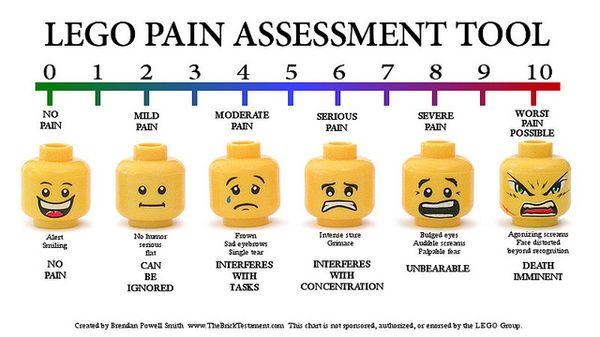
The truth about EGID is this:  It’s not just about the food allergies, that’s the easy bit to understand and, in many ways, the easiest bit to live with.  It’s about much, much more than that.  It’s about the unexplained joint aches, the never-ending tummy cramps, the relentless feelings of nausea or reflux whenever you eat. The dark shadows under the eyes, the manic mood swings, the overwhelming lethargy, or the inability to fall asleep and stay that way.  The damaged bowel, the fear of not being near enough to a toilet whenever you need one, or knowing that you’ll never get there in time anyway.  legoThe fear of your friends making fun of your allergies or finding out that you’re still wearing a pull-up because your bowel can’t be relied on when you most need it to.  The daily medicines, restricted diets and the feeding tubes. The chronic pain that can reduce you to tears, yet you don’t complain because nothing helps, even when it’s at its worst and you’re familiar with just about every pain chart created in the history of man.
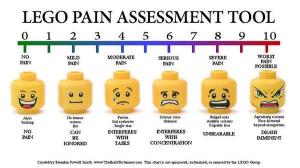
It’s about getting used to these things as being normal, or not even realising they’re not. 

And it affects the whole family, not just the one with the diagnosis.  The endless merry-go-round of numerous hospital appointments, medicines to be taken and food to be cooked safely, avoiding cross-contamination at all costs is exhausting.  The keeping of meticulous daily records of food eaten and symptoms experienced to try to find a link and make sense of what’s going on, and dealing with the self-recrimination when you miss a day out because what if that was the one that would give you more answers? Pictures July 06 030Day trips, meals out, holidays all require military precision to organise and every decision is coloured by whether needs can be met or not. The feelings of isolation, for parent and sibling alike, because it’s frequently the case that there is no-one else nearby who has the same experiences or can truly understand. The lack of any conversation that doesn’t revolve around toileting and being too worn out to come up with an alternative subject.  The sense that I, as the parent, know more about the intricacies of my son’s chronic illness than any medical professional we meet along the way and the frightening realisation that my children know infinitely more than them too.

It’s about the heartbreak of holding my sobbing child at 3am, tears streaming down my own cheeks as I struggle to find the words to bring the comfort that nothing else can bring at that moment in time.

At our recent admission at GOSH, one of the gastro consultants told me that it is widely recognised that children with gastro conditions have the worst quality of life of any child living with a chronic illness.  EGID is an invisible illness, one where the individual frequently learns to hide, disguise and survive their struggles and just carries on regardless, accepting this life as their norm.  Families supporting a loved one with EGID often feel isolated – not just from their circle of friends, but from the medical community, who know little about it and may question the integrity of the very people who are fighting to get the best care they possibly can.  It’s not a parental fad about food allergies or an over-anxious Mum fussing about the small things; and it’s definitely not a figment of anyone’s imagination.  The effects of EGID can be cruel to experience and devastating to see.  So a change in attitudes is not only important, but a necessity for all those living with this diagnosis.

Now you know a little more about EGID and just how it impacts, take some time to think about how you can support those you know living with this disease.  Don’t think that there’s nothing you can do to help.  An offer of a cup of tea once the school-run is over, a home-cooked meal for the parent not in hospital or checking to see if there’s anything they need from the shops is more than enough.  No gesture is too small: a smile, a text message or even a FB like or comment on Twitter will let that family know that they’re in your thoughts and that there is hope for change in the future.

United we stand

Yes, you guessed it, today is:

U for Unite-page0001

and signifies perhaps the hardest challenge we’ve taken on for EGID awareness week, ever. This week Mike and I are standing in solidarity with M and with all those other brave souls out there who have to battle with EGID every day and have no chance to opt out when things get tough. For the past 2 years, I’ve documented how we’ve followed M’s diet for the week, restricting our diets as he has to restrict his and even drinking the occasional glass of Neocate Active to get a glimpse into that aspect of his life.

IMG_0940When we first started planning our activities for this year’s awareness week, I briefly considered eating like M again, but dismissed it, thinking that the limitations of 3 ingredients and a litre of E028 on a daily basis might just prove to be too much for both Mike and me.  However, fast forward a few weeks to my preparations for my newspaper interview and I revisited the idea of “eating like M” and wondered if actually this might be something we could achieve.  I chatted it over with Mike, debated whether we could do it and, both being keen to give it a go, decided this would be our diet for the week.  Each day will be filled with 3 meals of rice, chicken and cucumber prepared in a variety of ways and Mike will even be drinking the litre of E028.  I have undertaken this with careful consideration of my own T1D and will be keeping an even tighter eye on my blood sugar management to make sure that I stay fit and healthy during the week.  I have also opted out of the E028, but will be partaking in a pint of Neocate Active everyday to show willing.

We’re not on our own either as there are other parents, family members and friends who will be spending some or all of this week eating like their loved ones. Trust me, it’s not an easy decision to make, but is a great way to raise awareness and get conversations started, which is reason enough to stick to it for a week. I am filled with admiration for just how well M has coped with such a bland diet for so long and have been struck with the harsh reality of how much pain he must have been in for years to be able to cope with these limitations just because it’s helping him feel better. Three_Musketeers_SwordsSo tomorrow when you’re tucking into your bowl of honey nut corn flakes or a bacon roll for breakfast, or sitting with your feet up dunking a chocolate biscuit into your cup of tea, or perhaps even enjoying a plate of fish and chips for tea, spare a thought for M and the others like him who are eating a restricted diet right now or may not be able to eat anything at all.  This week it really is a case of “All for one and one for all“.

Today’s blog post is brought to you by the letter…

D

imagesEver had that feeling that you’re appearing in an episode of Sesame Street?  Sadly my children have absolutely no idea what I’m talking about, observe my poor attempts at impressions of the Count (1…ah ah ah…2…ah ah ah…etc) or Cookie Monster (me want cookie!) with complete and utter disdain, and yet it reduces me to giggles each and every time.  I am, without a doubt, drifting into the realms of “embarrassing Mum” behaviour just in time for G to advance into her teenage crisis years.

But I digress; today’s letter, D, stands for Donate.

This week is primarily about raising awareness of EGID, rather than rattling our buckets asking for money, but the harsh reality for children and adults living with EGID is that there is little promise of finding improved treatments until further research into it is carried out.  At the moment in the UK, there are no research projects listed specifically for EGID and less than 1% of all medical research funding is allocated for gastro research.  Kate, over at The Recipe Resource, talks about the need for increased funding for specialised research, especially for medical research in children, in her recent blog post, “Why we need a culture shift on medical research in children – for Eosinophilic Awareness Week” and it’s definitely worth a read.

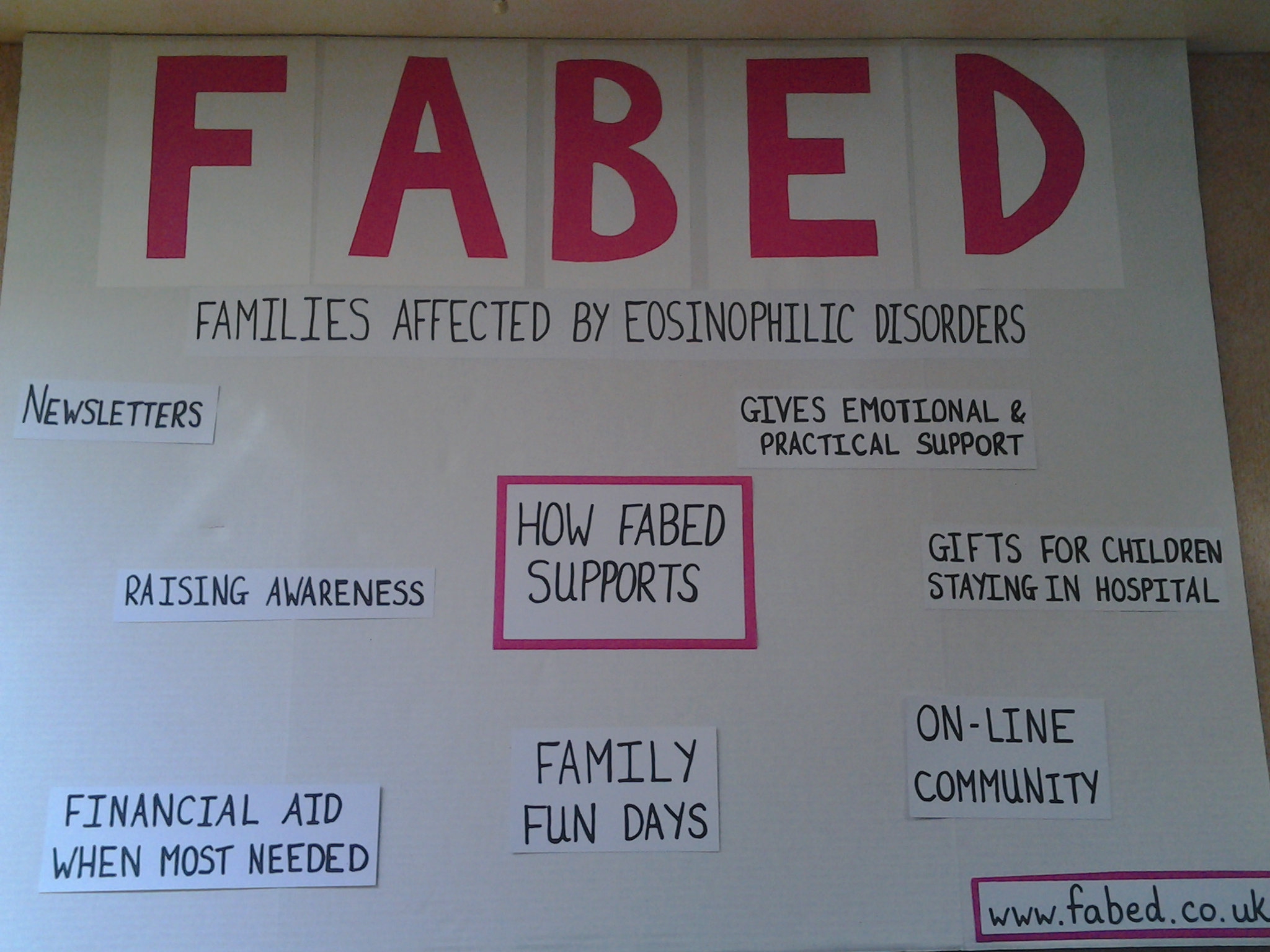
Don’t get me wrong.  I’m not expecting the money we donate to change the face of medical research just yet, that sort of change will have to happen at a much higher level than my meagre pounds can help me access.  However, where these donations can make a difference is to charities such as FABED, who really are small fish in the big pond of the charity world.  20150515_151847I’ve talked many times about how much support is given to individuals and families by FABED and the image opposite, which I also posted on yesterday’s blog post, shows just some of the many ways they support their members. We’ve benefitted from most of them.  Our amazing trip to Legoland 2 years ago was organised by FABED and gave Mike and I the opportunity to talk to other parents living with EGID: some who were further down the line in their journey and full of years of hard-earned expertise to share; and some even newer to it than us, who were overflowing with endless questions.  More importantly, it enabled M and G to meet other EGID children and their siblings. They could compare war wounds and stories; and both came away feeling less isolated in their struggles.

The on-line community is a veritable hive of activity and no question is too stupid or concern too small when it comes to these amazing people.  They have extensive knowledge and experience that they are more than willing to share, and when they don’t know the answers, will send a virtual hug to let you know you’re not on your own.  The support doesn’t stop there and this week members have also been sharing photos, images and videos with each other to help raise awareness for EGID.  The emotional and practical support offered has been a lifeline for us more than once and the emails, text messages and phone-calls received from FABED members when we’ve been going through tough times are worth far more than their weight in gold.  This is one such video, which proved to be all the inspiration M needed to finish his own:

So, what can you do today?

With the help of the fantastic choirs I sing with in our community’s Singing Project, we raised an amazing £180 at Saturday’s concert and if you’re able, any small donation you can give to FABED will make a massive difference and will be gratefully received.  I have set up a JustGiving page for this week and all money will be going to this cause.  You can access it by clicking on the image below:

Fabed needs you

And if you’re not able to help financially, that’s ok too.  Please just keep spreading the word and remember that every single person you tell about EGID is one more person who can help support people like M.

NEAW 2015 – E is for Educate

NEAW

It’s difficult to believe that National Eosinophil Awareness Week (NEAW) is once again with us and we have been, believe it or not, even busier this year than last in spreading our message about life with EGID.  I’m hoping to again post a blog a day to raise awareness and this year have decided to follow the theme of NEAW, which uses the word E-D-U-C-A-T-E to do it:

Today’s letter is E for Educate.

This year we have been focussing our energies on educating those around us and around M about EGID.

How? Well. in the last week I’ve been interviewed on our local BBC radio station, featured on the front page of our local newspaper and last night we had a display and raffle at a local choral concert. During the week ahead, M will be sharing his story at school via a PowerPoint presentation that he and G worked together to produce and later in the week, I’ll be sharing that video with you all.

stats

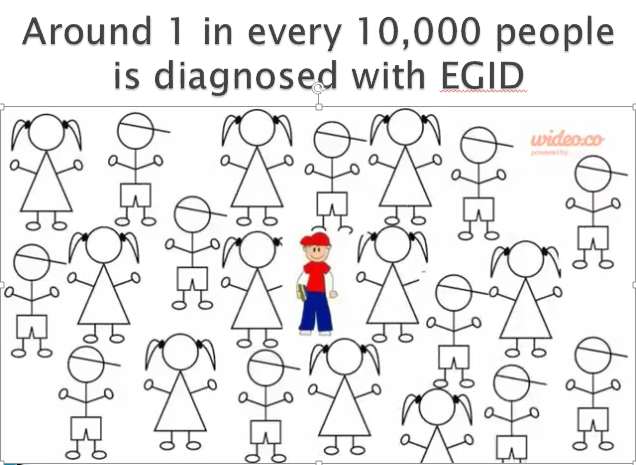
Why? Because awareness is key.  The more people who know about EGID and trust me, the number of medical professionals who have even a passing knowledge of this chronic illness is staggeringly low, let alone the general public, the greater awareness of it there will be, which in turn means better support for children and adults like M and families like ours.  Not only is there little understanding, but there is also an astonishing lack of funding for research into gastrointestinal disorders in the UK.  Without medical research, then it is highly unlikely that approaches to treatments will improve and nor, by default, will the quality of life for these individuals.

20150515_151932

What can you do? Re-read my explanation of EGID and then spread the word by talking to someone about EGID and explaining what it is.  You can share these blog posts this week and ask friends and family to share them on too. Keep an eye on my FB page and Twitter feed to see who else is sharing information for NEAW 2015.  Find out more about those charities supporting families living with EGID:  FABED in the UK, Apfed in the USA and AusEE in Australia. Change your FB or Twitter profile picture to one of those promoted by FABED or Apfed even for just one day.  Be more aware and know that by knowing something about EGID, you are helping support M and others like him.

20150515_151847