
The end of August always seems to be something of a surprise in our household. We arrive home from our holiday feeling relaxed and calm and then almost immediately face a madcap race to reach the finish line of shoes bought, uniform named, PE kits found and bags packed before school starts. In years past I have also had to make sure provisions are packed, discussions had and medical notes updated for M, but, for the first time ever, this year I wasn’t trying to squeeze in a critical meeting alongside my own new start with a new job. 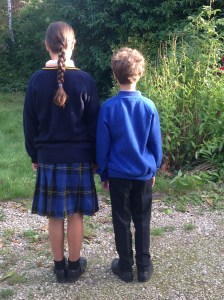 I know that next year when M moves up to our local secondary school it will be a very different picture, but after 3 years of working with the teaching community at our junior school, and with no major changes to contend with, M was able to start in Year 6 without this over-anxious Mum hovering in the background.
Without a doubt we have been incredibly lucky with the amazing support given by the fantastic teaching staff at our local school, but we have also had more than our fair share of bad experiences and teachers who don’t care in the past and I can well remember the anxieties and hours of meticulous planning that heralded the start of every new school year. The novelty of not having to head into the classroom before the end of M’s first week back has still not worn off and I’m certain that it’s thanks to the hard work that’s been put in on all sides to formulate strategies that meet M’s needs and to develop a strong working relationship between home and school that is reliant on open communication that flows both ways.
Over the last few weeks, there’s be a lot of chatter in the online allergy community about the fears that surround the milestone of starting school and, with over 8 years of “parenting-a-school-child-with-allergies” experience under my belt, I’ve been asked what tips I would give to any parent facing this situation for the first time. In all honesty, M’s first few years at school were difficult and certainly not the positive experience we would have liked. We had to deal with a SENCo, who trivialised his allergies because they “…wouldn’t have to call 999 if he ate something he shouldn’t…” and refused to recognise how important it was to communicate his allergies and health issues to any member of staff dealing with him and not just his class teacher, which led to numerous occasions of him being offered food he couldn’t eat. His teachers lost their focus in teaching him because they felt he already had a lot to cope with with his regular appointments at GOSH and his education suffered as speech impediments, dyslexia and dyspraxia were missed by those who worked with him on a day-to-day basis.
Fast-forward to the start of Year 3 and all our negative experiences became a thing of the past. The year actually began at the end of Year 2, when I met with the Head, SENCo and class teacher of his new school to discuss all of M’s health and educational needs and worked with them to put practical solutions into place before the term started. They understood the value of seeing him as more than just his EGID and food allergies,  but also knew that his health problems were a big part of his everyday life and couldn’t be ignored. At the end of his first week there, M’s teacher held a circle time in class where she shared about M’s ill-health and restricted diet with his classmates. It was done in such a nurturing and non-confrontational manner that by the end of the session M was willing to answer any question that his new friends had about what they had been told himself and has being doing so ever since.
 The information sheets that I had provided were given to the teachers and, combined with the notes they had taken whilst talking with me, used to draw up a healthcare plan for M that covered all possible situations. His on-going bowel control problems were sensitively handled and a contingency plan put in place to ensure that he always has access to a toilet wherever he is in the school. The HCP was written by the school SENCo and then sent home for my review before being published, shared with the whole teaching team and displayed prominently in the staff-room. Even better, every year since then I have been asked to review and amend his HCP to reflect any medical changes that have happened and the school continue to be sympathetic to his needs.
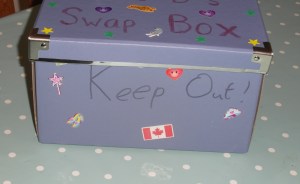 As for his swap box, it has proved to be an invaluable tool in the classroom setting and is something that is really easy to implement. The idea behind the swap box is a simple one – it contains a selection of safe items, be they edible or non-edible, that can be swapped for those unexpected treats that sometimes come into the classroom to celebrate birthdays or other special events. When M’s swap box came into being, it was filled with a mix of Haribo sweets and the odd Lego minifigure and the choice was his as to what he chose to take. Since going elemental 2 years ago, the box now contains Lego, trading cards and other fun small toys and ensures that M never feels that he is missing out when his friends celebrate. What’s more, his teachers have taken inspiration from it for their own purchases of small gifts at Christmas or the end of term and given him something he can enjoy.
I think the biggest secret to our great experience with our Junior school is communication. The lines of communication are always open and actively work in both directions between home and school through meetings, phone calls, e-mails and the home/school book. The willingness of so many of the school staff to learn to support M to the best of their ability has created a level of trust unlike any other and means that I am 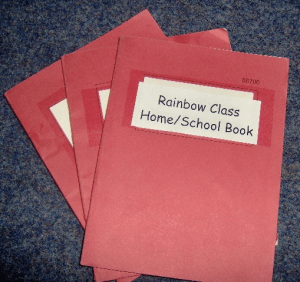 happy to leave M in their more than capable hands on a daily basis. It is a testament to their dedication to their work that, in the last 3 years, the only things that have caused an extended absence from school have been the annual hospital admissions at GOSH. They have always endeavoured to make sure that M is safe whilst at school and the fact that he was able to attend as normal with both his NG feeding tube and his broken leg is incredible. A truly remarkable relationship has grown over the years between our family and so many of the teachers and is something I really value.
They have also nurtured and encouraged M to talk about his allergies and EGID and have shown continued support as he has become an advocate for educating others about his illness. M has held cake sales, run playground games and created short films explaining the impact his diagnosis has on his life. He has developed a confidence in talking to others and 18 months ago was able to answer the questions asked by members of  every class in the school. When he left his Infants school, he was a child reluctant to talk about his food allergies or hospital appointments because he was scared of being isolated and bullied because of how different he was to everyone else. These days he has an incredibly strong friendship group who look out for him during school hours and think about him when he’s had to be in hospital, and he never thinks twice to share what’s going on with his friends.
If I had to sum it up, I guess I would say this:
Be open, be honest, be available. Keep communicating and tell them how they can make it better if you need to. Do what you can to help them out and don’t forget to say thank you when they get it right.
![IMG_0506[1]](https://7yearstodiagnosis.com/wp-content/uploads/2016/06/img_05061-e1465074621823.jpg?w=260&h=300) During that unexpected extra time, M had really made the effort to use his leg even more and became scarily fast and adept at using his crutches in every situation. The last week saw even more development as he more or less abandoned his crutches at home and finally started putting his full weight on his left leg. All this to ensure that that cast would well and truly be removed that afternoon and be needed no more.
During that unexpected extra time, M had really made the effort to use his leg even more and became scarily fast and adept at using his crutches in every situation. The last week saw even more development as he more or less abandoned his crutches at home and finally started putting his full weight on his left leg. All this to ensure that that cast would well and truly be removed that afternoon and be needed no more.![IMG_0777[1]](https://7yearstodiagnosis.com/wp-content/uploads/2016/07/img_07771-e1470003134182.jpg?w=300&h=120) M and I sat waiting for the orthopaedic consultant to look at his x-rays before giving us his opinion, so I tentatively peeled back the tubigrip stocking that had been the only barrier between his leg and the plaster for the last 3 months. His left leg was a little skinnier than his right, though not as much as we had feared it might be, but was also incredibly hairy, something we hadn’t anticipated at all. A little research told us that when a cast is in place for an extended period, it causes constant irritation of the skin and so the hair grows to form a protective layer between the skin and the plaster cast. It was a completely unexpected insight into what M might look like when he eventually hits those dreaded teen years and puberty – and he really wasn’t impressed! In stark contrast to his skinny, white and very hairy leg, M’s foot was almost orange in colour and as scaly as his
M and I sat waiting for the orthopaedic consultant to look at his x-rays before giving us his opinion, so I tentatively peeled back the tubigrip stocking that had been the only barrier between his leg and the plaster for the last 3 months. His left leg was a little skinnier than his right, though not as much as we had feared it might be, but was also incredibly hairy, something we hadn’t anticipated at all. A little research told us that when a cast is in place for an extended period, it causes constant irritation of the skin and so the hair grows to form a protective layer between the skin and the plaster cast. It was a completely unexpected insight into what M might look like when he eventually hits those dreaded teen years and puberty – and he really wasn’t impressed! In stark contrast to his skinny, white and very hairy leg, M’s foot was almost orange in colour and as scaly as his ![IMG_0783[1]](https://7yearstodiagnosis.com/wp-content/uploads/2016/07/img_07831.jpg?w=225&h=300) We were sent home with a walking boot and crutches to help ease him back into the routine of walking and exercising without his leg in a cast and within 3 weeks both had been abandoned to one side. We’ve been back for our final fracture clinic, where M was discharged with a clean bill of health and permission from the consultant to participate in as many of the activities as he wants at next week’s activity camp. Unbelievably there is no physiotherapy available for M through the NHS, but we have an excellent private physio in a nearby town and M will have a couple of sessions there to get him well on the road to recovery. He is having to learn to pace himself, something my hyperactive 10 year-old is not very good at doing, but the aching leg that results from a couple of hours running around our garden with G is a harsh reminder that his leg won’t just bounce back to where it was at the start of the year. It will take a few months to recover the strength, muscle tone and mobility that M is used to, but some hard work and focus will get him there in the end.
We were sent home with a walking boot and crutches to help ease him back into the routine of walking and exercising without his leg in a cast and within 3 weeks both had been abandoned to one side. We’ve been back for our final fracture clinic, where M was discharged with a clean bill of health and permission from the consultant to participate in as many of the activities as he wants at next week’s activity camp. Unbelievably there is no physiotherapy available for M through the NHS, but we have an excellent private physio in a nearby town and M will have a couple of sessions there to get him well on the road to recovery. He is having to learn to pace himself, something my hyperactive 10 year-old is not very good at doing, but the aching leg that results from a couple of hours running around our garden with G is a harsh reminder that his leg won’t just bounce back to where it was at the start of the year. It will take a few months to recover the strength, muscle tone and mobility that M is used to, but some hard work and focus will get him there in the end.![IMG_0617[1]](https://7yearstodiagnosis.com/wp-content/uploads/2016/06/img_06171-e1467302233284.jpg?w=225&h=300)
![IMG_0502[1]](https://7yearstodiagnosis.com/wp-content/uploads/2016/06/img_05021-e1465074582260.jpg?w=194&h=300) The preceding weeks had been busy with costume preparations and plans to pimp his wheelchair for the event and his decision to ask for a 70s themed cast at the previous fracture clinic meant that we were all set for the parade. Mike and I had also been roped in to help out for the day and I had even managed a few tweaks to our own clothes to make sure we were part of the 70s disco theme. All of the children were fantastic as they sang and danced their way towards the town’s football club and entertained the crowds, who joined in with the familiar moves of “Night Fever” and “Tragedy”. I was particularly proud of G, whose hard work and dedication to her dance saw her selected to be one of the 2 dance captains and she led the group with a flair and sense of fun that I rarely see from her when she’s performing. She really stepped up to the mark and the smile on her face showed just how much she enjoyed it.
The preceding weeks had been busy with costume preparations and plans to pimp his wheelchair for the event and his decision to ask for a 70s themed cast at the previous fracture clinic meant that we were all set for the parade. Mike and I had also been roped in to help out for the day and I had even managed a few tweaks to our own clothes to make sure we were part of the 70s disco theme. All of the children were fantastic as they sang and danced their way towards the town’s football club and entertained the crowds, who joined in with the familiar moves of “Night Fever” and “Tragedy”. I was particularly proud of G, whose hard work and dedication to her dance saw her selected to be one of the 2 dance captains and she led the group with a flair and sense of fun that I rarely see from her when she’s performing. She really stepped up to the mark and the smile on her face showed just how much she enjoyed it.![IMG_0850[1]](https://i0.wp.com/7yearstodiagnosis.com/wp-content/uploads/2016/07/img_08501-e1468346986785.jpg?w=229&h=587&ssl=1 "IMG_0850[1]")
![IMG_0844[1]](https://i0.wp.com/7yearstodiagnosis.com/wp-content/uploads/2016/07/img_084411-e1468346857806.jpg?w=388&h=333&ssl=1 "IMG_0844[1]")

![IMG_0308[1]](https://7yearstodiagnosis.com/wp-content/uploads/2016/04/img_03081-e1464812058488.jpg?w=300&h=139) With hopefully only another 2 weeks or so to go until the leg might finally reappear from underneath the protective plaster, I thought it about time I give you all a proper update.
With hopefully only another 2 weeks or so to go until the leg might finally reappear from underneath the protective plaster, I thought it about time I give you all a proper update. M’s leg was finished, rather than before, although that day’s orthopaedic technician did offer him the alternative of pink camouflage with sparkles whilst she was checking that stock levels were enough to cover his entire leg. 6 weeks later, and following regular fortnightly fracture clinic appointments with x-rays, the bone growth was considered enough to move M to a
 ![IMG_0479[1]](https://7yearstodiagnosis.com/wp-content/uploads/2016/06/img_04791.jpg?w=225&h=300) M requested a “70s Disco” theme for reasons that will later become clear, and believe me when I say that the bright orange and neon yellow stripes with added silver glitter certainly meets his somewhat unusual brief.
M requested a “70s Disco” theme for reasons that will later become clear, and believe me when I say that the bright orange and neon yellow stripes with added silver glitter certainly meets his somewhat unusual brief.![IMG_0439[1]](https://7yearstodiagnosis.com/wp-content/uploads/2016/06/img_04391-e1464811428943.jpg?w=226&h=300) He has not missed a single day of school due to his broken leg, other than for necessary appointments and that is due to the willingness of the Headteacher and his teaching team to accommodate M’s needs in a safe way and involve him in the classroom as best they can.
He has not missed a single day of school due to his broken leg, other than for necessary appointments and that is due to the willingness of the Headteacher and his teaching team to accommodate M’s needs in a safe way and involve him in the classroom as best they can.![IMG_0499[1]](https://7yearstodiagnosis.com/wp-content/uploads/2016/06/img_04991.jpg?w=225&h=300) Stagecoach school are performing a 70s tribute routine in a local carnival parade in the middle of June. He has once again been to every Stagecoach session this term, and so have I, and knows both the songs and the dance routine by heart, even though dancing it has been an impossibility. There is every chance that his cast may actually be off his leg by the time the parade happens, but we wanted to show wiling and be prepared “just in case”. Given the length of the parade route, M will unfortunately still be restricted to his wheelchair as his leg won’t be strong enough to walk its length, but we have some other suitably funky 70s ideas in mind to pimp both his costume and his wheelchair to fit the party vibe!
Stagecoach school are performing a 70s tribute routine in a local carnival parade in the middle of June. He has once again been to every Stagecoach session this term, and so have I, and knows both the songs and the dance routine by heart, even though dancing it has been an impossibility. There is every chance that his cast may actually be off his leg by the time the parade happens, but we wanted to show wiling and be prepared “just in case”. Given the length of the parade route, M will unfortunately still be restricted to his wheelchair as his leg won’t be strong enough to walk its length, but we have some other suitably funky 70s ideas in mind to pimp both his costume and his wheelchair to fit the party vibe! At the start of 2016, not long after we had returned home from M’s December admission, I spotted an opportunity for M and me to volunteer our time to be assessors for the annual
 ing us, just as if we were in the midst of another inspection. What’s more, as often comes of these things, some more opportunities for both children to be involved in an ongoing capacity with developments at GOSH came out of that day which is really exciting, but that, as they say, is another story.
![IMG_0391[1]](https://7yearstodiagnosis.com/wp-content/uploads/2016/05/img_03911.jpg?w=225&h=300) You might think that the possibility that a full leg cast would prevent regular bathing would bring joy to the heart of any small boy and, as far as my 10 year-old is concerned, you wouldn’t be far wrong. He spent the first night back at home pouring over the “How to look after your cast” leaflet that had been given to us on discharge and, having inwardly digested all the salient facts, made his opinions on the matter quite clear:
You might think that the possibility that a full leg cast would prevent regular bathing would bring joy to the heart of any small boy and, as far as my 10 year-old is concerned, you wouldn’t be far wrong. He spent the first night back at home pouring over the “How to look after your cast” leaflet that had been given to us on discharge and, having inwardly digested all the salient facts, made his opinions on the matter quite clear:
![IMG_0409[1]](https://7yearstodiagnosis.com/wp-content/uploads/2016/05/img_04091.jpg?w=225&h=300) What is even better is that the seal means that air is trapped around the leg and it becomes self-supporting, effectively allowing the leg to float in the water without any effort on the part of the child. That was the bit the M liked best!
What is even better is that the seal means that air is trapped around the leg and it becomes self-supporting, effectively allowing the leg to float in the water without any effort on the part of the child. That was the bit the M liked best! We’re halfway through the Easter school holidays and, with my Mum on her travels once again and me committed to work, Mike has taken some time off from his job to be on childcare duties for the duration.
![IMG_0301[1]](https://7yearstodiagnosis.com/wp-content/uploads/2016/04/img_03011-e1461243747370.jpg?w=187&h=300) With very little debate and a hurried phone-call to A&E, we were soon back in the car and heading to the hospital, this time determined not to leave without an x-ray. The nurse assessor admitted on the phone to Mike that she had been reflecting on M and regretting discharging him without an x-ray, so for once we were happy to be visiting our local A&E again.
With very little debate and a hurried phone-call to A&E, we were soon back in the car and heading to the hospital, this time determined not to leave without an x-ray. The nurse assessor admitted on the phone to Mike that she had been reflecting on M and regretting discharging him without an x-ray, so for once we were happy to be visiting our local A&E again.![IMG_0302[1]](https://7yearstodiagnosis.com/wp-content/uploads/2016/04/img_03021-e1461243806635.jpg?w=300&h=249) The next few weeks are going to be tough and not just because of his broken leg. M is going to have to find a fortitude he’s never had before as he misses out on a much longed-for dream because of it. He is extremely disappointed, but courageously trying to take it in his stride, with the smile on his face we all know and love. I can see the hurt deep in his eyes, but we will hope that something even better comes from this disaster. What saddens me even more is that he really has been the victim in this situation. His broken leg is not due to careless or reckless behaviour on his part, but down to the action of another child. A child who probably has no idea of the physical damage to M’s body, let alone the other far-reaching consequences of his violence towards my child. I’m still reeling from the shock that a child of a similar age could cause such injury; disturbed that a family could leave without checking on his well-being and left hoping that my children don’t lose their beautiful skill of making friends of strangers wherever they are, even though the consequences can unbelievably be so devastating. I fear that this incident will leave an emotional scar on them both that will take a long time to heal.
The next few weeks are going to be tough and not just because of his broken leg. M is going to have to find a fortitude he’s never had before as he misses out on a much longed-for dream because of it. He is extremely disappointed, but courageously trying to take it in his stride, with the smile on his face we all know and love. I can see the hurt deep in his eyes, but we will hope that something even better comes from this disaster. What saddens me even more is that he really has been the victim in this situation. His broken leg is not due to careless or reckless behaviour on his part, but down to the action of another child. A child who probably has no idea of the physical damage to M’s body, let alone the other far-reaching consequences of his violence towards my child. I’m still reeling from the shock that a child of a similar age could cause such injury; disturbed that a family could leave without checking on his well-being and left hoping that my children don’t lose their beautiful skill of making friends of strangers wherever they are, even though the consequences can unbelievably be so devastating. I fear that this incident will leave an emotional scar on them both that will take a long time to heal. 7 years to diagnosis