Category Archives: Chronic Illness

United we stand

Yes, you guessed it, today is:

U for Unite-page0001

and signifies perhaps the hardest challenge we’ve taken on for EGID awareness week, ever. This week Mike and I are standing in solidarity with M and with all those other brave souls out there who have to battle with EGID every day and have no chance to opt out when things get tough. For the past 2 years, I’ve documented how we’ve followed M’s diet for the week, restricting our diets as he has to restrict his and even drinking the occasional glass of Neocate Active to get a glimpse into that aspect of his life.

IMG_0940When we first started planning our activities for this year’s awareness week, I briefly considered eating like M again, but dismissed it, thinking that the limitations of 3 ingredients and a litre of E028 on a daily basis might just prove to be too much for both Mike and me.  However, fast forward a few weeks to my preparations for my newspaper interview and I revisited the idea of “eating like M” and wondered if actually this might be something we could achieve.  I chatted it over with Mike, debated whether we could do it and, both being keen to give it a go, decided this would be our diet for the week.  Each day will be filled with 3 meals of rice, chicken and cucumber prepared in a variety of ways and Mike will even be drinking the litre of E028.  I have undertaken this with careful consideration of my own T1D and will be keeping an even tighter eye on my blood sugar management to make sure that I stay fit and healthy during the week.  I have also opted out of the E028, but will be partaking in a pint of Neocate Active everyday to show willing.

We’re not on our own either as there are other parents, family members and friends who will be spending some or all of this week eating like their loved ones. Trust me, it’s not an easy decision to make, but is a great way to raise awareness and get conversations started, which is reason enough to stick to it for a week. I am filled with admiration for just how well M has coped with such a bland diet for so long and have been struck with the harsh reality of how much pain he must have been in for years to be able to cope with these limitations just because it’s helping him feel better. Three_Musketeers_SwordsSo tomorrow when you’re tucking into your bowl of honey nut corn flakes or a bacon roll for breakfast, or sitting with your feet up dunking a chocolate biscuit into your cup of tea, or perhaps even enjoying a plate of fish and chips for tea, spare a thought for M and the others like him who are eating a restricted diet right now or may not be able to eat anything at all.  This week it really is a case of “All for one and one for all“.

Today’s blog post is brought to you by the letter…

D

imagesEver had that feeling that you’re appearing in an episode of Sesame Street?  Sadly my children have absolutely no idea what I’m talking about, observe my poor attempts at impressions of the Count (1…ah ah ah…2…ah ah ah…etc) or Cookie Monster (me want cookie!) with complete and utter disdain, and yet it reduces me to giggles each and every time.  I am, without a doubt, drifting into the realms of “embarrassing Mum” behaviour just in time for G to advance into her teenage crisis years.

But I digress; today’s letter, D, stands for Donate.

This week is primarily about raising awareness of EGID, rather than rattling our buckets asking for money, but the harsh reality for children and adults living with EGID is that there is little promise of finding improved treatments until further research into it is carried out.  At the moment in the UK, there are no research projects listed specifically for EGID and less than 1% of all medical research funding is allocated for gastro research.  Kate, over at The Recipe Resource, talks about the need for increased funding for specialised research, especially for medical research in children, in her recent blog post, “Why we need a culture shift on medical research in children – for Eosinophilic Awareness Week” and it’s definitely worth a read.

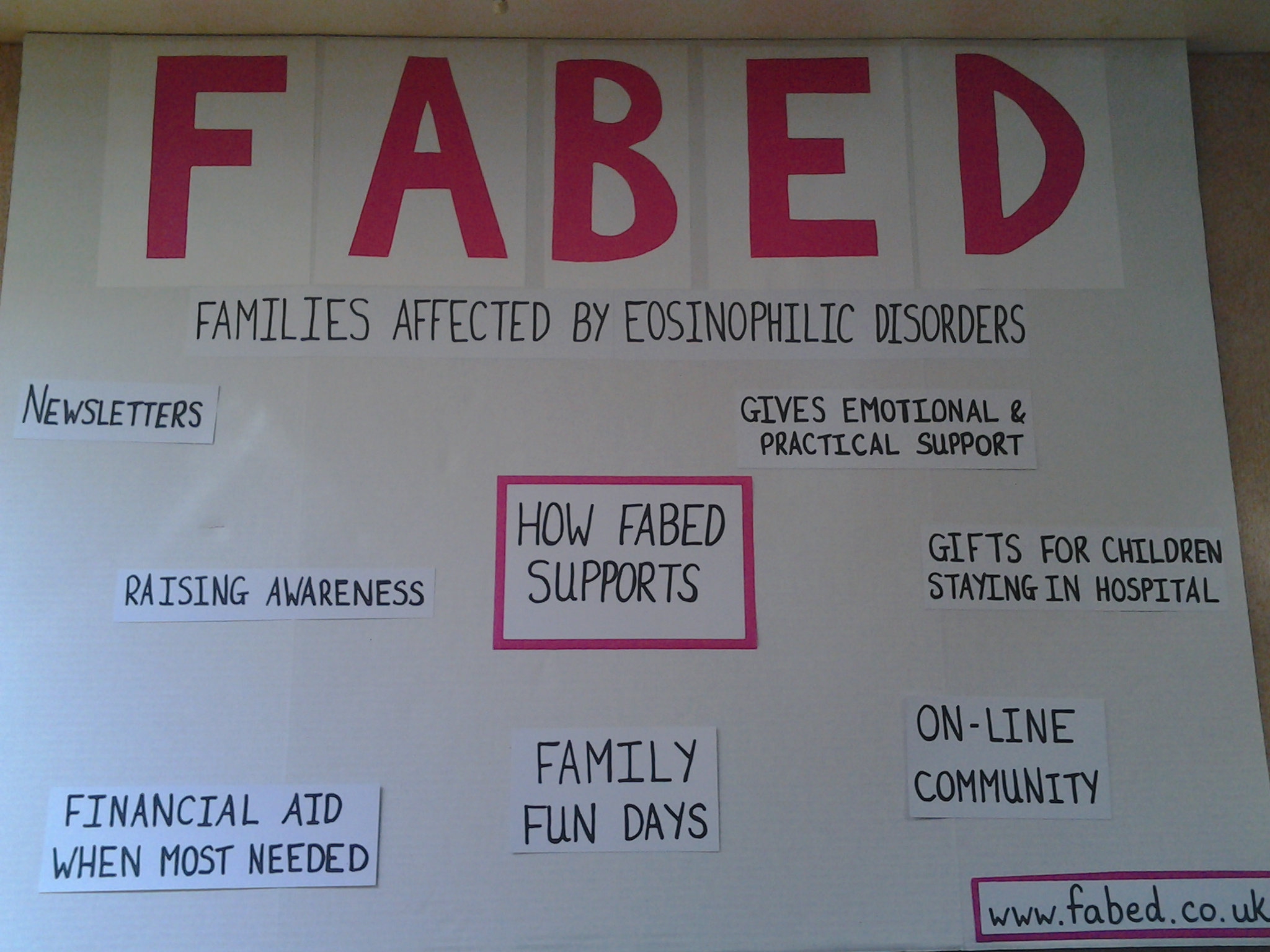
Don’t get me wrong.  I’m not expecting the money we donate to change the face of medical research just yet, that sort of change will have to happen at a much higher level than my meagre pounds can help me access.  However, where these donations can make a difference is to charities such as FABED, who really are small fish in the big pond of the charity world.  20150515_151847I’ve talked many times about how much support is given to individuals and families by FABED and the image opposite, which I also posted on yesterday’s blog post, shows just some of the many ways they support their members. We’ve benefitted from most of them.  Our amazing trip to Legoland 2 years ago was organised by FABED and gave Mike and I the opportunity to talk to other parents living with EGID: some who were further down the line in their journey and full of years of hard-earned expertise to share; and some even newer to it than us, who were overflowing with endless questions.  More importantly, it enabled M and G to meet other EGID children and their siblings. They could compare war wounds and stories; and both came away feeling less isolated in their struggles.

The on-line community is a veritable hive of activity and no question is too stupid or concern too small when it comes to these amazing people.  They have extensive knowledge and experience that they are more than willing to share, and when they don’t know the answers, will send a virtual hug to let you know you’re not on your own.  The support doesn’t stop there and this week members have also been sharing photos, images and videos with each other to help raise awareness for EGID.  The emotional and practical support offered has been a lifeline for us more than once and the emails, text messages and phone-calls received from FABED members when we’ve been going through tough times are worth far more than their weight in gold.  This is one such video, which proved to be all the inspiration M needed to finish his own:

So, what can you do today?

With the help of the fantastic choirs I sing with in our community’s Singing Project, we raised an amazing £180 at Saturday’s concert and if you’re able, any small donation you can give to FABED will make a massive difference and will be gratefully received.  I have set up a JustGiving page for this week and all money will be going to this cause.  You can access it by clicking on the image below:

Fabed needs you

And if you’re not able to help financially, that’s ok too.  Please just keep spreading the word and remember that every single person you tell about EGID is one more person who can help support people like M.

NEAW 2015 – E is for Educate

NEAW

It’s difficult to believe that National Eosinophil Awareness Week (NEAW) is once again with us and we have been, believe it or not, even busier this year than last in spreading our message about life with EGID.  I’m hoping to again post a blog a day to raise awareness and this year have decided to follow the theme of NEAW, which uses the word E-D-U-C-A-T-E to do it:

Today’s letter is E for Educate.

This year we have been focussing our energies on educating those around us and around M about EGID.

How? Well. in the last week I’ve been interviewed on our local BBC radio station, featured on the front page of our local newspaper and last night we had a display and raffle at a local choral concert. During the week ahead, M will be sharing his story at school via a PowerPoint presentation that he and G worked together to produce and later in the week, I’ll be sharing that video with you all.

stats

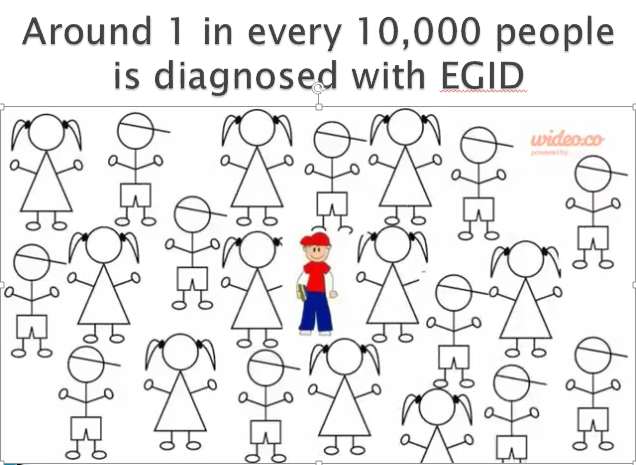
Why? Because awareness is key.  The more people who know about EGID and trust me, the number of medical professionals who have even a passing knowledge of this chronic illness is staggeringly low, let alone the general public, the greater awareness of it there will be, which in turn means better support for children and adults like M and families like ours.  Not only is there little understanding, but there is also an astonishing lack of funding for research into gastrointestinal disorders in the UK.  Without medical research, then it is highly unlikely that approaches to treatments will improve and nor, by default, will the quality of life for these individuals.

20150515_151932

What can you do? Re-read my explanation of EGID and then spread the word by talking to someone about EGID and explaining what it is.  You can share these blog posts this week and ask friends and family to share them on too. Keep an eye on my FB page and Twitter feed to see who else is sharing information for NEAW 2015.  Find out more about those charities supporting families living with EGID:  FABED in the UK, Apfed in the USA and AusEE in Australia. Change your FB or Twitter profile picture to one of those promoted by FABED or Apfed even for just one day.  Be more aware and know that by knowing something about EGID, you are helping support M and others like him.

20150515_151847

#Changes – Diabetes Blog week 2015

Sadly this week, time just hasn’t stretched enough to allow a blog a day for Diabetes Blog week 2015. The scant 24 hours in the average day mean that I barely have enough time for everything I normally need to do, and this week in particular has been manic as the excitement revs up for next week’s #NationalEosinophilAwarenessWeek.  I have grabbed 5 minutes here and there during coffee breaks and lunch-times to read what other dia-bloggers have had to say on the subjects of “Keeping it to yourself” and “Cleaning it out” and I’d heartily recommend a visit to Bittersweetdiabetes to peruse these thoughts for yourself as they really are worth a read.  However, today’s topic of #Changes struck a chord, not least because we’re about to embark on our own battle to change the awareness of another invisible illness, EGID and I wanted to blog my thoughts today.

Courtesy of youmatterlifeline.tumblr.com

Courtesy of youmatterlifeline.tumblr.com

The past 3 decades of life with T1D have seen a metamorphosis in my attitude to it:  I coped at the start; rebelled in my teens; became resigned to it during my 20s and in my 30s I have learned to embrace the lessons it has taught me and have relegated any other emotions to the back of the metaphorical cupboard of my mind.  As the next decade of my life comes ever closer, I’ve no doubt that attitudes will continue to change and that is something I look forward to embracing in a way that I now find myself able to do like never before.  The daily blood tests and injections are second nature to me and it’s not until I feel the curious gaze of strangers as I push the syringe needle into my leg/arm/tummy* (*delete as appropriate) during a coffee break with G at Costa or dinner out with the family, that I’m reminded that it probably isn’t a sight that most people see on a daily basis.  It has become, by necessity, an integral part of me and I am as oblivious to it as I now am to the tube that is stuck to the side of M’s face.

T1D is my partner for life and I’m okay with that.  All of the dramas and rollercoaster emotions I have experienced along the way have given me the huge advantage of immense insight and understanding of the frustrations of my own pair of mini superheroes, M and G.  When M has been sobbing on the floor because of a profound sense of despair and a feeling of hopelessness, I can honestly tell him that I know how it feels because I’ve been there and battled those demons myself.  I can empathise with G’s struggles with her own restricted diet and the temptation to cheat because I’ve done it and ended up in hospital as a result. I know that sense of isolation that overwhelms because it seems as if there’s nobody else nearby who’s going through what I’m going through in the here and now, and I know that however dark it might feel right now, there really is light at the end of that very long tunnel.

My parents were huge advocates for research into Juvenile diabetes and were involved for years in fund-raising, awareness events and medical research into T1D. A few months ago, I was talking to the Dad of M’s friend F, who has T1D, on the subject of the current developments being made in diabetes research and the search for a cure.  I am genuinely excited about the prospects of a major break-through that might see a more permanent cure becoming available, but found myself honestly admitting that, whilst I am excited for what that would mean for F, for J (another T1D friend of M’s) and for Pumplette, I am no longer concerned about the implications for me.  My focus has shifted and I have a new battle to fight – as an advocate for my son and his challenging life with EGID.  That, I believe, is the change of becoming a parent and just as my own parents worked tirelessly to support me through life with T1D, I found I have learned well from them and am hopefully just as dedicated to supporting M and G as they find their feet in the world of chronic illness.

Courtesy of ec.europa.eu

Courtesy of ec.europa.eu

That’s my change, but there is another change that I feel is very much worth fighting for: a change to the understanding of T1D which is so sadly lacking in the public eye.  Mike is well-used to hearing me shout in outrage at the television or radio whenever some well-meaning, but inadequately informed journalist or personality talks broad-brushstroke about “diabetes” and dumps those of us living with the epic failure of our pancreas to do the job it was designed to do in the same boat as those who have made lifestyle choices that have led to T2D.  Both are difficult to live with, of that there is no doubt, but the lack of clarity about the differences between the 2 conditions can be devastating for all concerned.

I did not choose to live my life accompanied by T1D, just as my parents did not choose for me to become so ill that living past my 9th birthday looked touch and go for a few dark hours all those years ago.  There are choices about my T1D management that I would change with the benefit of hindsight and I would rather have not even had to make those decisions, not just in the first place, but ever; and yet T1D arrived uninvited on our doorstep and we had no choice but to accept it, learn to tame it and eventually become comfortable with its presence in my life.  There is no reason, in this day and age, for there still to be so little understanding of the differences between the 2 types, nor so little regard for how this lack of distinction can impact young lives.  It is only when real change happens, when education improves so profoundly that there is proper understanding about what T1D is and why it happens, that those of us with it can sit back and breathe a little, knowing that that’s one less battle to be fought and that we can expend our energy on the important things in life, like continually working on preserving the best health we can, both physically and mentally.

Courtesy of annaraeburn.com

Courtesy of annaraeburn.com

Even more importantly for me, such a massive turnaround in the portrayal of diabetes in the media will signal a promise for things to improve for M too.  After all, if this is the state of affairs for a well-known condition such as T1D, then what hope is there for those of us battling to promote better understanding of the unknown ones such as EGID?

#ICan – Diabetes Blog week

This week is Diabetes Blog Week and a chance to take some time out from the unending whirlwind that is life with M and instead focus my attention on the story that is my very own journey with T1D.  Today’s title is #ICan and, taking inspiration from lifelong friend and fellow blogger, The Understudy Pancreas, I thought I’d take a quick look at some of the #ICan moments from the past 29 years:

  • teenSurvived the trauma of teenage rebellion (and my parents did too!) against my T1D, even though I suspect my parents wondered if the end was ever going to be in sight; and have learned that that experience has now given me a unique perspective on how M feels about his own chronic illness;
  • uniDidn’t think twice about going away to University and learned that I could manage on my own, though there might have been a few lessons along the way about managing things well;
  • Travelled abroad with school and university several times and not only survived to tell the tale, but thoroughly enjoyed every moment spent with good friends and experiencing new cultures, blissfully ignorant of any worries that my parents and teachers undoubtedly had;travel2
  • Continued that travelling in my 20s and 30s, accompanied by ample supplies of insulin, needles and blood-testing equipment and the requisite letter from my GP stating why I needed to carry all this kit.  Mike and I have been lucky to be able to visit China, Hong Kong, Thailand and Australia as well as Canada, USA and throughout Europe. I’ve walked along part of the Great Wall, seen Shakespeare at the Sydney Opera House and walked behind Niagara Falls, and my T1D hasn’t stopped me doing any of them;
  • pictures-july-06-009Had 2 successful pregnancies and brought 2 gorgeous children into the world, having found that giving them the best start I could was all the motivation needed to have tight control of my T1D during those critical 9 months;
  • Do anything I set my mind to – with the small exceptions of flying an airplane or donating blood as my T1D makes me persona non grata as far as those things are concerned;
  • Survive whatever life throws me – believe me there’s been a lot – and, what’s more, survive it with a smile on my face and a steadfast determination to keep going along the path I’m following.

And the most important thing of all: that T1D does not define who I am, though it has unquestionably shaped my attitude and approach to life.  This is something that I hope I’ve instilled in both G and M and #ICan and I will continue to show them, as best I’m able, that chronic illness is only a very tiny part of the amazing people they are growing up to be.

Working hard to keep the magic alive

Working hard to keep the magic alive

You can read more from other T1D bloggers around the world, including:

The Understudy Pancreas:  “Diabetes Blog Week 2015 – Day 1 #ICan

Diabetogenic: “I think I can, I think I can, I think I can

six until me: “Diabetes Blog Week: I can.

Type ONEderful: “2015 Diabetes blog week Day 1 – I can

“So much time…

...and so little to do. Wait a minute. Strike that. Reverse it…”

                                                          – Willy Wonka, “Charlie and the Chocolate Factory” (Roald Dahl)

This past week has been busy and there’s still lots more to do, not least of which is a proper blog post.  However, the reality that is choir rehearsals,..SATS revision,..sunflower growing,..Anglo-Saxon house building,..SATS revision,..CAMHS appointments,..food-trialling,..SATS revision and May Bank holiday trips to Legoland Windsor for “Star Wars Day” as well as time spent prepping for EGID awareness week with Powerpoint presentations to perfect and conversations with local media to be had, means that this week’s posts have gone by the wayside, so instead here’s a small photo round-up to give you a taster of all the fun we’re having:

“Elementa(l)ry, my dear Watson”

(with profuse apologies to all Holmes fans out there, but I just couldn’t resist!)

As we head into our 5th month of E028, the positive impact of the elemental diet on M is plain to see.  Family, friends and even casual acquaintances have commented on his improved health, behaviour, appearance and overall much happier demeanour.  We have seen glimpses of the happy-go-lucky, confident and outgoing child he can be when constant pain is not plaguing him and we have celebrated that success with him.  We’ve even embraced the somewhat daunting prospect of food trials despite the lack of useful advice we were originally given and have ploughed on regardless, surviving the highs and lows of this latest rollercoaster ride. Believe me, there have been plenty of both.

The highs have been encouraging; 

highsWe have successfully reintroduced rice, chicken and cucumber to his diet and he’s loving being able to eat something solid once again.  I’ve adapted, tweaked and sometimes created from scratch recipes to give him a range of meals that make meal-times more exciting than just plain boiled rice, grilled chicken and a few slices of cucumber 3 times a day.  We’ve even found a new favourite in rice noodles, something he would never eat when he was small and, thanks to the advice of 1 kind reader, I have even managed to lay my hands on a bag of the elusive rice pasta and he’s enjoying the variety to his diet.  The bonus of finding some amazing allergy-friendly restaurants earlier this month was a real boost and will make a big difference to us all.

M has stayed positive and has very much been involved in making the decisions about what foods he trials next.  We are working closely with our GOSH dietitian to choose our hit-list of foods in a balanced manner and I speak to her every 2 or 3 weeks to provide an update on our progress.  Even better, she is constantly contactable via e-mail, which has given me huge peace of mind as I know I can ask her any questions I might have and she will always come back to me by either phone or email, even if it’s just to say she’s looking into it and will let me know.  We’re once more on a small break, but are looking forward to attempting carrot, corn and apple over the coming few weeks.

And the lows have been exhausting.

exhaustionmanageI never realised just how exhausting the process of food challenges would be and that’s on all levels: physical, mental and emotional.  Each new food starts with the excitement and hope that it will be a safe food for M and managing expectations has become key.  It feels easy at the moment to be downhearted as we have had 4 fails – pineapple, pork, sweet potato and banana – and a question-mark over the 5th – salmon; but it’s critical we stay positive as there are an awful lot more foods for M to try, and every success brings with it many more options for meals.  Unfortunately, every fail leads to disappointment and discouragement and we have to pick ourselves up, brush ourselves off and look forward to the next one as best we can.

The need to be constantly alert to the risks of cross-contamination during food prep, as well as ever-vigilant about rogue additions to lists of ingredients and being constantly alert to any signs of a reaction in M, requires a stamina I didn’t know I had.  That is something I’m sometimes finding it hard to hang on to.  Whilst we are almost desperate to successfully introduce another ingredient to our meagre list, it’s become clear that we have to do it at a pace that suits M’s pernickety digestive system, and that seems to be a very slow rate indeed.

SHERLOCK_HOLMES_-_01-743978However, despite the exhaustion and the blood, sweat and tears shed in the name of finding another safe food, the future is looking bright and M’s better health gives us all a reason to keep going, even when it seems tough.  To have him in the best health we’ve known for 9 years means that our decision to go elemental really was…well…”elementary, my dear Watson.”

London: our whistle-stop tour

With our appointment at GOSH over, we then focussed our attention on the activities we’d chosen for the rest of our London stay.  We had narrowed down our choices from the lengthy starting point created by G and M and suggested that each child chose 1 activity each that they really wanted to do on this trip: be that museum, park, art gallery or tourist attraction.  G quickly settled on the Imperial War Museum, M picked the London Eye and Mike and I agreed on booking tickets for a show as well as attempting to complete the amazing “Shaun in the City” sculpture trail.  It was, without question, an ambitious plan, but with some careful planning and the agreement of both children that the amount of walking required would far outweigh the maximum moaning I was prepared to accept, I was confident we might just be able to squeeze it all in.

Imperial War Museum

imperial-war-museum-aburtThis has been on our “hit list” for quite some time, but our previous 2 attempts to visit had both been scuppered by an extended closure to prepare the exhibits marking the centenary of the start of WWI last year.  With nothing to stop our visit this time, we travelled across London via tube and finally convinced our pair to head inside after the requisite hundreds tens of photos had been taken of the impressive naval guns at the front entrance.  G was keen to work her way through the WWI exhibits, whilst M had a yearning for learning more about being a spy and Mike was intent on seeing the Holocaust display.  I had allowed a full day for our visit and we certainly needed it.  There was an incredible mix of posters, photos, short films, interactive displays, war memorabilia and oodles of facts to work our way through and the children were able to dip in and out of the information as they wanted.  We lasted until mid-afternoon before G and M started to flag, interest was lost and we made our way back to the apartment for a little downtime before we headed out for dinner.

The Railway Children – near Waterloo Station

rcIn the run up to our visit, M had spotted an advert for “The Railway Children” and was keen to see the show.  As this was a perfect opportunity to watch a play, rather than the musicals or pantomimes we usually attend, we agreed to get some tickets and had great seats near to the front of the seating area.  M and G loved that the characters came out to talk to the audience before the play started and were enthralled throughout.  I won’t spoil the experience – but it does include a real steam train and the most amazing staging I’ve seen in a long time – and would definitely recommend going to see this fabulous classic if you have the chance.

London Eye

IMG_0746This has quickly become an instantly recognisable icon on the London skyline and is actually something the family has done before.  Every time we head to GOSH for an appointment, M begs for a trip on the Eye and every time I say no, not least because it’s actually nowhere near the hospital and our regular visits are almost always somewhat tight on time.  Having given them free rein to choose one thing they each really wanted to do, it was no surprise that this was M’s selection.  The 30-minute revolution offers spectacular views across London and both children were fascinated with trying to pick out various buildings they knew from the pod.  I was also impressed with the thoughtfulness of the member of staff directing people into the waiting lines.  You can easily end up queuing for around 20-30 minutes, which is never ideal when you have children in tow and definitely not when one of them is sporting a litre feeding bottle and pump on his back.  This lovely lady spotted us in the queue with M and invited us to enter via the fast-track system instead, stating it was “.,just too chilly..” to be standing around waiting.  Of course we all realised that M and his tube were the real reason behind her kind offer, but appreciated her not making a fuss about it and simply offering us an alternative that would make life a lot easier and our experience a lot more fun.

Shaun in the City sculpture trail

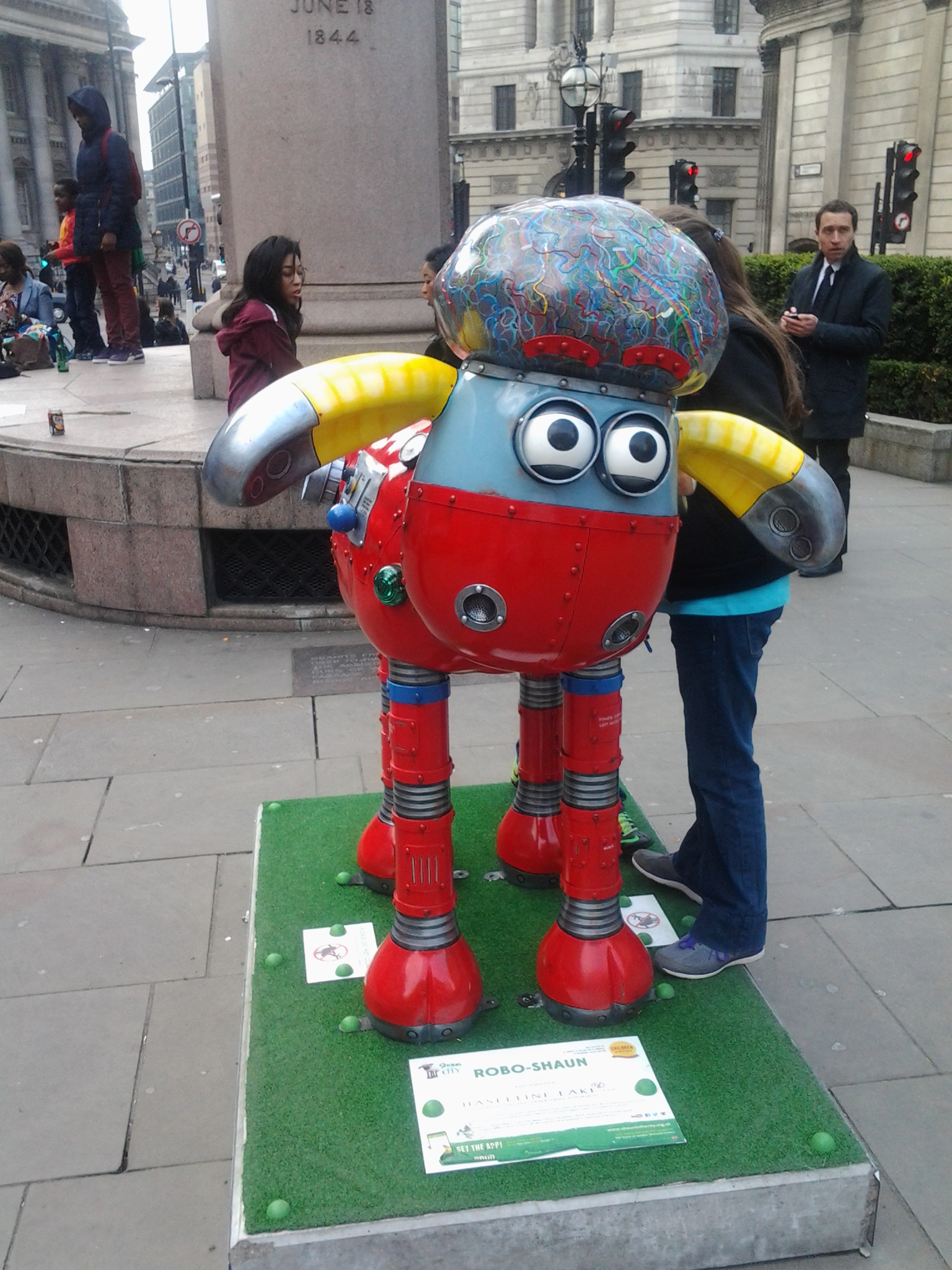
Just one of the many Shauns we found

Just one of the many Shauns we found

Yet another sculpture trail to echo a multitude that have been seen across the UK over the past few years, including the Paddington Bear one we dipped into whilst visiting the poppies at the Tower of London last November.  This year’s trail was based on Nick Park’s popular character, “Shaun the Sheep” and featured 50 sculptures, each individually decorated by a host of celebrities, found at strategic locations around the capital.  The sculptures were split into 5 groups – 4 distinct trails and then 5 “lost sheep”, who were not particularly close to any of the other ones – and most were close enough together to allow us to attempt to find nearly 40 of them in one day.  G and M’s aim was to find and be photographed with all 50 before our trip was over and we managed it, though with very little time to spare before we needed to catch our train home.  These London sculptures are only in place until 25th May and then there will be 70 Bristol counterparts during July and August.  Later in 2015, all 120 will be auctioned to raise much-needed funds for children’s hospitals across the UK through Wallace and Gromit’s Children’s charity.  We loved following the map before finding ourselves in parts of London we wouldn’t normally visit and there’s a real camaraderie between fellow Shaun-spotters you come across along the way.  You can find out more about the “Shaun in the City” trail here.

Stomp – Ambassadors Theatre

Our final treat was unplanned, but was definitely a winner.  Every time we travel up, or down, the escalators at tube stations, G and M love to look at the advertising posters that adorn the walls.  If you ever hear cries of “Seen that one…and that one…but we haven’t seen that,..yet!“, then it’s a fairly safe bet that we are somewhere in the vicinity.  Stomp is one of those productions that they’ve been longing to see for quite some time, but we’ve been reluctant to go because G, in particular, doesn’t cope well with loud noises.  Our search for Shaun led us into Leicester Square and the hordes of theatre ticket booths that can be found there.  For those not in the know, these sell last-minute tickets for many of the numerous shows being performed in London at any given time and often represent great value for money due to the discounts they give.  We decided to see if we could get some discounted seats for Stomp and were delighted to have the choice of 4 prime seats on the second row of the circle.  The children were a little shocked to learn that there was no interval in the performance, but were even more surprised at how quickly that 1.5 hours passed notably as they were left wanting more.  The skill of the performers is phenomenal, especially when you realise that you hear no words and no music for the duration of the show, but are totally absorbed by the percussive masterpieces they produce.  Another fantastic show that we’d highly recommend.

We even managed a trek across Tower Bridge on our travels

We even managed a trek across Tower Bridge on our travels

So, it was definitely something of a whistle-stop tour of the capital for us this April, but a great break that we won’t forget for a while.

Because #livinginfear is not *just* about the allergies

I wrote yesterday about the #livinginfear campaign and started thinking about what that really means to me.  I quickly realised that #livinginfear is not what I want for M or, indeed, for G.  It is so important that they are both aware of their allergies and that M, in particular, could suffer adverse reactions to the foods he eats.  They must take on responsibility for their own health when away from home and have an understanding about what they eat and what they have to avoid.  They need to know how to deal with mild reactions and how to communicate their needs to the people around them, especially when in new situations, or when Mike and I are not there to speak up on their behalf.  After our experience with the sweet potato trials, they now know that there could be other, more serious reactions that M’s not experienced before and that they could be frightening.  Most critically, I need to teach them how to respond calmly should those reactions occur.

dsc02717However, the most important thing is this: that my children are still children and whilst living with a chronic illness has forced them both to grow up a little faster than their friends and peers, I don’t want them shouldering adult worries or concerns, or feeling weighed down with fears that may never be realised.  Until the point when they reach their majority, I want my children to laugh, play and simply live each day as children, trusting that Mike and I will always be there supporting them, ready to catch them when they fall.

The truth about #livinginfear for us is that it is my burden to bear and is about more that just the potential for serious allergic reactions.  My fear is not even about M possibly suffering from anaphylaxis one day as, although the prospect of facing that is daunting, I trust that my parental instincts and ability to stay calm under pressure would get me through that most difficult of experiences.

No, that weekend highlighted for me what my true and biggest fear about his allergies and his health really is:  that I will not be believed…that I will become “that” parent…and that the health professionals involved in my child’s care will doubt what I say, thinking I’m causing a fuss about something that is simply not true.  The years spent chasing a diagnosis despite everything the doctors were telling us have taken their toll on my self-belief.  I second guess myself at every turn.  I discuss and dissect and deliberate my every waking thought about M with Mike to check that I’m not going mad, that he, at least, understands where I’m coming from and that I’m not being unreasonable or over-reacting to the situation.

Nothing demonstrates that self-doubt more than the fact that I insisted we tried M on the sweet potato again the following day when Mike was there, just so he could see the reaction for himself and confirm that what I had seen, and M had experienced, was true.  Despite my natural concerns that it could have been an anaphylactic reaction, I needed Mike to be an eye-witness to it too and I had our back-up plans in place, just in case his response was even worse that time round (fortunately it wasn’t).  I didn’t want to put M through the terror and pain of the reaction again, what parent would, but I needed to be certain that I hadn’t imagined it to be more extreme than it actually was.

I know that my confidence has been shattered by the very people who should have been supporting me and my family every step along the way – the medical professionals we’ve encountered on our journey.  I am no longer comfortable in trusting my gut instincts about M’s health, even though I have been proved right time after time after time; and that’s simply not acceptable.

willowtreeBeing a parent is a hard enough job when you have a happy, healthy child – there are no superheroes living in secret in my local community as far as I’m aware; but the burden quickly becomes overwhelming once you throw a chronic illness into the mix.  I find myself not always being able to state my case clearly or argue M’s corner when it matters most and I lie awake worrying in the middle of the night that the treatment I’ve demanded may not be the best course of action, or whether there was anything I forgot to mention at the most recent appointment.  I know myself to be a strong, intelligent woman and yet I find myself being instantly returned to my school days, with all the mixed emotions of being sent to see the Headmaster, the minute I find myself facing a consultant.

And I worry that G is getting lost in the chaos that is hospital stays and food allergies and medicines and diagnostic tests and the relentless need to monitor, record and report everything.  As she approaches her SATs and the prospect of moving up to “big” school looms ever nearer, my firstborn is growing up fast and I wonder how our relationship will survive the inevitable traumas of her teenage years when my focus so often has to be on her younger brother. Time together is rare and incredibly precious and something we both need and enjoy because I’m fully aware that I’m not necessarily getting this parenting thing right.

So, raising awareness this week has to be not just with the general public, although that is undoubtedly critical to protect the allergy-sufferers around us, but within the medical community too.  For most of us, you are our firefighters and the people we are forced to depend on in our darkest moments.  We need you to be strong, focussed and the experts that we are not, BUT we also need you to be gentle, compassionate and understand that you are holding the future of our most precious possessions in your hands.  Don’t dismiss our concerns, but believe that we know our children best and have an insight or opinion that is just as valid as your professional one.  Don’t belittle our emotions, but be empathetic when they overcome us and we need a shoulder to cry on more than anything else in that moment.  Be honest, but in the kindest way, knowing that your words have the power to break us when we least expect it.  Most of all, understand that we are constantly #livinginfear about our children’s health and life, so they don’t have to.

Why #allergyawarenessweek is important

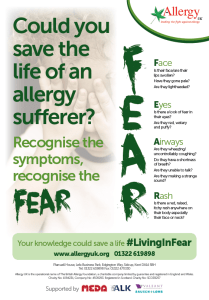
This week is Allergy UK’s #allergyawarenessweek and their aim is to raise awareness of the serious, and sometimes severe, impact of allergies on everyday life.  Their campaign #livinginfear has invited allergy sufferers to talk about the frightening side of allergies, not least of which are the statistics that show an astonishing lack of knowledge about how to deal with serious allergic reactions amongst the general public.  Recent research carried out by Allergy UK shows that 44% of allergy sufferers in the UK are living in fear of a serious reaction, whilst 68% of the people surveyed wouldn’t know how to deal with a reaction; and this lack of public knowledge could be forcing sufferers into a life of fear and anxiety.  This useful infographic published this week uses the acronym FEAR to educate us all on how to recognise, help and potentially save the life of someone struggling with a severe reaction:

Courtesy of Allergyuk.org

Courtesy of Allergyuk.org

Whilst M’s allergies are extensive and challenging, I have always been extremely grateful that he has never suffered anaphylactic shock from anything he has eaten, although the question of whether he could experience one has floated at the back of my mind for quite some time.  We were lucky enough to be able to bring home a training epi-pen after our visit to the Allergy UK annual conference in 2014, though other than a cursory look when it first came home, I have to confess it’s been gathering dust in a box on top of one of our kitchen cupboards since then.  We’ve even gone as far as discussing, late at night, whether we should have an epi-pen on hand at home “just in case”, but I’m ashamed to admit that that is as far as we’ve got in actually doing something about it.

Courtesy of foodb.ca

Courtesy of foodb.ca

However, less than a month ago that decision came back to haunt me and I learned unexpectedly just what the reality of the #livinginfear campaign could be like.  We were trialling sweet potato with M, a previous favourite that we were desperately hoping would bring some much-needed variety to his meals.  The first mouthful on that first Friday night had been eagerly received and much enjoyed by M and although the following day was a little more fraught on the toileting front than it had been for a long time, we hoped it was nothing more than a temporary blip to be overcome.  We ploughed on with the food challenges and M had taken to waxing lyrical about how much he was looking forward to including sweet potato in his diet once again.  He even asked how long it would be before he could enjoy a “whole baked potato” once again.

It was at the 3rd meal and the increase to 2 teaspoons of mashed sweet potato that things suddenly and rather dramatically went horribly wrong.  Mike, rather typically, was out for the evening at a charity whisky-tasting event and it was just me and the children enjoying our evening meal at home.  M tasted his mouthfuls of the mash before anything else and then got on with the rest of his dinner.  He got no further than half-way through when he suddenly grabbed at his throat and started gulping down mouthfuls of his glass of rice milk.  He complained that his tongue was stinging and itchy, his whole mouth was itching and it felt as if someone had grabbed his throat and was squeezing hard.  Two glassfuls of milk later and a frantic phone-call to Mike about what was going on, things settled down and M was feeling a lot better.

I had spent those 20 minutes just about holding it all together, whilst running anxiously through all the possible scenarios in my head and trying to work out what I needed to do if things took a turn for the worse:

  • Option 1 – Jump into the car with both children, trying to keep as calm as possible and race to our local hospital, 20 minutes away and with no car parking options on site:  I’d get there, but what if he stopped breathing in the car and I needed G to get involved, even if it was just by using my mobile to phone for back-up?
  • Option 2 – Dash off to one of several nearby friends who are also doctors and ask for their help:  much quicker, but at least one of those was at the same event as Mike and who knew whether the others would be at home
  • Option 3 – Call 999 and wait anxiously for an ambulance to turn up, all the time acting as the proverbial duck (calm on the surface, but paddling furiously beneath the water): how long would it take for an ambulance to reach us? Could I keep both children calm at home as we waited? What would I do if M stopped breathing? What would I do with G if we needed to rush off to hospital?

We were lucky.  The reaction passed, although the stinging pain in his mouth and throat and the sensation of his throat tightening returned at odd times over the next few days.  Following a lengthy conversation with our GOSH dietitian, it seems likely that M actually suffered an oral allergy to sweet potato rather than full-blown anaphylaxis, though it doesn’t quite fit with the known causes and triggers of Oral Allergy Syndrome.  If you are interested to learn more about living with OAS, then I highly recommend the blog Feeding my intolerant child, whose description of her son’s oral reaction to a simple fruit ice lolly whilst on holiday is definitely reminiscent of those frightening moments at home a few weeks ago.

epipenNeedless to say, sweet potato has been banished from M’s diet for the foreseeable future and we are now seeking a local allergist who can help advise us on dealing with any other more serious allergic reactions that M might experience as we continue along the food reintroduction road.  Oh yes, and we’ll also be pleading to get him an epi-pen for our own peace of mind and for the sake of his well-being and I will make sure that we all know how to administer it correctly.