Tag Archives: Great Ormond Street Hospital

Exhausted!

It’s been a long, exhausting, but fantastic weekend.  We’ve got so much more from this weekend than we had expected or even hoped we might.

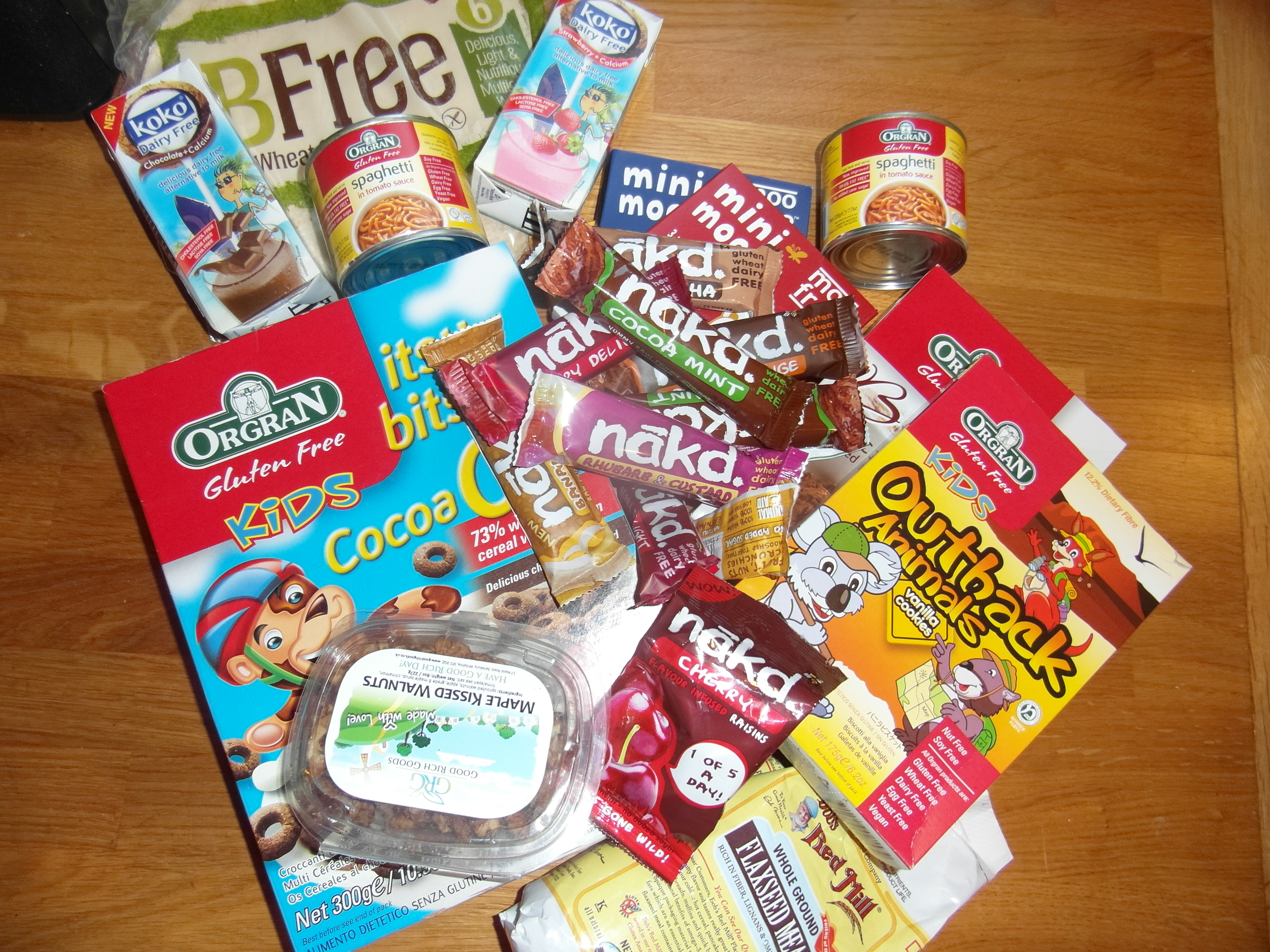
Saturday was a busy day at the Allergy and Free from Show and I really wish we’d had the 2 day visit we’d originally planned.  Just to give you an idea, the photo below is a small part of the hoard of M-friendly goodies we came back with:
SAM_1171

We managed to pick up some of our family favourites at “show” prices, which meant that lots of the products were at half price or less, but also found some new things too, which were either new to the market by some familiar names or simply new products to us.  Amongst the new treats we discovered were

  • Bfree Gluten and wheat free tortilla wraps – perfect for M and G’s lunchboxes
  • Gluten, wheat and egg free spaghetti – the manufacturer assures me it won’t go sticky during cooking like so many other brands do.  This is one that we’ll have to try and see
  • MozzaRisella – a mozzarella-type cheese made from rice and containing no dairy or soya
  • KoKo Strawberry flavoured coconut milk –  not just a new flavour, but now also available as a pack of 3 250ml cartons, perfect for a treat on a day trip

We found that all the stall holders were knowledgeable, informed and friendly.  Nothing was too much trouble for them and they all took their time to talk with not only Mike and me, but M and G also.  We were also lucky enough to meet the wonderful folks of both Fabed and Parentsown and discovered them to be even more delightful and helpful than they are on their respective web forums.  Finally, the children were collared by well-known TV weather girl, Sian Lloyd who had her very own weather map on hand to show the pollen count and problems experienced by hayfever sufferers in the UK.  She spent a long time teaching both G and M how to present the weather, had photos taken with them and chatted to us about M’s condition and why we were visiting the show.

My round-up of the show has to be M’s quote on whether he enjoyed our visit:

“It’s the best show we’ve ever been to, Mummy.  Can we come again?”

Sunday was another great day, although the sunshine we had been hoping for didn’t materialise and the morning was overcast and grey.  We made our way across London and eventually reached Battersea Park to join around 3,996 other people in the 5K RBC Race for the Kids raising money for Great Ormond Street Hospital.  It may have been a less than sun-filled day, but the number of people taking part was amazing to see and I can’t wait to hear the final figure for the amount of money raised.  We didn’t rush to get to the start early after a late night at Matilda on Saturday – and before I forget, I highly recommend a visit to the Cambridge Theatre to see this awesome show – but we felt the camaraderie and excitement of the walk nevertheless.  As requested by M and G, we had taken along the scooters and they happily led our way as Mike and I followed, alternating between a walk and a gentle jog.

We had some highs and lows along the way with M as expected as he took the occasional tumble from his scooter (we’re still working on the balance issue as he struggles because of the dyspraxia) and minor tantrums as it appeared that G might beat him across the finish line.  However, finish it we did and we collected our medals and goodie bags, completed a quick tour of the entertainment provided for those who took part and even fitted in a play at the fantastic park in Battersea, before heading back across London for lunch and our train back home.

I’m still waiting for a final couple of donations to be made before I can update you on our personal family fundraising total, but, for the interim, here’s a photo of M in his race t-shirt, RBC lion and medal.

SAM_1166

The importance of doing research

research

Not long after our January appointment in London, I received a phone-call from one of the research nurses at GOSH.  My details had been passed on to her by the Dietetics team, who felt that M was a good fit for the research project they were currently undertaking.

I listened with interest as she took her time to explain what they were doing and what involvement they needed from us.  The research was looking at the impact of multiple food allergies on the whole family and not just on M, thereby considering the emotional, social, psychological and financial impact as well as the physical symptoms that M suffers.  As soon as we had established that we fitted their criteria, I said yes.  There was no need to consult or discuss with family members, I knew that this was something we had to do.

After 27 years living as a T1D, I have taken part in very many aspects of research and teaching concerning not only my diabetes, but my pregnancy and my eye sight too.  I remember as a child, my parents agreeing for medical students to sit in on my diabetes clinic reviews to learn about treating a child with T1 diabetes.  As an adult, I’ve always agreed to having students in my appointments as I feel that this is a great way for them to get relevant and realistic hands-on experiences in the field.

diabetes

Back in 1998, I had laser eye surgery to correct a diabetes-related complication with my left eye, Diabetic retinopathy.  Unfortunately, the treatment went wrong and my eyesight was reduced to between 5 and 10% in that eye.  The damage caused by both the condition and the subsequent surgery is unusual and for a number of years, student doctors and newly qualified registrars were brought into my appointments to look at the eye for teaching purposes.

As a pregnant diabetic, I was asked to trial a new insulin that they believed would be effective in improving the health of diabetic mothers during their pregnancy.  Not only did I agree, but nearly 10 years on, I am now using that insulin on a daily basis.  That really is fantastic: seeing the medicine I trialled now being used actively in the daily management of diabetes and improving the control for many.  We’ve also encouraged both G and M to be involved in an important study into whether there is a genetic link relating to T1D.

I believe wholeheartedly that research and study is key in finding answers, treatments and cures for the many illnesses that strike people down.  It leads to an understanding of a condition and how best to support those suffering from it.  Without such research, I wouldn’t be around today to write this blog; I would have lost my life to T1D almost certainly within 4 years of diagnosis and those 4 years would have been spent on a “starvation diet”, which was the only known way to manage the condition.  The work of Banting and Best in Toronto, Canada in 1922 saved and changed the lives of millions of people as they discovered, refined and successfully introduced insulin to the medical world.

In comparison, EGID is a relatively young condition.  There is not a great deal known about it, what causes it and certainly no cure for it.  I felt that it would benefit not just the medical world, but also our family, to be involved in a research study that would seek to understand more about it.

questionnaire

We were sent a series of questionnaires to complete, which included:

  • a detailed food diary for 3 days, including any recipes used and how M felt about eating on those days
  • Mike and my opinions about the physical, social, emotional and psychological impact of M’s food allergies on M, on G and on us
  • details of any ways in which the food allergies hampered or changed the way we live our lives
  • M’s thoughts on how he felt about his food allergies and his life.

We filled these out and our return visit to GOSH in May saw us meeting not just with M’s consultant, but also with the Research team.  The meeting itself encompassed the final part of the research – taking M’s weight and height measurements, using a calliper to measure his body fat from a fold of skin on his arm and performing 20 skin-prick tests to common allergens.  The time passed swiftly, M enjoyed meeting the staff, discovered he was participant number 99 and we left having learned a little more about what they were finding out about multiple food allergies and EGID.

The most interesting thing I discovered on the day is that skin prick tests are notoriously ineffective in picking up allergies in children with EGID.  M did not react to a single one of the allergens tested, not even the 5 to which he currently suffers an allergic reaction.  This is apparently a common occurrence in EGID sufferers as their bodies react internally rather than externally in most cases.  I didn’t know this before and explains why previous skin prick tests always came back negative.

The results from this study won’t be available for a while as they seek to increase the number of children involved in it, but I’m glad we could be a part of it.  We feel involved in the process of learning more about this little recognised condition and M is proud that he has helped out.  We would happily do it all again in a heartbeat and if we are asked, the answer will inevitably be yes.  The truth is that no matter what insight this gives, however small, it will have a huge impact on the future lives of EGID children.

The final answer?

finalanswer

Having taken a week’s hiatus from the story of our journey to a diagnosis to blog about our week on M’s diet, I wanted to just go back a few months and finish the story of getting to where we are today.

In September 2012, we had now reached what appeared to be a status quo for M, which though still not ideal, was vastly improved from the position we’d been in less that 18 months earlier. He was taking 5 lots of different medicines during the day to cope with his symptoms – 2 anti-histamines, 1 calcium supplement, 1 probiotic and the protein shake – and was still dairy, egg, wheat and soya free in his diet.

We survived day trips, weekends away and even a two week holiday to Canada to visit Mike’s family and had come through them all relatively unscathed. M was growing taller by the day, though his weight continued to be a concern. We only suffered with a couple of bouts of croup and the household coughs and colds didn’t appear to have any ill-effect on him. There was the occasional, inadvertent slip-up with his food and we all suffered the consequences of those, but we quickly identified what had caused the problem and realised that, for the time being at very least, M would need to continue on his strict diet.

Christmas 2012 came and went as did G’s birthday and both occasions were celebrated with M-friendly food. 2012 had been a tough year for us all for very many reasons and it was good to finally see it leave and be able to look forward to a brighter 2013.

The beginning of January 2013 saw us returning to GOSH for an appointment with M’s consultant. This time round we were able to make it a family trip as the children had yet to return to school and so all 4 of us spent 2 days in the Capital. Mike and I were determined to get some answers this time round. We felt that whilst we had made huge progress with M, we still weren’t in a place that was ideal for any concerned. We didn’t know what we could expect, but we were desperate for a diagnosis and a clear plan in place for the foreseeable future.

The appointment started in usual fashion with a quick overview from our standpoint of how things were going since we had last been there. I had spoken to Dr Hill in the run up to Christmas and she was concerned by the continued frequency of M’s soiling accidents. I was able to report that little had changed since my conversation with her and so she suggested that we took the step of taking gluten out of M’s diet too. At this point, Mike lost it a little and expressed just how frustrated we all were with the lack of knowledge we had about what was wrong with M. We both felt that they were continuing to limit his safe foods without having a good reason for doing so.

She looked at us amazed and asked what exactly he meant. To cut a long story short, it turns out that there had, in fact, been a diagnosis in place since the previous April, but not one of the gastro team we had seen during the past 9 months had thought to advise us of it. I’m sure that many of you would imagine us to be fuming at this apparent incompetence, but, to be perfectly honest, both Mike and I were just extremely grateful that we now had a name to put to M’s condition.

The diagnosis was EGID – Eosinophilic Gastro-Intestinal Disease – a relatively rare and fairly recently identified family of gastric diseases, which fall into the bigger category of Inflammatory Bowel Disease. There is no need for me to bore you with the finer details (you can read a much better explanation here anyway), but it is an auto-immune condition that sees the eosinophils, which are a part of the white blood cells, attacking the body itself instead of the allergen.

For those among you with the better memories, this is indeed the exact condition I had tentatively self-diagnosed during 2012 (see here) and so, for me, this diagnosis was something I already knew a lot about and knew we could manage. I had sourced some fabulous support groups and had already joined them in the belief that this was the road we were destined to be travelling. We now felt empowered and able to take this diagnosis and run with it. The Dietetics team agreed to write a letter to M’s school explaining his condition and the impact it could have on him, which we hoped would enable some support and understanding that had previously been lacking.

We could also now educate both M and G about his condition. You could palpably sense the relief that M had simply by being able to put a name to his condition and he has a reasonable understanding of what’s going on in his body. It doesn’t make it any easier when you trying to explain to the 7 year old why he can’t eat a particular item, but he has grasped the reasons for the reactions his body is experiencing and is learning to accept the current limitations.

We also learned that we were in the best possible place to receive care for a child with EGID. GOSH is a leading light in the research world for understanding more about this family of diseases and is considered to most certainly be on par with the US in terms of their research. This was never going to be something M could outgrow, despite the reassurances of our local hospitals, but we could and would learn to live with it and to make the best of a difficult situation.

National Eosinophil Awareness Week

Week

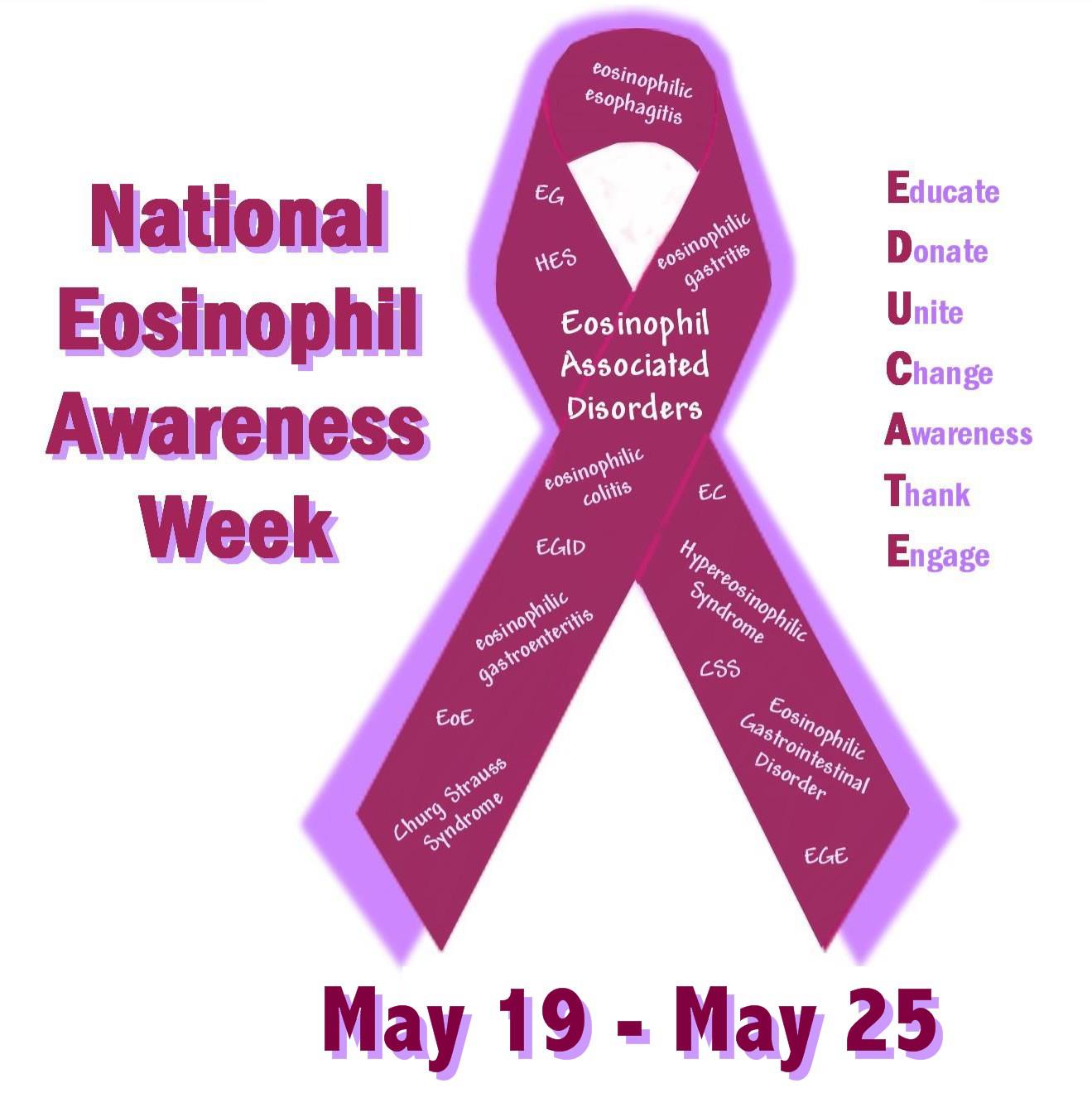
Forgive me for interrupting our “story so far” and I promise that normal service will resume soon, but I wanted and needed to raise awareness of the importance of next week.  As the image above shows, May 19th – May 25th is a week dedicated to raising the awareness of everyone to Eosinophilic Disorders.  Until we were dragged kicking and screaming on this tumultuous journey with M, neither Mike, I or indeed our families had ever even heard of Eosinophils, let alone had any idea what they did and the massive impact they could have on life as we knew it.

We are amongst the lucky ones as M is able to eat “proper” food, even with all his dietary restrictions and is happy to take his medicines on a daily basis to help manage the symptoms.  There are very many children out there who have even more restrictive diets or cannot eat at all and instead are fed through nasogastric tubes.  That could so easily have been the position for us and could still be if we can’t stabilise M to everyone’s satisfaction, and so I’m thankful for every day that it isn’t.

Over next week and the weekend of June 8/9th, we will be committing to raising awareness and educating friends and family about M’s condition.

Next Friday, May 24th, is “Eat like us” day, when families of children with EGID will be committing to eating like their child for the day.  Mike and I are, however, committing to something slightly more.  We will be adopting M’s diet for the full week, adapting our recipes and meals to accommodate the “egg, dairy, wheat, gluten and soya” free diet he has to eat everyday.  On the Friday itself, we will be eating exactly what he eats for the day, though I’m not sure either of us will be braving the Protein shake!

On Sunday June 9th, we have signed up to walk the RBC Race for Children in Battersea Park, London.  This 5k walk/run/ride/scoot is to raise money for GOSH, who are currently redeveloping the hospital to create more much-needed space for the children, family and staff who are there on a daily basis.  M is keen to fundraise for “his” hospital and as we are already in London that weekend and have a lot to say thank you to GOSH for, it was a really easy decision to make.

This is not M’s first foray into fundraising for GOSH.  Following his and our stay at the Patient hotel last January whilst he had his scopes, M asked how much money it cost to support a family to stay there with their child for the week.  Through some research on the GOSH charity website, we learned that £50 would pay for the upkeep of one room for a family for 5 nights.  With the help of the Stagecoach theatre school that G and M have been attending for 5 and 3 years respectively, the end of term collection in March 2012 raised a fantastic £135, which will pay for nearly 2 full weeks for a family in one of their rooms.

I will be updating my blog on a daily basis from May 19th to detail our menu choices and how we manage the week on the diet M has been following for the last 2 years.  It will undoubtedly be a tough week for us and I have to ask – would you be brave enough to walk even 1 day in the shoes of these courageous children?

Life is a roller-coaster

images

Having put M’s scopes behind us, we headed into February and our next appointment at GOSH with lighter hearts. We had been reassured that Dr Hill had identified what the problem was during the surgery and that all we needed was the biopsy results to confirm the diagnosis.

Unfortunately, Mike and I were about to hit a “low” on our roller-coaster ride. The much anticipated diagnosis of Crohn’s Disease was not supported by M’s biopsy results and we left that appointment with no end in sight. There was talk of putting him onto the “Elemental diet”, which entails removing all foods for a number of months until the body has time to recover. The prospect of having to consider a nasal-gastric tube to feed M for any length of time was a tough one and one that Mike and I disagreed over. I felt that we needed to do whatever was necessary to get our boy onto the road to recovery, whereas Mike felt this was too extreme an approach and one that he wasn’t yet prepared to commit to. The registrar we saw suggested that M had some blood tests done to rule out some other possible contenders before we headed down this road and another appointment was set for a month later with M in tow once again.

Another month passed and the day before M’s birthday, we headed back to GOSH. This time Mike wasn’t able to take the day off work, so Mum accompanied M and me on our trek to the capital. We weren’t really sure about what we were trying to achieve and where we were heading. M had now been on his free-from diet for 9 months and whilst we had made progress, it wasn’t enough to satisfy us or the medical team. We were also concerned that M’s weight gain was minimal especially as his appetite had dropped off since starting his new diet and it was becoming a tough game to get him to eat.

We left GOSH with a raft of medicines to add to M’s daily diet. He was prescribed Cetirizine and Ketotifen, both anti-histamines that would help his body recover and repair from the allergic reactions he was still suffering from internally. We also needed to introduce a protein shake called Neocate Active to help him gain and maintain his weight. The biggest challenge was going to be to convince M to drink the protein shakes as they are notoriously difficult to introduce successfully to children and even our GP wished us luck as he wrote the prescription.

True to form, however, after an initially bumpy start and numerous attempts at flavouring the shake, M willingly drank his shake daily and even now, 12 months on, has been known to ask for more than one in a 24-hour stretch! The medicines proved to make a difference to how M was feeling and whilst there were no immediately obvious improvements, M seemed to understand that they would help him feel better and took them with very little fuss.

It was during this time that I became a big fan of Dr. Google.  I wasn’t looking for all the answers to all my questions, including those I hadn’t yet thought to ask, but rather needed to find information about the experiences we were going through and to know that we weren’t on our own. It is important to stress that you do have to be sensible in your approach to using on-line search engines to identify a condition. It would have been very easy to diagnose any one of a number of frightening illnesses, so a modicum of common sense had to prevail.

However, in my desire to understand why both antihistamines had been prescribed and what result we were trying to achieve, I stumbled across a list of symptoms that fitted M to a T. The Fabed website sought to educate and support families coping with something called “Eosinophilic disorders”.  I knew nothing about these conditions, having never even really heard about eosinophils and what they were, but the symptoms rang a bell and I determined to read around it until I became a home-grown expert in it.  I discovered not only Fabed, but also another website called Parentsown, which is home to a series of forums for varying conditions.  Whilst the forums are not massively active, I made contact with a couple of other parents who had children with Eosinophilic disorders and became more convinced that this was the diagnosis we were seeking with M, although the condition was going to haunt me for another 9 months before we got it confirmed as a definitive diagnosis.

D-day

surgery

As we head up to London today for yet another appointment at GOSH, I thought I’d complete the story started in my last blog.

D-day had finally arrived. We got up, washed, dressed and packed up our bags before heading over the road to the ward for M’s scopes. We had a lot of hope pinned to these simple tests and both believed that we would get some answers once they had been done.

When your child faces surgery of any kind, as a parent you are understandably nervous. The medical team at GOSH did their best to put us at ease and to reassure us that all would be well whilst M was being examined. My biggest concern was the anaesthetic. M had broken his left arm in 4 places when he was 4 and had had to have 2 operations to put it back together. Both times he had experienced a noticeable reaction to the anaesthetic used with symptoms of a high temperature, hallucinations and thrashing about as he came round from it. The second time had been worse than the first and I was concerned about how he would react this third time as I had been warned that his reaction may become more severe each time he had to undergo anesthesia. His consultant and the anesthetist talked this over with us and reassured me that they would keep an eye on him.

We went with him when he was given the anaesthetic and this experience hit Mike particularly hard. On both of the previous occasions, only one parent had been allowed to accompany M into the prep room, so I had “been there and done it” before. The sight of M chatting away one moment and drifting to sleep with his eyes rolling back in his head the next, reduced Mike to stunned silence and to something of an emotional wreck. We returned to the waiting area, where the nurse advised us that it would all be over in about 30 minutes, so enough time to go and get a coffee at the nearby coffee shop.

Taking note of my need for a sweet and caffeinated beverage (Vanilla latte!) and his own for some fresh air , Mike and I wandered out into the winter weather and down the street. Neither of us wanted to linger, so we grabbed a coffee to go and hurried back to the waiting room. What happened next was every parent’s nightmare. M did not come out of his surgery within half an hour, or indeed within an hour. After over an hour of anxious waiting and quizzing of the nursing staff, we were finally ushered into the recovery room to see our boy.

The operation had not gone as smoothly as hoped because of the state of M’s insides. The colonscopy had gone well, but when they inserted the tube for his endoscopy, they discovered that his intestines had been badly damaged by the as yet undiagnosed condition and he had bled heavily as they tried to examine and take biopsies for testing. In the end, they had done what they could and had left it that. His consultant was confident that she knew what the problem was, even with an incomplete examination done, but she wanted to wait for the results of the biopsies before confirming her diagnosis.

The original plan had been that M would come round from the anaesthetic, have a small bite to eat, use the toilet and then be discharged by lunch-time. The extended length of the operation and then the extreme reaction to the anaesthetic meant that we’d be lucky if we got out by dinner. Fortunately, Mike and I had anticipated this turn of events, well the reaction bit at least, and had sensibly booked a later train to take us back home.

I dealt with the thrashing, the biting, the uncontrollable sobbing and the screaming as the anaesthetic passed through M’s tiny body, until finally he fell into a fitful sleep. We survived the departure of those children who had been scoped after him and the arrival of those for the afternoon list for theatre. We manoeuvred ourselves, M’s bed and our bags away from the main recovery room to the “spare machinery” room as they needed the bed space for those new patients. And we appreciated the drinks and sandwiches they provided for us and for M when he eventually woke up completely.

As the consultant left at the end of her day, we were finally told that M was going to be discharged and we left GOSH approximately 10 hours after we’d entered it that very morning. Mike flagged down a passing black cab and the cabbie helped us in with our luggage as I carried our suffering and sleepy lad in and onto my lap. We had acquired some additional soft toys on our trip, well every boy needs a gruffalo and mouse to see them through surgery, as well as a GOSH bear for G as a present from our stay away from home and we needed extra arms to manage those without losing them along the way.

Getting onto the train at Paddington felt like no mean feat, but we were reassured and hopeful by our consultant’s assurances that she knew at last what we were dealing with and prepared for our return visit less than a month later.

The countdown begins

As the date for his scopes, endoscopy and colonscopy, approached, and filled with dozens of questions, I read the information sheets sent by GOSH and forum links found through vague internet searches to understand what would be involved. Our trip to London was going to be a 2 night stay and this is where GOSH really comes into its own. They have the most amazing facility for families such as ours with children who need to be there for more than a flying visit and are travelling from outside of the M25. The Patient Hotel is situated opposite the main entrance to the hospital and is free – yes you read that correctly! – accommodation provided to patients and their families who need to stay overnight. All they ask is a £10 deposit for the room, returnable when you check-out and a £10 deposit for the TV remote control, which is similarly refunded.

Each room is large and practical as well as comfortable, allowing for hospital beds or other specialised medical equipment to be reassuringly on hand without crowding the space. There is a large kitchen and sitting room area open to everyone on every floor as well as a pile of menus for the local restaurants and takeaways. When you’re facing the trauma of your child being in hospital for however long, having one less thing to think about is invaluable and knowing that you’re on hand for the hospital, a real god-send.

M was due to be seen for his pre-op first thing in the morning, so we travelled up to London by train the night before, leaving G once again in my Mum’s capable hands. We settled quickly into our room before heading out to have some dinner and then to get some sleep before the challenging days ahead. The pre-op was an emotionally charged occasion for us all. M was allowed to eat breakfast on that morning (Wednesday), but would then be unable to eat any solid food until after his scopes, which were being performed on the following day (Thursday). His bowels needed to be “prepped” for the scopes, so his system was flushed out completed by a series of strong laxatives given in intervals during the Wednesday.

M approached the whole experience with a stoicism that belied his years. He chatted cheerfully to the nurses we met during the pre-op, listened intently when the anesthetist talked about the procedure and refused the “magic” cream to numb his arm whilst his cannula was put in. Armed with the list of the few things he was allowed to consume before his operation and filled with more than my fair-share of trepidation, we left GOSH at lunchtime to while away the hours before bed.

M understood that Mummy would have to eat during his 24+ hours without food because of my diabetes, but he asked Daddy to stick to his enforced fast with him. Mike gladly agreed and the pair of them survived on ice-lollies and fruit juice whilst I enjoyed, somewhat guiltily, the sandwiches and snacks I needed to keep me going throughout the day.

With a long day ahead of us, we prepared as best we could. We know M would experience intense diarrhoea as his bowels were emptied, so we bought some boys training pants to keep his clothes from being spoiled. We also decided to take him to the theatre to see “Stick Man” by Julia Donaldson. This took us into the evening and we finally headed back to our room at GOSH. I had hoped that M would settle to sleep quite quickly, though looking back at it now, I have no idea why I thought that day would be so very different to any other! I think I had hoped that the lack of food since 7am would mean that his body would be tired and push him towards sleep, but instead he and I sat up watching “Monsters Inc” on our portable DVD until at least 11pm.

M was understandably nervous about what was going to happen, though we had taken time to explain it to him and to answer any questions he had. I suspect that his sense of humour was probably what helped him the most, the prospect of a camera going down his throat, but even more hysterically, up his bottom, to take photos of his tummy had him giggling for days and even now, he laughs every time he thinks of it.

By midnight on that Wednesday evening, our room was finally quiet and whilst it took me a little longer to drift off to sleep, we all managed to get a reasonably good night’s rest.

When life gives you lemons…

120907-Lemonade-275x275

…make lemonade. Isn’t that how the saying goes? I have to confess to pondering this one in the early hours of this morning after being woken up by a somewhat distraught M who had just had a soiling accident whilst asleep. He woke me at 3.45am and 2 hours later, my mind was still buzzing and sleep seemed a thing from the dim and distant past. This doesn’t happen very often, but the impact is huge and it got me to thinking.

The impact of M’s condition has been massive on us all as a family and not just on M himself. To anyone who has a “sick” child, you will understand what I mean.

Mike and I have suddenly had to become medical experts in our own rights, despite our alternate careers as an accountant and surveyor, as who else is going to make sure that the best is done for M? I now know so much more about gastro conditions and food allergies than I ever anticipated needing to know. I’ve had to learn coping mechanisms, not just for M to deal with his frustration and anger at being ill, but to help us cope as well. The years of not having an answer have taken their toll and both Mike and I have had to re-learn who our little boy is and what makes him tick. I have to be his first line of defense wherever we are and I’m the one in his corner fighting his cause.

One of the hardest things about this illness is that there are no obvious outward signs that M is ill. He is a slight child and even when seriously underweight and struggling with full toilet-training, he has never lacked energy or enthusiasm for life. He may suffer with stomach cramps and joint aches that would floor most adults, but he just gets on with it. His complaints of aching limbs have been ignored for years as I was guilty of thinking of him as a “moaning” child, but now I know that those aches are very real and extremely uncomfortable whilst they last. He has been living the last 7 years with these as his normal, so he only stops when he’s suffering extreme moments of pain. He had then, and continues to have, the most amazing stamina and a reserve of energy that I can only envy. He is constantly on the go and has never let his health problems slow him down. In very many ways, this is his greatest strength, but also the biggest problem for us.

The lack of obvious evidence of his poor health means that people just don’t understand that he is ill and look at me in disbelief when I explain just how poorly he can be and, to be perfectly honest, I don’t blame them at all. He doesn’t look like a child who eats fresh air and frequently manages on less than 8 hours sleep a night; but he is.

I don’t think that Mike will mind me sharing that he has struggled to come to terms with M’s condition. I have an advantage in that I have grown up living with my own T1 diabetes. I know that these things can be survived and have just got on with it. Mike has found it harder and has longed for an easier fix than the road we seem to be travelling down at the moment. Of course, we now have a diagnosis and that has helped us all. Being able to put a name to the condition, even though it’s so rare that no-one ever seems to have heard of it, means that our fight has not been in vain and we can no longer be dismissed as fussy parents. This is M’s life for now and for the foreseeable future, and as his parents, our job is to ensure that he learns how to make the best of a bad situation.

M has struggled too, as you would expect and his levels of frustration at times are massive. Not only is he restricted by what he can eat and how his body reacts, but he also has to deal with the knock-on consequences. It is no longer possible for him to go home for tea with his friends, attend birthday parties, participate in cooking at school or even have a Christmas or Easter treat, without me having to provide a detailed list of what he can and can’t eat and the inevitable 20 minute discussion with the adult in charge about his condition. We encourage him to have a go at whatever he wants and refuse to let his condition dictate who he is or how he lives his life; and a big thank you has to go to my parents who brought me up with that very same approach to T1D and my life.

He acts out – he kicks and hits and shouts and bites – and sadly the people who have to survive the mood swings are us and G. G has had a hard role to play as the big sister to a poorly child. She worries about his health and I know struggles when we have to disappear off to London for the day for his hospital check-ups. But, she is also a child and has her own challenges to deal with. My children are the best of friends and would defend each other to the end; but are also the worst of enemies. It has become extremely important for us to invest as much time in G as we can and the last couple of months have enabled us to do just that far more than before. She recently took part in a music event organised by the local authority music education department and her clarinet skills were considered good enough to allow her to play with the wind band. This was something just for her and she loved every moment.

She has also been invited to join the local swimming club and that is something we are keen to encourage her to do. There was a point when we wondered a couple of years ago if she’d ever learn to swim, but she is now excelling at it and her teacher invited her to join the Club to see how she gets on. It’s an additional time commitment on a weekly basis for us as she will need to attend at least 1 extra training session a week as well as competitions, but we wouldn’t have it any other way.

I’m proud of both my children – M for his stoicism in dealing with his condition and making the most of life; and G for her continued hard work at school and at her after-school clubs. She may not like the fact that M misses school regularly to attend hospital appointments, but she admits that she wouldn’t want to have the blood tests and diet that he has. Neither child has an easy cross to bear right now, but I hope Mike and I manage to get it right enough to see them successfully and happily through to adulthood.

Baby steps

baby stepsThe summer of 2011 was an interesting one.  As I alluded to in my last blog, M took to his new diet like a proverbial duck to water and 9 weeks in, we finally began to see some tangible and very noticeable improvements. The number of toileting accidents reduced significantly and whilst we were still not “accident-free”, I no longer felt as if I was packing for a trek to the Himalayas every time I stepped out the door.

M’s weight did dip a little, but not significantly enough to give us concern and we all enjoyed a fantastic summer holiday. We even managed a holiday abroad – a week’s trip to Portugal with my Mum. We decided to relax the diet a little during that week after discussions with the GOSH dietetics team and M was able to once again enjoy chips with his meals! We even braved half of a small 1-egg omelette without too much of an impact on his health. Both M and G enjoyed a week of sun, swimming and Mediterranean food and I enjoyed being able to get away from home whilst still managing a challenging diet. We went prepared as Mum and I both carried food supplies in our cases and I suddenly became proficient in scanning food labels in another language!

The start of September saw not only M moving up into Year 1, but also our return visit to GOSH. I felt confident that we had established that M did not have an allergy problem with potatoes and thankfully our consultant agreed. We were encouraged to re-introduce potatoes back into his diet as well as trialling the re-introduction of some of the other forbidden foods. As it now turns out, we were definitely attempting to run before we could walk and the trials ended without success. This was a disappointment for M as he was desperate to return to egg mayonnaise sandwiches, but he faced it like a trooper and just got on with it.

It was at this point that we learned that there are in fact many reactions to food allergies. The most dangerous and well-known is an anaphylactic shock such as frequently suffered by those with severe nut allergies. M had never suffered from anaphylaxsis, which has led to people believing that he does not have food allergies, but rather food intolerances. However, as we now know, allergic reactions wear many different hats and we were to encounter some of these as we attempted to re-introduce some foods into M’s diet.

M’s most obvious reaction was the chronic diarrhoea that he had been suffering since he was a baby. This can be an almost instantaneous reaction, but frequently takes several hours to develop. The length of the attack can vary from person to person, but the experience is unpleasant for all.

However, there can also be emotional, social or psychological reactions that can occur up to 72 hours after a food has been eaten. Back in September 2011, M showed this kind of reaction when eating and drinking soya. After a couple of days of including soya back into his diet, M become uncontrollable and somewhat hyperactive. I can vividly remember sitting at a meal with my Mum, my Godmother and her husband at the end of 5 days with M being back on soya. He was unable to sit still, was constantly up and down from the table, was rude, unmanageable and nothing could convince him to behave. A week later in almost identical circumstances, but having been back off soya for 5 days, he sat peacefully, showing the most beautiful table manners and behaving as a completely different child. I have never seen such a dramatic display of how a simple food can have such an immense impact. Even now, we can tell if a trace of soya has crept into his diet unawares.

During our September appointment, we discussed our next steps with the registrar. Although M was a lot better than he had been 3 months earlier, we were still struggling with multiple toileting accidents a week and it was suggested that it might now be worth considering a set of scopes to see what was going on inside.

I would love to say that the next step was to have these performed, but in fact it took a lot of to-ing and fro-ing, several telephone conversations and another visit to London before we got confirmation that the scopes would take place. As we waited for the date of the scopes to be sent, M continued on the strict MEWS diet and we approached our first ever allergy-friendly Christmas!

Reaching London

bus2

In June 2011, we all set off to London for the first of very many visits to GOSH. Walking through those doors for that very first time is an experience I’ll never forget. Having heard so much about GOSH over the years, I had never imagined that one day we would be visiting in what felt like a last-ditch attempt to help our son. I was filled with awe, hope and finally a sense that we would now know one way or another whether something could be done to help him.

It was such a momentous occasion, that we had brought G with us too, feeling that it was important for her to be part of this new journey we were embarking on. I will be forever grateful to her godfather, Uncle A, who was on hand in London and able to whisk her away for an hour to play, whilst Mike, M and I waited to meet his consultant. The only problem was that M really didn’t want to stay with us and would have much rather disappeared to the park than sit and talk to yet another doctor in yet another hospital.

We didn’t have to wait too long and we were quickly ushered into a room with Dr Hill and a member of her team. Unlike many of the other medics we’d already seen, there was no sense of there being a time limit and I was able to fully explain what had brought us to her door. We went right back to the beginning, looking at every aspect of our 5 year journey so far. She asked probing questions and actually listened to our answers; she examined M; considered his height and weight; looked at the food diary that I’d been faithfully maintaining for months, before finally sitting back in her chair.

Perhaps I’m now adding to the sense of drama, but as I look back at the moment that was about to change all our lives, I can almost taste the palpable tension in the air. You have to remember that by now, every doctor we had seen had diagnosed toddler tummy, had rejected the idea of food allergies and felt that there was nothing wrong with M at all. If I were to discover the words “Munchausen syndrome by proxy” scrawled across M’s medical notes somewhere, I really don’t think it would surprise me.

Dr Hill looked at Mike and me and stated, simply,

“Well, there’s obviously something very wrong with this little chap”.

I could have cried, or possibly kissed her at that point! From that moment on, every difficulty we had faced over the past 5 years faded and we had a sense of purpose and of how to move forward.

Whilst usually favouring an investigative set of scopes initially, as we were already old hands at working within the constraints of a restrictive diet, Dr Hill sent us to the Dietician to discuss starting M on a MEWS diet. This meant that for the next 3 months at very least, M would be Milk, Eggs, Wheat and Soya free and, for good measure, because of my own problems with potatoes, we had to take those out of his diet too. This felt like a daunting task, but I knew I would do anything I needed to to seek a resolution for M’s problems. The dietician was fantastic and spent nearly an hour talking through how I could feed my hungry child whilst excluding all these food groups. Laden down with leaflets galore, the all important follow up appointment for September and several phone numbers to give me access to the help we would need, we left GOSH and headed for a local restaurant to enjoy our last “normal” meal for a long time.

As we sat waiting for lunch to arrive, I phoned my Mum to give her the news. She now says that she could hear the relief in my voice and I’m not surprised. I felt as if a huge burden had been lifted from my shoulders, all because one individual had listened and believed what I had to say about the health of my child. There was no question about our parental instincts, simply affirmation. We were right to have pursued in our goal and though we were still to wait another 18 months to get the final diagnosis, we knew that suddenly the future looked bright.