
May 20: E is for Educate
When M was finally diagnosed with EGID 5 years ago, it came at the end of a long, relentless and frustrating battle with the medical profession to have our concerns heard and acknowledged; and not simply be dismissed as over-protective parents; or worse. By the time the diagnosis was actually formalised, I had done a lot of my own reading around the subject and already knew as much about the condition as was readily available online.  In the 5 years since that hospital appointment, we have found ourselves continually having to educate those around us, including the medics, who know little to nothing about what is becoming an increasingly controversial diagnosis, especially when it affects the lower GI tract as M’s does.
EoE, or Eosinophilic Oesophagitis, is becoming more widely recognised and the diagnostic criteria for this condition are well established, not least thanks to the continued research of Dr Marc Rothenberg and his team at Cincinnati Children’s Hospital. When it comes to the rest of the GI tract however, there opinion is very much divided. There are no clear guidelines as to how any of the other Eosinophilic disorders should be identified and diagnosed; and as the recent documentary about GOSH revealed, there is definitely no consensus on how they are best treated. One of the biggest problems facing children like M is the minimal investment into the research of gastrointestinal disorders and the fact that there is absolutely none into paediatric gastro research. With the credibility of EGID as a “real” chronic illness under debate, consultants all too often veer away from it as a possibility and either move towards a more psychological diagnosis or simply shrug their shoulders and leave these individuals to cope on their own, with little or no regular input.
Whether you want to lay the blame of M’s health issues at the feet of eosinophils, or mast cells, or indeed any other type of white blood cell that could be causing his body to attack itself and react to more foods that you can even begin to imagine, I don’t really mind. I’m not one to hang my hat on labels particularly, especially when that label has no meaning for the greater proportion of the people that M comes into contact with on a day-to-day basis; but I also know that being able to put a name to a problem lends a sense of genuineness to his symptoms as well. As a family we’re not able to walk away from the reality of living with this condition day in and day out because every week we experience the effect of it. I’ve said it before, I’ll say it now and I will no doubt say it many times in the future:
The symptoms that M suffers are very real and can be hugely distressing at times.
M is absolutely your average 12 year-old. He has attitude, he knows it all and he could argue that black is white with the best of them. He loves computer games, fantasy stories and endlessly watching Star Wars or Marvel films. He runs around and is noisy and can drive even a saint up the wall at times. He doesn’t look ill and I’d defy anyone who doesn’t know him to pick him out as the “sick kid” in the line-up. 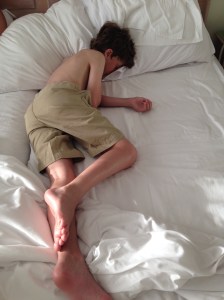 But that’s the face he presents to the outside world and reflects the attitude to his health that Mike and I have worked hard to engender within him.
What you don’t see is the worn out child who can’t move from his bed at times because of the pain and lethargy that accompany a flare-up. You don’t hear the quiet heart-to-hearts late at night, when he’s struggling with yet another reaction and doesn’t understand why it’s happening to him again. You don’t feel the despair that hits hard after another food causes soul-destroying disappointment because it’s clear that he just won’t be able to eat it without problem. And you can’t imagine the heartbreak of seeing the quiet acceptance that he won’t be able to go to a friend’s sleepover or away on school camp because of the possibility of suffering an embarrassing symptom that none of his friends really understand.
That is the truth of life with EGID and that’s the reason we will always endeavour to educate those who come into contact with M as well as the rest of the world in whatever way we can.
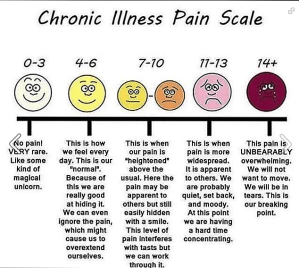 G’s godmother shared this pain scale image with me and I love the wording that is attached to it as it sums up to a tee how M has described his levels of pain over the years. From the magical unicorn of no pain at all which happens occasionally, to the breaking point of inconsolable sobbing and unbearable pain that little can ease, I’ve seen M pass through every stage of this chart on all too regular a basis. I doubt the colours, images or facial expressions would appeal overly to him, but it helps to clearly explain how he copes to those who need to know.
 A fellow
  This third one I discovered through Twitter and was posted up by @2tubies, whose 6-year old son helped make his own pain chart for the school environment with the help of the school SENCo and his Mum. They used Lego figurines to depict how he might be feeling and offered some easy solutions for his symptoms. This solution-based approach is one that I find works well with M and have started using it more and more over the years. I rarely give M the option of staying home from school when he’s feeling unwell, but will instead list out those solutions I think might ease not only his pain, but also the whirlwind of emotions that is so frequently tied into what he’s feeling on a physical level. Whilst he was still being tube-fed, I would always start with the offer to slow down or even stop his pump for a limited amount of time and then followed that up with pain relief or a hot water bottle. My final question has always been what M thinks will help him the most and given he has a clear idea of what I’m suggesting, then we have always been able to find a solution that works for us both. Whilst giving these choices verbally works well at home, I imagine that presenting them in a pictorial fashion would make great sense in the school setting.
 At G’s secondary school, they have included traffic light coloured pages in the back of the pupils’ planners and the children are encouraged to use them by putting the relevant colour facing up on the desk if they need some help during a lesson, but are too worried or nervous to ask. For some children, a “traffic lights” approach using counters or cards can also be effectively used to indicate how they are feeling in any given situation, where red can indicate their sense of losing control or not coping with the environment surrounding them. The opportunity to be tactile with the counters may also help children with sensory issues order their thoughts and be more able to express them when asked. Even if the child is not able to share what’s troubling them, a clear plan of how the teacher or adult in charge should respond to each colour will change that child’s perceptions and experiences away from home. Similarly, M’s school uses a “Fist to 5” approach to their work, where fist indicates a lack of understanding and the need for some help, and 5 means they are confident and happy to carry on on their own.






 7 years to diagnosis