Category Archives: Parenting

A Whodunnit birthday!

In the past 3 months, we’ve conquered Christmas, survived the return to school, managed the mysteries of the NG-tube and, most recently, started to tackle the tricky business of food re-introductions,  Now it was time for my biggest challenge yet:  M’s birthday party.

20150301_143337As G turned 11 back in December when M and I were in GOSH and we didn’t get to mark it in any great way,  I wanted to make sure she could celebrate her day with her friends albeit belatedly.  By the time Christmas had passed, the new year was in and we got round to making plans, half-term was fast approaching with M’s birthday hot on its heels.  I tentatively suggested we threw a joint party, not at all sure what response I might get and was delighted when they leapt at the chance.  Next came the trickier job of agreeing what to do and even though many ideas were bandied around, we struggled to come to a compromise that suited them both. With M keen to do LaserQuest or rock-climbing and G hankering after bowling, a final decision seemed impossible to reach until, in a rare moment of like-mindedness, they put their heads together and came up with the idea of a Cluedo-themed birthday party.

20150210_225626The first step was to set the scene for the murder of Mr Black by choosing enough character names, crime scenes and potential murder weapons to accommodate 16 children.  We started with the original lists of the game itself and added to them, ending up with 10 weapons, 10 rooms and 16 characters, which G and M allocated to each of their friends in turn.  I designed and then created the invitations to be handed out at school, inviting the children to join in the birthday celebrations for Captain M Emerald and Countess G Pearl.

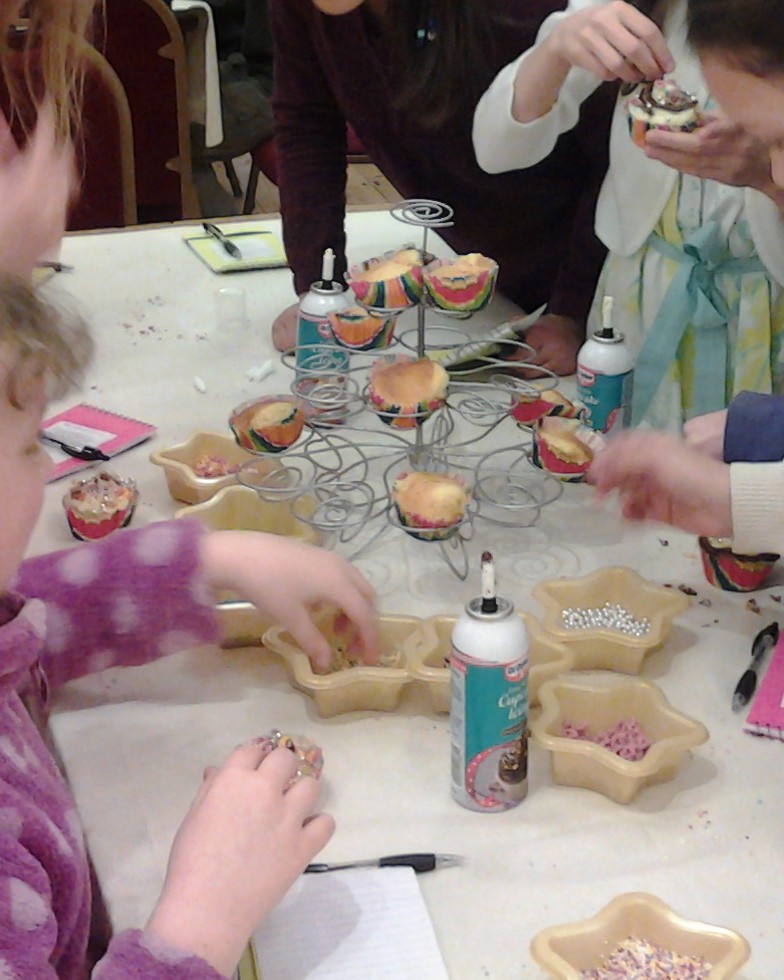
Naturally, the finer details of exactly how the party would be run were left to me, but I loved the idea of a murder-mystery style party based on this classic board-game and have spent much of the last 4 weeks planning, preparing and perfecting each element of the day.  The children had lots of ideas about what they wanted to do and we ended up with a series of games, activities and refreshments that would prove to keep the most picky of 11 year-old girls and most active of 9 year-old boys happy for 2 hours.  Each game was attributed to one of our 16 characters, so the guests had the opportunity to test their skills with a Nerf gun at Colonel Mustard’s Shooting range or joined in the pottery painting classes run by Mrs Peacock and Lady Lilac.  We wanted the children to still experience the original aim of the game and work out the who, where and how of the murder, so every activity they did gave them the opportunity to reveal more cards to eliminate suspects from their lists.  This could be as simple as decorating a cupcake for Reverend Green’s church fundraiser to see 2 cards, or as revolting as delving deep into Mrs White’s giant trifle to pull out another one. Everybody had a chance to try their luck at each of the games and they all had a whale of a time.

20150301_144602 20150301_144542

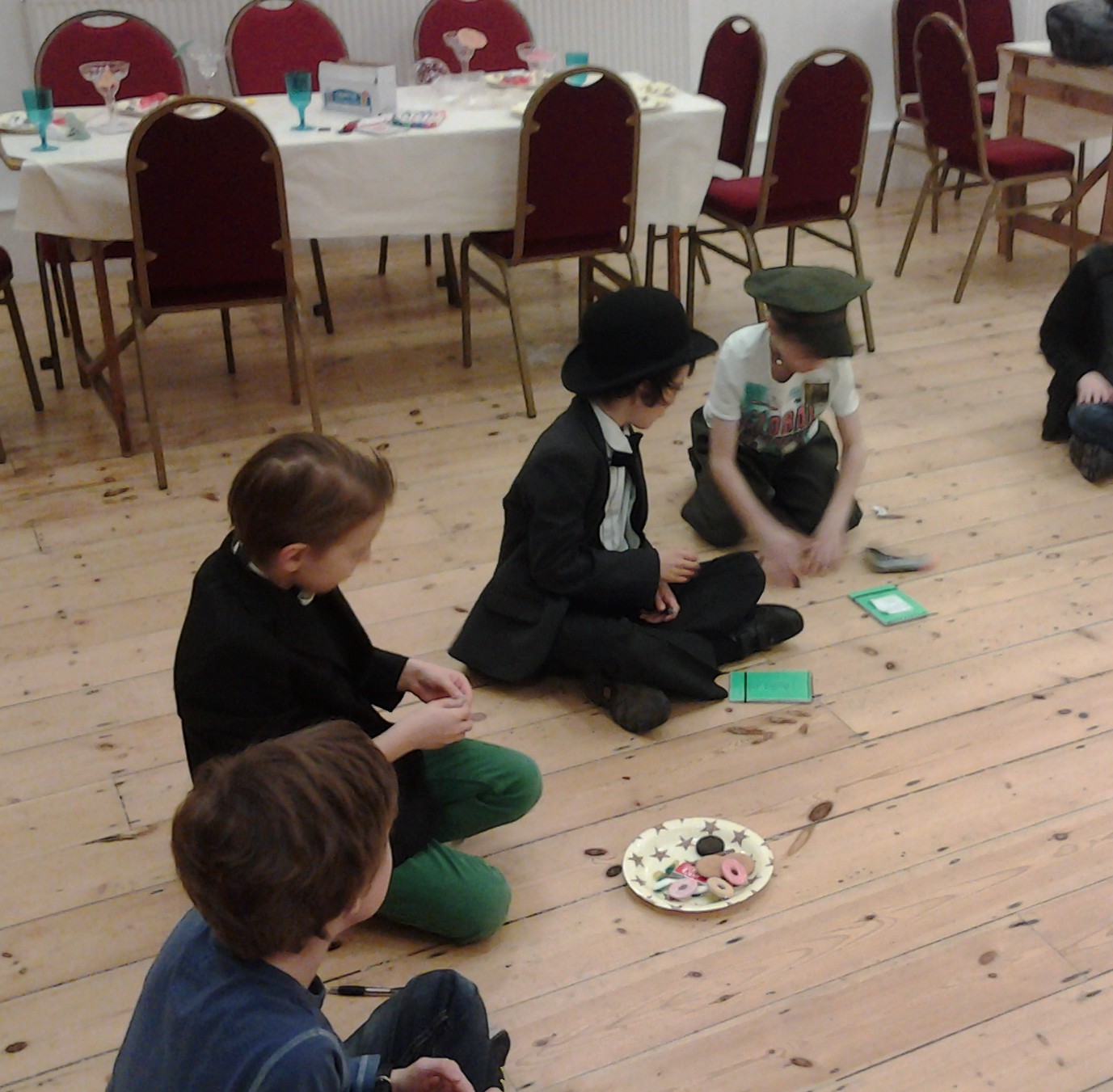
As M is still very limited with the foods he is currently able to eat, I decided to avoid a traditional party tea and instead served a dessert buffet, which included pineapple and Foxes glacier mints, both of which are safe for him.  He was also involved heavily in the decision-making about which cakes, biscuits and sweets would be on offer to his friends, which meant he was aware of what his friends would be eating and was happy to sit with them and chat as they all helped themselves to the selection of treats.  20150301_155523The final party game was “Pass the revolver”, which saw the children completing forfeits to see the final 2 Cluedo cards before they had to reach their conclusions and share the results of their investigations.  Nobody successfully worked out all 3 murder cards, though there was a small cohort who managed to work out 2 of the 3 elements correctly.  We finished with the traditional rousing renditions of “Happy Birthday” and then sent our guests on their way.  Both G and M loved every moment of their Cluedo birthday party and the text messages I’ve since received have assured me that their friends had a great time too.  In the words of one of M’s friends, it was “the best birthday party EVER!
When life gives you lemons…

120907-Lemonade-275x275

…make lemonade. Isn’t that how the saying goes? I have to confess to pondering this one in the early hours of this morning after being woken up by a somewhat distraught M who had just had a soiling accident whilst asleep. He woke me at 3.45am and 2 hours later, my mind was still buzzing and sleep seemed a thing from the dim and distant past. This doesn’t happen very often, but the impact is huge and it got me to thinking.

The impact of M’s condition has been massive on us all as a family and not just on M himself. To anyone who has a “sick” child, you will understand what I mean.

Mike and I have suddenly had to become medical experts in our own rights, despite our alternate careers as an accountant and surveyor, as who else is going to make sure that the best is done for M? I now know so much more about gastro conditions and food allergies than I ever anticipated needing to know. I’ve had to learn coping mechanisms, not just for M to deal with his frustration and anger at being ill, but to help us cope as well. The years of not having an answer have taken their toll and both Mike and I have had to re-learn who our little boy is and what makes him tick. I have to be his first line of defense wherever we are and I’m the one in his corner fighting his cause.

One of the hardest things about this illness is that there are no obvious outward signs that M is ill. He is a slight child and even when seriously underweight and struggling with full toilet-training, he has never lacked energy or enthusiasm for life. He may suffer with stomach cramps and joint aches that would floor most adults, but he just gets on with it. His complaints of aching limbs have been ignored for years as I was guilty of thinking of him as a “moaning” child, but now I know that those aches are very real and extremely uncomfortable whilst they last. He has been living the last 7 years with these as his normal, so he only stops when he’s suffering extreme moments of pain. He had then, and continues to have, the most amazing stamina and a reserve of energy that I can only envy. He is constantly on the go and has never let his health problems slow him down. In very many ways, this is his greatest strength, but also the biggest problem for us.

The lack of obvious evidence of his poor health means that people just don’t understand that he is ill and look at me in disbelief when I explain just how poorly he can be and, to be perfectly honest, I don’t blame them at all. He doesn’t look like a child who eats fresh air and frequently manages on less than 8 hours sleep a night; but he is.

I don’t think that Mike will mind me sharing that he has struggled to come to terms with M’s condition. I have an advantage in that I have grown up living with my own T1 diabetes. I know that these things can be survived and have just got on with it. Mike has found it harder and has longed for an easier fix than the road we seem to be travelling down at the moment. Of course, we now have a diagnosis and that has helped us all. Being able to put a name to the condition, even though it’s so rare that no-one ever seems to have heard of it, means that our fight has not been in vain and we can no longer be dismissed as fussy parents. This is M’s life for now and for the foreseeable future, and as his parents, our job is to ensure that he learns how to make the best of a bad situation.

M has struggled too, as you would expect and his levels of frustration at times are massive. Not only is he restricted by what he can eat and how his body reacts, but he also has to deal with the knock-on consequences. It is no longer possible for him to go home for tea with his friends, attend birthday parties, participate in cooking at school or even have a Christmas or Easter treat, without me having to provide a detailed list of what he can and can’t eat and the inevitable 20 minute discussion with the adult in charge about his condition. We encourage him to have a go at whatever he wants and refuse to let his condition dictate who he is or how he lives his life; and a big thank you has to go to my parents who brought me up with that very same approach to T1D and my life.

He acts out – he kicks and hits and shouts and bites – and sadly the people who have to survive the mood swings are us and G. G has had a hard role to play as the big sister to a poorly child. She worries about his health and I know struggles when we have to disappear off to London for the day for his hospital check-ups. But, she is also a child and has her own challenges to deal with. My children are the best of friends and would defend each other to the end; but are also the worst of enemies. It has become extremely important for us to invest as much time in G as we can and the last couple of months have enabled us to do just that far more than before. She recently took part in a music event organised by the local authority music education department and her clarinet skills were considered good enough to allow her to play with the wind band. This was something just for her and she loved every moment.

She has also been invited to join the local swimming club and that is something we are keen to encourage her to do. There was a point when we wondered a couple of years ago if she’d ever learn to swim, but she is now excelling at it and her teacher invited her to join the Club to see how she gets on. It’s an additional time commitment on a weekly basis for us as she will need to attend at least 1 extra training session a week as well as competitions, but we wouldn’t have it any other way.

I’m proud of both my children – M for his stoicism in dealing with his condition and making the most of life; and G for her continued hard work at school and at her after-school clubs. She may not like the fact that M misses school regularly to attend hospital appointments, but she admits that she wouldn’t want to have the blood tests and diet that he has. Neither child has an easy cross to bear right now, but I hope Mike and I manage to get it right enough to see them successfully and happily through to adulthood.

First Christmas

First Christmas ever with our 2 little monkeys in 2006

Our first Christmas with our 2 little monkeys in 2006

That first allergy-friendly Christmas seemed a little daunting to begin with, but with some canny forward planning and lots of investigation into recipes and food sources, we were able to enjoy as normal a Christmas as possible for those suffering with food allergies.

The first step was to look at each part of the meal and decide whether :

a) it was M-friendly as it was
b) could be adapted to accommodate the “everything-free” diet we were now following
c) could be easily replaced by a free-from alternative available from our local supermarket or health food shop
d) we really needed it, if no obvious alternatives came to mind.

I have to confess that nearly 18-months on, my memory is more than a little hazy about what we did and didn’t, or should that be could and couldn’t, eat. Somewhat ironically, for a household who’d never really had a chocolate advent calendar before, we suddenly had 2 as I discovered the amazing Moo-free advent calendars that suited even my most-difficult to feed child. A Christmas pudding recipe was adapted by my Mum, who then spent Stir-up Sunday with both children in the kitchen to prepare this. Mince pies and shortbread disappeared as no successful alternatives could be found that Christmas; but creams and custards were replaced with dairy and soya free ice-cream.

I even found a vegan chocolate cake recipe which worked and was able to concoct a rather spectacular Christmas cake that we all could enjoy.

I can honestly say that, whilst we had to adapt our menu for the big day itself, we managed it and Christmas lunch was enjoyed by all. Tackling this important day in our year had felt like a real challenge and it was fantastic to succeed against the odds. It might not have been the typical menu enjoyed across the western world, but it suited our family and set us up for life going forward.

Several birthdays and another Christmas on and I am continually searching for new recipes to try or adapt to suit M’s diet. I now have a range of party foods that I can prepare for M and have discovered that some things can be perfectly frozen in advance. This past Christmas we were able to enjoy mince pies as I found the perfect vegan pastry recipe to bake. We have even just adapted a simple shortbread recipe that M had in his reading book from school. By swapping out butter and flour for the snappily titled “free-from dairy alternative spread” and rice flour, we baked a batch of shortbread cookies with which the toughest critic would have struggled to find fault.

We got through that first Christmas despite our fears and were then delighted to welcome a string of Canadian guests for the New Year. As one of those was a vegan, I was suddenly able to put my new-found food knowledge to good use and with the help of the fantastic “Better Food Company” in Bristol, managed to find a whole range of foods that would feed both vegan friends and allergy-suffering children alike. What’s more, the date for M’s scopes had been confirmed and the first week of January saw us welcoming in 2012, Uncle A’s wedding and travelling to GOSH for scopes.

Baby steps

baby stepsThe summer of 2011 was an interesting one.  As I alluded to in my last blog, M took to his new diet like a proverbial duck to water and 9 weeks in, we finally began to see some tangible and very noticeable improvements. The number of toileting accidents reduced significantly and whilst we were still not “accident-free”, I no longer felt as if I was packing for a trek to the Himalayas every time I stepped out the door.

M’s weight did dip a little, but not significantly enough to give us concern and we all enjoyed a fantastic summer holiday. We even managed a holiday abroad – a week’s trip to Portugal with my Mum. We decided to relax the diet a little during that week after discussions with the GOSH dietetics team and M was able to once again enjoy chips with his meals! We even braved half of a small 1-egg omelette without too much of an impact on his health. Both M and G enjoyed a week of sun, swimming and Mediterranean food and I enjoyed being able to get away from home whilst still managing a challenging diet. We went prepared as Mum and I both carried food supplies in our cases and I suddenly became proficient in scanning food labels in another language!

The start of September saw not only M moving up into Year 1, but also our return visit to GOSH. I felt confident that we had established that M did not have an allergy problem with potatoes and thankfully our consultant agreed. We were encouraged to re-introduce potatoes back into his diet as well as trialling the re-introduction of some of the other forbidden foods. As it now turns out, we were definitely attempting to run before we could walk and the trials ended without success. This was a disappointment for M as he was desperate to return to egg mayonnaise sandwiches, but he faced it like a trooper and just got on with it.

It was at this point that we learned that there are in fact many reactions to food allergies. The most dangerous and well-known is an anaphylactic shock such as frequently suffered by those with severe nut allergies. M had never suffered from anaphylaxsis, which has led to people believing that he does not have food allergies, but rather food intolerances. However, as we now know, allergic reactions wear many different hats and we were to encounter some of these as we attempted to re-introduce some foods into M’s diet.

M’s most obvious reaction was the chronic diarrhoea that he had been suffering since he was a baby. This can be an almost instantaneous reaction, but frequently takes several hours to develop. The length of the attack can vary from person to person, but the experience is unpleasant for all.

However, there can also be emotional, social or psychological reactions that can occur up to 72 hours after a food has been eaten. Back in September 2011, M showed this kind of reaction when eating and drinking soya. After a couple of days of including soya back into his diet, M become uncontrollable and somewhat hyperactive. I can vividly remember sitting at a meal with my Mum, my Godmother and her husband at the end of 5 days with M being back on soya. He was unable to sit still, was constantly up and down from the table, was rude, unmanageable and nothing could convince him to behave. A week later in almost identical circumstances, but having been back off soya for 5 days, he sat peacefully, showing the most beautiful table manners and behaving as a completely different child. I have never seen such a dramatic display of how a simple food can have such an immense impact. Even now, we can tell if a trace of soya has crept into his diet unawares.

During our September appointment, we discussed our next steps with the registrar. Although M was a lot better than he had been 3 months earlier, we were still struggling with multiple toileting accidents a week and it was suggested that it might now be worth considering a set of scopes to see what was going on inside.

I would love to say that the next step was to have these performed, but in fact it took a lot of to-ing and fro-ing, several telephone conversations and another visit to London before we got confirmation that the scopes would take place. As we waited for the date of the scopes to be sent, M continued on the strict MEWS diet and we approached our first ever allergy-friendly Christmas!

Dietary Challenge #1

nofood

The first thing to tackle was the introduction of the MEWS diet into our everyday life. M was a child who loved his food and was always keen to try new things. Having to take out some familiar favourites as well as the trusty fallback of chips was not going to be easy, especially as M would no longer be able to eat his all-time favourite meal:  egg mayonnaise sandwiches!

Consider having to give up eating chocolate, fish and chips, roast dinners, cooked breakfasts and milkshakes to name but a few. That would be hard enough for your average adult to do and yet we were asking it of a 5 year old boy. No longer would M hold the family status of being able to eat “everything”; he was now reduced to having the most difficult and restrictive diet of us all. It is truly a credit to him at how brilliantly he took to this proposal. I think that this is when we first realised just how difficult the previous 5 years had been on him and how unwell he must have been feeling. It was pretty much without complaint that M stoically accepted the dietary challenge and 18 months on, we are still impressed with his positive attitude about it.

No longer could I resort to my freezer fail-safes on nights when time was running short or I didn’t want to cook. More or less every meal had to be cooked from scratch as it was the only way I could ensure that none of the forbidden five made it’s way into his meals and I became an overnight expert in reading and interpreting food labels.

From an outsider’s viewpoint, it’s extremely difficult to even begin to comprehend just how tough our new dietary challenge was. Perhaps the easiest way to de-mystify the impact and adjustments we had to make, is to show a “before” and “after” set of scenarios:

Before   After
     
     
Weetabix   Wheat-free cereal
Milk   Coconut or rice milk
Toast   Rice cakes
Butter   Dairy and soya free spread
Jam   Jam
Biscuits  
Fruit snacks eg. Yoghurt covered fruit flakes   Fruit snacks eg. Fruit yoyos or stars
Fresh fruit   Fresh fruit
Sandwiches   Rice cakes or corn thins
Ham   Ham
Cheese  
Crisps  
Yoghurt  
Mashed potato   Mashed sweet potato
Chips  
Jacket potatoes  
Tuna Mayonnaise   Tuna with coconut cream
Egg mayonnaise  
Fish fingers  
Sausages   Wheat-free sausages
Pasta   Wheat and egg-free pasta
Pizza  
Ice-cream  
Chocolate  


The biggest problem I had with a lot of the “free from” alternatives offered in supermarkets is that potato flour is commonly used as a wheat-free substitute for flour.  The initial ban on potatoes made this first dietary challenge a real test of my inventiveness and made Google one of my best friends!

I also had to tackle the issue of M’s weight.  He had only been gaining a small amount whilst on his previous “normal” diet and now we were introducing a diet so healthy that he would naturally lose weight on it if I did nothing to counterbalance the lack of fats.  I had to learn to put “added fat” into my cooking wherever possible and M went from having 1 or 2 packets of crisps a week to having 1 a day.  His lunch box at school was now filled to over-flowing with fresh fruit and veg – thank goodness it was the summer and he could have strawberries galore as a treat – and I’m sure could have won prizes for just how healthy it was.  He also was allowed to take an additional snack into school for mid-morning as there was nothing substantial to see him through the long morning session between breakfast and lunch.

Whilst we had dabbled previously with removing wheat and dairy from M’s diet, this was the first full-on approach to tacking his health problems.  Dr Hill was confident that food allergies were a part of M’s illness, though we needed to establish which foods he was reacting to and whether it was as simple as “just” a food allergy.  Unlike the earlier attempts, we were also warned that it could take at least 8 weeks before we saw any signs of improvement.  This small, yet critical piece of information had never been given to us before, but proved vital as it did indeed take nearly 9 weeks until we started to see some changes in M’s toileting habits.

I am still amazed that we managed to go through so many medical institutes without someone thinking to tell us that the process could take so long.  Looking back now, it seems obvious that the food needs to be completely expelled from the body and no trace left behind before the body can start to repair and yet, it had been assumed that we would know that – or perhaps it’s just that the gastro doctors we had seen before had not known this themselves.

By the time we reached September 2011, although we still did not have all the answers, M’s health had improved and we were well on our way to our final destination.

Reaching London

bus2

In June 2011, we all set off to London for the first of very many visits to GOSH. Walking through those doors for that very first time is an experience I’ll never forget. Having heard so much about GOSH over the years, I had never imagined that one day we would be visiting in what felt like a last-ditch attempt to help our son. I was filled with awe, hope and finally a sense that we would now know one way or another whether something could be done to help him.

It was such a momentous occasion, that we had brought G with us too, feeling that it was important for her to be part of this new journey we were embarking on. I will be forever grateful to her godfather, Uncle A, who was on hand in London and able to whisk her away for an hour to play, whilst Mike, M and I waited to meet his consultant. The only problem was that M really didn’t want to stay with us and would have much rather disappeared to the park than sit and talk to yet another doctor in yet another hospital.

We didn’t have to wait too long and we were quickly ushered into a room with Dr Hill and a member of her team. Unlike many of the other medics we’d already seen, there was no sense of there being a time limit and I was able to fully explain what had brought us to her door. We went right back to the beginning, looking at every aspect of our 5 year journey so far. She asked probing questions and actually listened to our answers; she examined M; considered his height and weight; looked at the food diary that I’d been faithfully maintaining for months, before finally sitting back in her chair.

Perhaps I’m now adding to the sense of drama, but as I look back at the moment that was about to change all our lives, I can almost taste the palpable tension in the air. You have to remember that by now, every doctor we had seen had diagnosed toddler tummy, had rejected the idea of food allergies and felt that there was nothing wrong with M at all. If I were to discover the words “Munchausen syndrome by proxy” scrawled across M’s medical notes somewhere, I really don’t think it would surprise me.

Dr Hill looked at Mike and me and stated, simply,

“Well, there’s obviously something very wrong with this little chap”.

I could have cried, or possibly kissed her at that point! From that moment on, every difficulty we had faced over the past 5 years faded and we had a sense of purpose and of how to move forward.

Whilst usually favouring an investigative set of scopes initially, as we were already old hands at working within the constraints of a restrictive diet, Dr Hill sent us to the Dietician to discuss starting M on a MEWS diet. This meant that for the next 3 months at very least, M would be Milk, Eggs, Wheat and Soya free and, for good measure, because of my own problems with potatoes, we had to take those out of his diet too. This felt like a daunting task, but I knew I would do anything I needed to to seek a resolution for M’s problems. The dietician was fantastic and spent nearly an hour talking through how I could feed my hungry child whilst excluding all these food groups. Laden down with leaflets galore, the all important follow up appointment for September and several phone numbers to give me access to the help we would need, we left GOSH and headed for a local restaurant to enjoy our last “normal” meal for a long time.

As we sat waiting for lunch to arrive, I phoned my Mum to give her the news. She now says that she could hear the relief in my voice and I’m not surprised. I felt as if a huge burden had been lifted from my shoulders, all because one individual had listened and believed what I had to say about the health of my child. There was no question about our parental instincts, simply affirmation. We were right to have pursued in our goal and though we were still to wait another 18 months to get the final diagnosis, we knew that suddenly the future looked bright.

Five consultants, four registrars…and a partridge in a pear tree!

We had reached the end of our patience with the local hospitals and doctors. M had started school the previous September and was doing well, having managed to exceed all expectations and avoid any embarrassing toileting “accidents” during school hours. Things at home however, were not getting any easier.

We had now suffered disrupted nights for 5 years thanks to M’s inability to switch off and fall asleep until past 11pm and he often woke once or twice a night and ended up in our bed. Whilst not every night was sleepless, it certainly felt that way and our sheer exhaustion was taking its toll on the whole family.

Every day was a relentless routine of regularly cleaning and changing M as he suffered from chronic diarrhoea and still hadn’t cracked full toilet training. On the best days, we had to change him 3 times, on his worst, 5 or 6 times wasn’t unusual. We had even managed to blow the motherboard of our washing machine after doing load after load of dirty washing on an almost daily basis.

He continued to eat huge amounts, complained of feeling constantly hungry and relished the fact that he was the only one of the family able to eat everything he wanted – G was still wheat, dairy and oats free, Daddy was mildly lactose-intolerant and I had discovered an arch-nemesis in the form of the simple spud! Meal-times were challenging as I cooked to manage every dietary need, but I look back on those days with fondness now as cooking daily has become even more…well…challenging.

We were also struggling with manic mood swings and temper tantrums that rocked the house when something went wrong. We now understand that M was frustrated with his inability to manage his toileting and this tipped over into every other aspect of his life, but at the time it just seemed like another behaviour that needed to be managed. And no, the old favourite of the star chart, recommended to us by every medic who’s path we crossed, did not help at all.

By May 2011, M had seen or been referred to:

  • 5 consultants
  • at least 4 registrars
  • 2 hospitals
  • 2 GPs
  • 1 school nurse
  • 1 continence clinic
  • 1 CAMHS nurse
  • and numerous other medical staff along the way

Finally at my wit’s end and obviously showing signs of strain, I sat in our GP’s consulting room and asked where we could turn to next. My mother’s instinct was still full force and despite the now numerous diagnoses of toddler tummy and the reassurances that M would grow out of it all, I knew categorically that he wasn’t getting any better and that we were now 5 years on from the initial set of problems.  I will be forever grateful to this individual who had absolute sympathy for our plight and offered to refer us to anyone, anywhere in the country.

With this in mind, we started to investigate where M could go in search of some answers and were pointed in the direction of Great Ormond Street Hospital (GOSH) in London. My Mum had been suggesting that we should go to them for a long time, but I had always ignored this advice, believing that whilst I knew something was wrong, it wasn’t serious enough to warrant a visit to those hallowed grounds. However, every other avenue open to us had been fully explored and when, at our final visit to the local Children’s Hospital, the registrar refused to perform an investigative colonoscopy on the grounds that such invasive intervention was too traumatic and unnecessary in M’s case, I knew we had to take a chance.

Mike contacted GOSH and asked for a name of a gastro-specialist that our GP could refer us to. We had to pay for the benefit of a private referral as a NHS referral could only be done through our local hospital, who still held there was nothing wrong, but we believed that this was the only way to get the answers our family so desperately needed.

Gut instinct

Buffet-Table1

Despite an appetite to rival a grown man’s, M’s weight stuck determinedly to the 9th percentile and considering his complete inability to be successfully potty-trained, this wasn’t really surprising. When I say he could eat as much as an adult, I’m not exaggerating – on one occasion he managed to consume more in a day than a good friend of the family, who had an extremely healthy appetite.

M was diagnosed early on by our GP as having “toddler tummy” and we were told that he would just grow out of it. This was a diagnosis that was going to dog our steps for the next 3 years. At this point, G developed some gastro problems of her own following a bout of food poisoning and another of gastroenteritis, and we established ourselves, as the medical tests proved inconclusive, that she was struggling with intolerances to wheat, dairy and oats. The thought had crossed our minds that perhaps M had similar intolerances, but our attempts to remove these from his diet showed no improvement, unlike for G.

It was armed with all of this knowledge, that I went back to the GP and insisted on a referral to a specialist, having kept an extensive food diary for a couple of months. This recorded not just what and how much M was eating on any given day, but also his sleep patterns (which continued to be poor) and his toileting habits. We also put together a list of our main points of concern. Preparation is key and we wanted to make sure we had a case to put to the specialist.

Our first appointment was disappointing. The specialist listened carefully, nodded sympathetically and instantly agreed with the GP’s diagnosis and left me feeling, once again, a paranoid Mum. He also referred M to the same specialist that G was seeing, in the belief that maybe our children were suffering from the same problem. My gut instinct disagreed and I made my feelings on the matter clear. Although on the face of it, their symptoms seemed similar, there were key differences that I knew had to be taken into consideration.

I have learned that a parent’s gut instinct is possibly the most important thing that any medical practitioner can listen to or, at very least, consider to be as important as the physical symptoms described. I knew deep down that there were something very wrong with my boy, but on the face of it, few agreed. His lack of toilet training was an annoyance we should learn to manage; his healthy appetite nothing of note; his poor weight gain irrelevant as he was growing along his predicted percentile; and his poor sleep patterns the same as every other new parent had to deal with. At each and every appointment we attended with M in tow, he was active, energetic, chatty and showed no sign of the tremendous tantrums he could throw at the drop of a hat at home.

Depending on our gut instincts about M and our determination to find out what was wrong, we kept on battling and refused to accept that it was toddler tummy and that he would eventually get better without any intervention.

Unfortunately, over the next two and a half years, we would need to rely heavily on that perseverance and an inner depth of strength that exceeded what either of us knew we had. We moved from one consultant to another, one hospital to another and even one GP’s surgery to another as we moved house and chased a diagnosis. Finally, in May 2011, we were given the referral that would finally set us on the road to an answer.

The first signs

It’s only now, looking back at those first couple of years with M, that I can so clearly see that all the signs pointed to something being wrong. BUT, as with all young parents, we took the rough with the smooth and just assumed that it was part and parcel of the development process, especially with a premature baby. Hindsight is a wonderful thing, but only because it is exactly that.

In the months following his traumatic arrival into our lives, M suffered with chest infections, high temperatures, reflux, high-pitched screams, poor sleep patterns and what I now realise was almost constant diarrhoea. He was prescribed an infant inhaler, seemed to bounce from one course of antibiotics to the next, gulped back infant Gaviscon with every meal and, despite his epic size and weight at birth, stayed at the petite end of the scale. He dropped from the 95th percentile at birth down to the 9th percentile, but everyone assured me that he was healthy and thriving – one doctor even suggested that his weight had been recorded incorrectly at birth and that his massive weight loss and subsequent low weight gain was nothing to be concerned about.

Comparisons between M and G also seemed irrelevant – G was your typical first-born girl. Bright, articulate and not exclusively breast-fed, unlike M who successfully breast-fed for the first 7 months. The health professionals suggested that the differences in weight, appetite and nappies were because he was breast-fed and as M seemed to be a relatively happy baby, I had no reason to question any of the theories behind his small size and constant battles with illness.

It was purely a chance comment by our nanny when M was around 15 months that triggered a realisation that perhaps something was wrong. She had been chatting whilst out at a local toddler group with M in tow, when another mother commented on how many times she had to change M’s dirty nappy. It wasn’t a complete surprise to us when she mentioned that perhaps the 8-10 dirty nappy changes a day in my 15-month old wasn’t “normal” as I had raised a similar concern with our health visitor when M was 8 months old, but it did make me stop and think.

I went back to the local health centre and voiced once again my concerns that 8 dirty nappies a day wasn’t typical and was told to keep an eye on it and to come back in a couple of months and see the GP if I was still concerned. M appeared to be thriving and was growing along his percentile line, so they weren’t as worried as me and I now suspect that this is this time when I first got labelled as a fussy Mum!

Little did I know then, but 7 years on, we now know that I wasn’t just a paranoid or fussy Mum, but rather that there was a genuine medical problem behind our concerns and that really our battle was only just beginning.

M's arrival

It wasn’t the easiest of starts, especially after the wonderful experience of our firstborn daughter, G. My first pregnancy had been easy and I had loved every moment of becoming a first time Mum. When, two years on, we decided to bite the bullet and go for baby number 2, I naively thought that it would be a similar experience, though a little more tiring as I now had an active and inquisitive toddler to deal with too.

However, from pretty much day one, my second pregnancy was tough. I suffered from morning sickness for months, developed SPD from 8 weeks and by month 4 was using a walking stick and eventually a wheelchair to get around. I suffered from low blood pressure and frequently felt faint and dizzy when standing. I stumbled my way through G’s second birthday party from the comfort of my rocking chair and just about managed Christmas too.

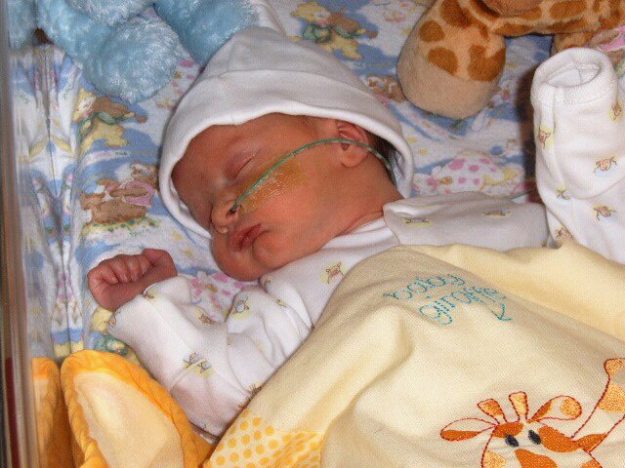
However, by the middle of January it was becoming obvious to everyone that something wasn’t quite right with my pregnancy. I was admitted into the High Dependency Unit of our local maternity unit at 26 weeks and that kick-started the roller-coaster ride to M’s birth on 8th March. M arrived 7 weeks early, weighing a mighty 5lbs 12.5oz (I dread to think what would have happened if I’d managed to get even close to full-term) and after an extremely harrowing birth experience for all concerned, M was born not breathing. He was resuscitated quickly and whisked off to NICU, without me even seeing or cuddling him. We had chosen a name and Daddy went with him and eventually came back clutching a polaroid photo of our new son for me to see.

Despite the extremely hairy start, M responded well and by just 3 weeks later, a full month ahead of when NICU would have expected it to be possible, we were sent home on Mothering Sunday with our baby boy in tow. It was, without doubt, one of the best Mothers’ Day gifts I’ve ever received – being able to be at home with both my children with me.

What we weren’t to know then, was that the following 7 years would be filled with a huge amount of tears and trials before we reached a diagnosis for the condition that would slowly appear.