Tag Archives: Occupational therapist

It takes a village

village

Do you know that quote?  There’s a chance you might associate it with American presidential hopeful, Hillary Clinton and her 1996 book of the same title, but in fact it comes from an Igbo and Yoruba (Nigeria) proverb and has a sentiment that is echoed by numerous other African sayings.  It recognises the great value of having community involvement in a child’s upbringing, not just for the child and immediate family, but for the extended family and local community too.  As I have mentioned so many times before, we are incredibly fortunate to have an amazing community surrounding us, who are unbelievably supportive, and none more so than our fantastic village school.

Since day one, when G first headed in through their gates, we knew that this was a place that would offer our children not just a great education, but also a safe and secure place to grow and develop, all within walking distance of our home.  The children have had the opportunity to build strong friendships with others living nearby that will hopefully continue into their teenage years and beyond.  In the 2 years that M has been there, we’ve seen time and time again just how invaluable the school community is, not just to M, but to G and to Mike and me too. The impact of M’s ever-changing health has been particularly profound in the last couple of years and there is no doubt in my mind that the unfailing support of their school has been a steadying force for us all.

Without the readiness of the Head and other key members of staff to accommodate M and all his needs, we would have struggled to keep his education a priority this year and I doubt I would have been able to continue working.  Their willingness to have M in school as normal and to learn the intricacies of his NG-tube and feeding regime has allowed me to stay in my job, confident in the fact that this is a group of people dedicated to including M in every planned activity and who have taken on that intense in loco parentis responsibility without a second thought. This year in particular has tested their mettle with the demands of not just feeding tubes and complex allergy requirements, but of occupational therapy, dyspraxia and dyslexia added to the mix too.  His teacher, Mrs M, has been amazing and she approaches every new challenge with great positivity and an unparalleled sense of humour. www.amazon.comEven the minor hiccups encountered along the way – non-stop beeping, blocked tubes, leaking pumps and soaking wet clothes to name but a few – haven’t derailed her and that attitude has helped M cope remarkably well with all the changes this year has thrown at him.  I cannot thank her enough for being the rock that M has needed during school hours.

Equally, Miss K, G’s lovely Year 6 teacher has been a real blessing to us as a family and to G in particular.  She has encouraged G every step of the way and helped build her confidence throughout the year.  M’s hospital stay in December was difficult for G as he and I disappeared off to London for 2 weeks and couldn’t be around to help celebrate her 11th birthday or enjoy the end of term build-up to Christmas.  What made a big difference was Miss K, who was fully aware of all that was going on, made herself available to G whenever necessary, understood that emotions were high and made allowances when needed, and stayed in regular e-mail contact with me during our stay and also during the Christmas holidays, so she was as prepared for where things stood with M as the rest of us.  She is moving on from the school at the end of this term and I, for one, will miss her, especially as I was hoping she would be M’s teacher for his Year 6 year.

It’s not just the teaching staff who have done their utmost to give us the support we depend on, but the parents and children too and this past week I was left speechless by the thoughtfulness and compassion of M’s class.  Following his presentation during EGID awareness week, this group of enthusiastic 9 year-olds discussed different ways they could support him and focused their attention on the fact that he has to wear a backpack all morning, which contains his pump and his “food”. This is what happened next:

“We decided, as a class, that we would all wear a backpack for a morning so that we are able to understand a little of what M has to go through each day. Therefore, on Friday 10th July, it would be great if all of 4M could wear their backpack to school and keep it on for the whole morning!  If you can make it weigh about 2 and a half kilograms that will be amazing as that is the weight that M carries around each day.”

20150710_111650On Friday I had the privilege of going into school to see this amazing group plus teacher and teaching assistants with their backpacks on and to express my thanks, not just to the children, but to Mrs M and the school for encouraging and allowing them to show their support in this tangible way. His classmates have adapted well to M’s tube and accept it as an essential part of him.  They’ve asked questions and been interested in the whys and wherefores about it and then just forgotten all about it and carried on with day-to-day life, which is exactly what M has needed.

There have also been shows of support from parents, including one from a Mum I’d never met before and doubt I’d recognise again.  We were travelling back home late from our last GOSH appointment after a long, hot day in London and arrived back at our local train station.  As we reached the stairs of the railway bridge, I became aware of a fellow passenger catching up with us and smiled with her as she chuckled at the inane chatterings of my night-owl.  I paused to let her go past, but she slowed her pace to match mine and started an unexpected conversation:

“I just wanted to tell you that my children are at the same school as your son and came home and told us all about his presentation. They both raved about how amazing it was and how much they had learned from watching it and asking him questions.  I just wanted to tell you how impressed they both were, especially as they now understand a little more of what he’s having to cope with and we all think he’s incredibly brave.”

The conversation carried on until we reached our cars and said a quiet good-night. This for me is the advantage of having not just a child who stands out from the crowd because of his tube,Colorful solidarity design tree but also a community who is brave enough to have the confidence to speak out words of encouragement to a near-stranger because of a shared experience and the desire to add their voice to offer support.

From helping take G to school early in the morning to having my tubie home for tea; and from working hard with M to improve his handwriting to encouraging G to reach her potential and aim for the stars, our school, its outstanding teachers and the families who go there have helped us out along the way. This academic year has been a tough one, but we’ve survived all the bumps in the road with the loving support of the truly exceptional community that we live in.

Busy days

Now that Halloween and Bonfire night are behind us and Christmas is fast approaching, there’s finally a little time to look back and reflect on the start of the new academic year.  September seems like a lifetime ago and yet was a busy month with appointments right, left and centre that have had a lasting impact on decisions about M’s long-term care.  We had appointments with GOSH, a new community paediatrician, M’s OT and with CAMHS; and I needed to be the thread that linked them all to ensure that M remained at the centre of their focus and that all agencies were working together to provide the best support they could.

Courtesy of travaasa.com

Courtesy of travaasa.com

The OT’s review was everything we needed it to be and she has already started going into school once a week to work with M on his handwriting skills.  The clinical psychologist he meets with fortnightly through CAMHS is slowly building a relationship with him and gently pushing him to talk about how he feels about life with EGID and the frustrations he experiences.  As for the new community paediatrician, who was recommended by our local hospital, well, lets just say we won’t be rushing to meet with her again.  Her complete lack of understanding of his condition was glaringly evident as she suggested that regular toileting and a sticker chart were the answers to all our problems.  How I refrained from saying something very rude is nothing short of a miracle!

The most important of all these, for us, was our regular appointment at GOSH with the gastro team charged with M’s care.  The restricted diet and increased medications over the last 3 years have not brought about the results we’ve been aiming for and M continues to be symptomatic a lot of the time.  We have become increasingly concerned about his emotional well-being as he struggles with the impact of EGID and multiple food allergies on his daily routines and I was determined to come away from that appointment with a tangible plan in place.  Despite our best efforts with the challenging treatment suggested by the local consultant leading into the summer, our worst fears were realised when the registrar told us that M appeared to be impacted again and we would need another course of fairly heavy-duty laxatives to empty his bowel.

planningThat led into a lengthy discussion about where we’re headed and what the most sensible next steps for M’s care are.  Short-term plans are all well and good, but we now need a long-term care plan put in place.  He agreed that we can’t keep limping from one appointment to the next and promised to discuss M’s current situation with our consultant.  Medical terms such as “pellet study“, “elemental diet” and “manometry” were bandied around and I am glad that, thanks to the support from other FABED families, I have a reasonable layman’s understanding of what all these terms actually mean.

We left the hospital feeling that we were beginning to making some progress in dealing with the problems that continue to dog M’s every step and a short-term plan that would start to deal with the current impaction issue.  The longer term decisions would be discussed both internally and with us before anything was settled on for definite.  A follow-up appointment with the consultant herself was made and our step was just a teeny bit lighter as we felt our concerns were being heard and addressed.

Courtesy of abercrombierealestate.com

Courtesy of abercrombierealestate.com

However, since that day, over 7 weeks ago, I have spoken to GOSH at least once a week and almost daily over the past 10 days.  The improvements expected haven’t happened and so the decision has been made to admit M into the hospital for further testing.  We need to understand whether his bowel is working as it should or not as that will give us a clue as to the direction we need to head.  We have also agreed with his consultant that the diet and medicines just aren’t helping his hugely allergic colon and so have made the decision to remove all food from his diet and follow the elemental diet via NG-tube for a while.  This should give his bowel and body some much-needed time to rest and recuperate, something I believe it so desperately needs.

Time for a Dyspraxia update

Over the last 18 months since we received a diagnosis of dyspraxia and visual dyslexia for M, he’s been making some progress and it was good to have a review this week with his Occupational Therapist to see just how far he’s come and what he should be aiming to achieve next.  When he was first assessed, it was noted that he had significant issues with his upper body strength, which was leading to weaknesses with his fine and gross motor skills.  He struggled to hold his cutlery or pencils correctly, couldn’t tie his shoelaces, wouldn’t tackle riding his bike and had handwriting that, at best, bore a passing resemblance to ancient hieroglyphics, assuming they’d been scrawled out by a spider meandering meaninglessly across the page.

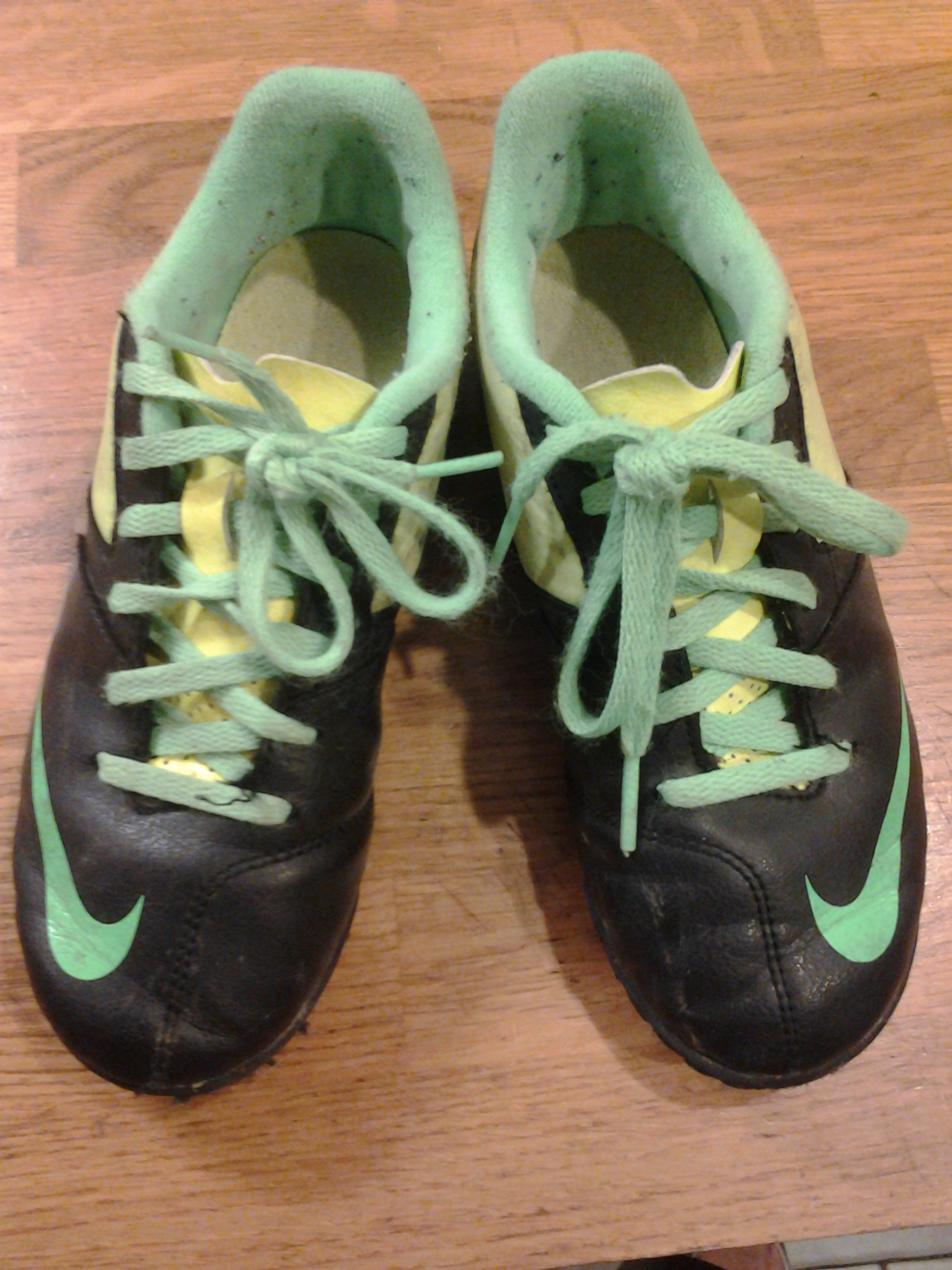
20141104_184432

Shoes tied by M

Meal-times have become easier, thanks to the sets of caring cutlery I invested in soon after we met his OT for the first time.  M has grown in confidence as he’s mastered the co-ordination needed to cut up his food himself, although constant reminders to actually use his cutlery are still a main feature at our dinner table!  After a year of having to ask for help to tie the laces on his football boots, M decided he was going to crack that challenge over the summer and having so determined, succeeded quicker than any of us expected, himself included, and was rewarded by 2 new pairs of trainers – with laces – whilst we were out in Florida.  As for the bike, well it’s still something of a no-go area for M right now, but the draw of being able to cycle to his godmother’s house along our local cycle-path, may be all the impetus for learning that we’re going to need this autumn.

However, the one skill that still needs a lot of work is that of his handwriting and was the key area for my discussion with his OT yesterday.  Over the last few weeks, I have been trying to track down some additional support with his literacy skills as we have become increasingly concerned that his school-work will start to suffer if an improvement isn’t made soon.  I contacted both our local Dyslexia Centre and the local branch of Dyslexia Action, to find out what support might be available to M and similar answers came back from both.  There was an opportunity for weekly, 1 hour small group sessions to develop his writing and literacy skills, but although it sounded good, there inevitably was a downside.  The sessions are only run during the day, Monday to Thursday, which would mean that he would need to miss around 2 hours of school a week, by the time you allowed for pick-up and travel.  As the helpful Dyslexia Action representative warned me, “You’ll have to get the school on board first, as they may be reluctant to allow him to miss that much school each week.”

I mused over the decision and discussed it at length with Mike.  Whilst we both know that the time is critical for M right now and he really needs that support, we are also waiting for an admission to GOSH, which will mean at least a week off school.  On top of all his other regular appointments, I felt that it was just too much time absent from his friends and his learning and so decided to put this plan on a back-burner for the time being until we have some more information about the admission.

At this point, like some sort of guardian angel, his OT expressed her own increasing concerns about his handwriting skills and suggested the perfect solution to our dilemma.  She has offered to visit M in school for an hour a week for 6 weeks and will work with him and a member of staff, teaching him how to properly form cursive handwriting and write in a size that makes his writing legible.  handwritingShe will make sure he is sitting correctly, holding his pencil in the right way and knows how each letter should be formed.  His class teacher has said that M is reluctant to use cursive writing, believing that he needs to print instead, so the OT will show him some examples of work from other children she has worked with to convince him that this is the way to go.

I am so delighted that this is being offered by an OT who is as concerned about M’s handwriting and the impact on his learning as we are and, what’s more, wants to actively do something about it. As well as teaching M the skills he needs, she will also be teaching the member of staff about what he needs to be doing in class and how they can encourage him to continue the good work once her 6 weeks are up.  M’s SENCo, who also just happens to be his class teacher this year, has already agreed that the school are happy to accommodate the OT’s visits and now I’m just waiting for confirmation of when the sessions will start.

Dyspraxia support

Courtesy of shoreline-pt.com

Courtesy of shoreline-pt.com

As well as going back to school, we’ve also had M’s referral appointment for Occupational Therapy to support him with his dyslexia and dyspraxia.  We had been warned that we might have to wait up to 9 months for the referral to be made, so you can imagine my delight to be offered an appointment just 3 months into the process.  The therapist, D was fantastic and a lot of the health professionals we’ve seen along the way could learn a great deal from her approach to helping M.

Unsurprisingly, she had not come across EGID before, so had spent some time researching the condition and understanding how this might impact on M before we got to the appointment.  She had read thoroughly the reports completed by the Dyslexia Centre, school and us, but then spent more time clarifying points with me, taking into consideration the change of schools and asking what we were hoping to achieve through OT.  As we chatted, D observed M as he played with the various activities she had set out in the room, including a bat and ball, foam football and low-level balance beam.  Her conclusion was that he most needs the support in improving his fine motor skills, which will directly impact his academic prowess and that working on those will then lead to an improvement in his gross motor skills and balance.

She then switched to assess his writing, cutting and cutlery-holding skills, all of which I had mentioned as areas that I felt needed some work.  M showed his reluctance to write by insisting on discussing each task she set him, obviously in the hope that he could browbeat her into leaving them untouched, but he had met his match.  D listened to his comments, acknowledged them and then prompted him to get on with what she had asked.  He may have grumbled each and every step of the way, but he did them all and enabled D to assess as she needed.

Creating and then dismantling paper-clip chains

Creating and then dismantling paper-clip chains

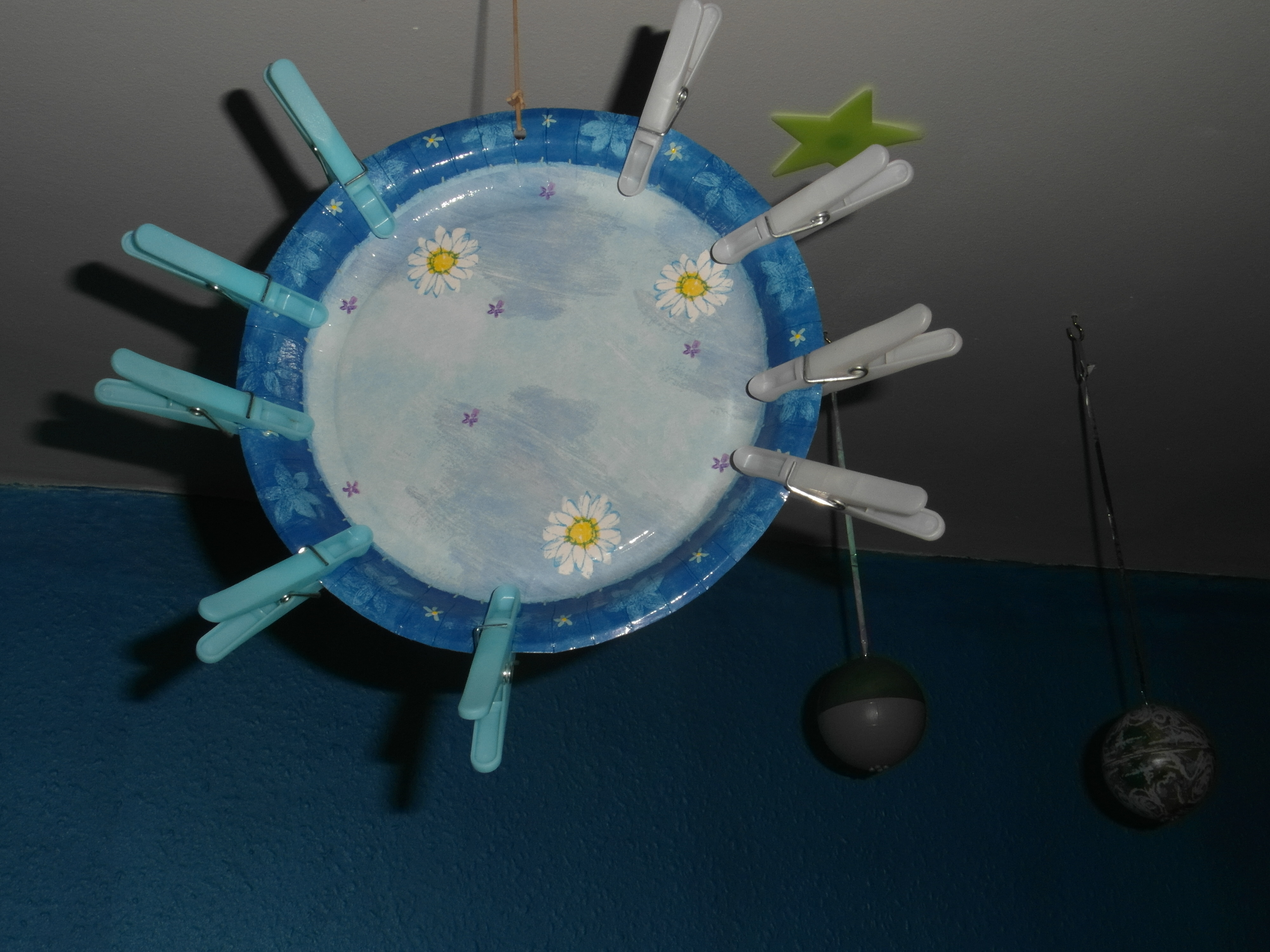
D suggested a number of games using everyday items – clothes pegs, marbles and paperclips – and explained how these would help build his finger strength.  She set him challenges and played the games with him, so that he could understand what was required and she could check that he was doing them correctly.  What impressed me the most was that D gauged accurately how many games to introduce and how long to play each one such that she didn’t overwhelm him with suggestions.  Playing these games at home several times a week will bring about improvement and I foresee a number of family challenges to see who can perform the best.

A paper plate sun with peg rays to attach every morning

A paper plate sun with peg rays to attach every morning

D also agreed that using a writing slope at school will make a massive difference to his writing ability.  As it is highly unlikely the school will have one lying around, the OT department will arrange to lend one to the school for 3 weeks, which will allow the teachers to assess the difference it makes to his work. This will be followed up by a written recommendation and a school visit, where D will be able to observe M in the classroom setting and see what else might be done to support M and help him achieve, before meeting with the SENCo and suggesting how some funding from their SEN budget will help.

This school visit will then be followed up by a return appointment with M himself, whereby she can see if the daily activities she has suggested have helped and whether school have followed her recommendations and funded the special equipment he needs.  I have already invested in a set of “caring cutlery” to help him at meal-times:

Courtesy of completecareshop.co.uk

Courtesy of completecareshop.co.uk

Whilst we continue to struggle with his gastro health, it is a huge encouragement that there is something useful that we can actively do to improve M’s school-work and performance. He is a bright and articulate child and it will be both fascinating and exciting to see how things develop over the coming months.