
It will come as no great surprise to anyone who knows us when I say that M is something of a daredevil. A true speed demon who loves nothing more than racing around at breakneck speed, sometimes with a frightening lack of regard for his own well-being or my nerves. I think his attitude to life could well be described as “why do anything at walking pace when you can run?” He’s always been the same and mastered climbing out of his cot and climbing up anything to hand (think window-sills, wardrobes and shelving units) from an early age. It was something of a shock when he swept into our lives like a whirlwind, especially after 2 peaceful years with G, who took a much more relaxed approach to just about everything in her early years.
Despite M’s continuing love of climbing, which now includes any tree he can get a foothold on, and his passion for being constantly on the go even until the wee small hours, he has struggled to come to grips with the more mechanical methods of moving around. His obvious clumsiness as a toddler and unquestionable difficulties in balancing in gymnastics meant that it came as no great surprise when a few years later he was finally diagnosed with dyspraxia and dyslexia. M didn’t particularly struggle with his hand-eye co-ordination, in fact his nursery commented on how impressed they were with his tennis skills at age 3, but fine motor skills, upper body strength and balance have all taken a lot longer to achieve and are things he continues to work on both at home and in school. 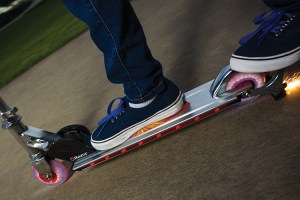 It took a little longer for him to become confident on his scooter, but his determination to succeed on a 2-wheel one, rather than the 3-wheel “easier” option, paid off and earlier this year he saved up enough money to buy himself the new one he’d been eyeing up in the Argos catalogue since last Christmas.
However, the one thing that had continued to defeat him was successfully riding his bike without stabilisers. For years, M has been telling us that all we needed to do was arrange a return visit to Canada so Grandpa could teach him how to ride his bike, just as he had G and the rest of their cousins; and there was little we could do to persuade him that he could actually learn at home. Despite M’s belief that Canada and Grandpa were the key to his success, we’ve continued to encourage him to practice at home and had even attempted removing the stabilisers a couple of times in an attempt to push him into giving it his all, but to no avail.  When M had his NG-tube placed at the start of this year, he was initially a little more cautious about all things even vaguely adventurous and after a couple of failed attempts on his bike, it was relegated to a dusty corner of the garage to gather cobwebs.
I’m not quite sure what changed over the summer, but something obviously did. It may have been seeing G and Mike head out on some Saturday afternoon bike-rides, whilst he and I played together at home; it could have been his increasing belief that he can do anything he wants with his tube in place; and without a doubt, his improved balance that is so clearly evident as he scoots around and attempts trick-jumps on his scooter also played a part; but a few weeks ago he finally found the courage to take that last step. It came as a something of a surprise and was his response to my somewhat flippant comment one afternoon. He was chatting away to me as I was pulling the washing from the machine in our garage and talking about Mike’s need to tidy up in there. I told him that in terms of sorting out their outdoor toys, maybe we should get rid of his bike as it was just cluttering up the corner and could be put to better use by someone else. He took it as a personal challenge:
“Ok Mummy, I’m going to get on my bike and ride it now!“
and with that comment, on he jumped and wobbled his way out onto the driveway, with his toes barely touching the ground.
I watched from the kitchen door as M persevered to overcome this challenge that has been his nemesis for so many years. There was a look of absolute determination etched into his brow and he just kept on going until, with G by his side cheering him on, he finally managed to put both feet to the pedals and rode the length of our driveway. Elated with his success, both children shouted out in triumph, summoning Mike and me to watch in amazement as M grew in confidence in front of our eyes and completed his victory lap several times over. Since that day he’s improved in leaps and bounds, with his bike being the first thing he pulls out as soon as he gets home from school for a few bumpy trips around the garden. We always knew that his premature arrival in the world with the dyspraxia added on top would mean he might take a little longer to master certain skills, but that he would get there in the end; and we were proved right that his refusal to be beaten by anything would eventually lead to an even sweeter success when we least expected it.


 7 years to diagnosis