Tag Archives: NHS

Busy days

Now that Halloween and Bonfire night are behind us and Christmas is fast approaching, there’s finally a little time to look back and reflect on the start of the new academic year.  September seems like a lifetime ago and yet was a busy month with appointments right, left and centre that have had a lasting impact on decisions about M’s long-term care.  We had appointments with GOSH, a new community paediatrician, M’s OT and with CAMHS; and I needed to be the thread that linked them all to ensure that M remained at the centre of their focus and that all agencies were working together to provide the best support they could.

Courtesy of travaasa.com

Courtesy of travaasa.com

The OT’s review was everything we needed it to be and she has already started going into school once a week to work with M on his handwriting skills.  The clinical psychologist he meets with fortnightly through CAMHS is slowly building a relationship with him and gently pushing him to talk about how he feels about life with EGID and the frustrations he experiences.  As for the new community paediatrician, who was recommended by our local hospital, well, lets just say we won’t be rushing to meet with her again.  Her complete lack of understanding of his condition was glaringly evident as she suggested that regular toileting and a sticker chart were the answers to all our problems.  How I refrained from saying something very rude is nothing short of a miracle!

The most important of all these, for us, was our regular appointment at GOSH with the gastro team charged with M’s care.  The restricted diet and increased medications over the last 3 years have not brought about the results we’ve been aiming for and M continues to be symptomatic a lot of the time.  We have become increasingly concerned about his emotional well-being as he struggles with the impact of EGID and multiple food allergies on his daily routines and I was determined to come away from that appointment with a tangible plan in place.  Despite our best efforts with the challenging treatment suggested by the local consultant leading into the summer, our worst fears were realised when the registrar told us that M appeared to be impacted again and we would need another course of fairly heavy-duty laxatives to empty his bowel.

planningThat led into a lengthy discussion about where we’re headed and what the most sensible next steps for M’s care are.  Short-term plans are all well and good, but we now need a long-term care plan put in place.  He agreed that we can’t keep limping from one appointment to the next and promised to discuss M’s current situation with our consultant.  Medical terms such as “pellet study“, “elemental diet” and “manometry” were bandied around and I am glad that, thanks to the support from other FABED families, I have a reasonable layman’s understanding of what all these terms actually mean.

We left the hospital feeling that we were beginning to making some progress in dealing with the problems that continue to dog M’s every step and a short-term plan that would start to deal with the current impaction issue.  The longer term decisions would be discussed both internally and with us before anything was settled on for definite.  A follow-up appointment with the consultant herself was made and our step was just a teeny bit lighter as we felt our concerns were being heard and addressed.

Courtesy of abercrombierealestate.com

Courtesy of abercrombierealestate.com

However, since that day, over 7 weeks ago, I have spoken to GOSH at least once a week and almost daily over the past 10 days.  The improvements expected haven’t happened and so the decision has been made to admit M into the hospital for further testing.  We need to understand whether his bowel is working as it should or not as that will give us a clue as to the direction we need to head.  We have also agreed with his consultant that the diet and medicines just aren’t helping his hugely allergic colon and so have made the decision to remove all food from his diet and follow the elemental diet via NG-tube for a while.  This should give his bowel and body some much-needed time to rest and recuperate, something I believe it so desperately needs.

Just when you thought it was going to be easy…

…something happens that shows you that it really doesn’t pay to be complacent, especially when it comes to children with complex medical needs.  The reason for my most recent angst? The whole ‘flu vaccination thing! Yes, you probably read my blog post over a month ago, where I discussed the decision process we were going through regarding M and the ‘flu jab, and almost definitely concluded by the end that everything was set firmly in place.  Having visited our new GP, I certainly felt that we had agreed what was best suited to M’s needs and was now just waiting for the confirmation phone-call and a date for my diary.

You’ll have guessed by now that it hasn’t been that easy and whilst that doesn’t come as any surprise to me when it concerns my youngest, the complexities of getting the situation sorted came at a time when, to be perfectly honest, I really didn’t need the added aggravation.  It all started when I phoned the surgery to book the appointment.  The receptionist needed to discuss which clinic to book M into because he was having the injection and not the nasal spray and so referred him on to the practice nurse, with a promise she’d call me back.  10 days and 3 phone-calls later, I was still waiting for the practice nurse to confirm which clinic M needed to attend.  Oh, and there was the added problem – or so I was told – that there wasn’t enough child vaccines in our health centre, so we would have to wait for those to arrive before I could make a definite appointment.

This is definitely a t-shirt us #EGID parents need!

This is definitely a t-shirt us #EGID parents need!

The string of events that followed are like the plot of a bad 1980s sitcom as we got bounced from one local medical establishment to the next.  The first problem was that the no egg vaccine is not licensed for use in under-18s and so the nurse wasn’t happy to give it to M, especially as he’s never had the vaccination before.  She was keen to discuss the situation further with one of our local hospitals and so I agreed to wait.  Next, I had a message telling me that the hospital would give M the injection, so that he could be monitored and could I confirm that I was happy for my contact details to be passed onto the appropriate administrator to arrange that appointment.  Needless to say, I confirmed as soon as I could and then sat waiting for the next installment in this latest saga.

Three days later, a copy letter arrived in the post from the community paediatrician, who has met M once, knows very little about him and just confirmed that he could have the ‘flu vaccination unless Mike and I knew of any reasons why he shouldn’t have it.  Er, no – after all, we’re the ones requesting he be given the damned thing.  A week after that, another phone-call from our local health centre, advising me that the local hospital won’t give M the injection because his 2009 blood tests didn’t show any sign of an egg allergy.  WHAT?!

Now, don’t get me wrong, M does not suffer an anaphylactic reaction to egg, rather a delayed non-IGE one, so I can understand that they don’t think it necessary to be monitoring him on the ward; but blood tests from 5 years ago are hardly a good basis for any medical decisions made in my opinion.  In the 5 years since those blood tests were carried out, he has been treated by GOSH, had a diagnosis of EGID and we have established that he struggles with several food allergies that, because of the very nature of his reactions, will never show up in the standard blood tests.

The next part of the conversation however, really took the biscuit for me, though I don’t blame the poor receptionist tasked with phoning me to make the relevant arrangements:


As his blood tests were negative, the hospital have said he can have the ‘flu vaccine here, so I can book him into this Saturday’s clinic for the nasal spray.”

“Um, no he can’t have the nasal spray because of his egg allergy and the nature of his underlying chronic illness.”

“Oh, well the hospital said he could have it as he doesn’t suffer an anaphylactic reaction, so they want him to have the nasal spray here.”

“Well,” – (a somewhat hysterical tone starts to creep into my voice) – “Great Ormond Street have said he needs to have the injection, so I think we’ll follow their advice as they understand his medical needs.”

“Right, so you want him to have the injection?” – (she’s now slightly perplexed) – “Well, I’ll have to check which clinic I need to book him into.  I’ll call you back.”

womenonthebusinessstage.co.uk

womenonthebusinessstage.co.uk

Have you ever felt like you’re going in circles?  Five weeks on from my original GP appointment and I was right back where I started and M still hadn’t had the ‘flu vaccine. I was even beginning to question just how important it is for him to have it, given he hasn’t had it before, but GOSH had recommended it as a good idea for him and I wasn’t prepared to give up at the first hurdle.  Fortunately, the receptionist was as good as her word, has booked him in for appointment after school one day next week and has left a note on the system for the nurse at that clinic to review his medical history before he has the injection.  Of course, I’m trying not to panic that she might take one look at his notes and refuse to give it to him, but at least we’re making steps in the right direction at long last.

Time for a Dyspraxia update

Over the last 18 months since we received a diagnosis of dyspraxia and visual dyslexia for M, he’s been making some progress and it was good to have a review this week with his Occupational Therapist to see just how far he’s come and what he should be aiming to achieve next.  When he was first assessed, it was noted that he had significant issues with his upper body strength, which was leading to weaknesses with his fine and gross motor skills.  He struggled to hold his cutlery or pencils correctly, couldn’t tie his shoelaces, wouldn’t tackle riding his bike and had handwriting that, at best, bore a passing resemblance to ancient hieroglyphics, assuming they’d been scrawled out by a spider meandering meaninglessly across the page.

20141104_184432

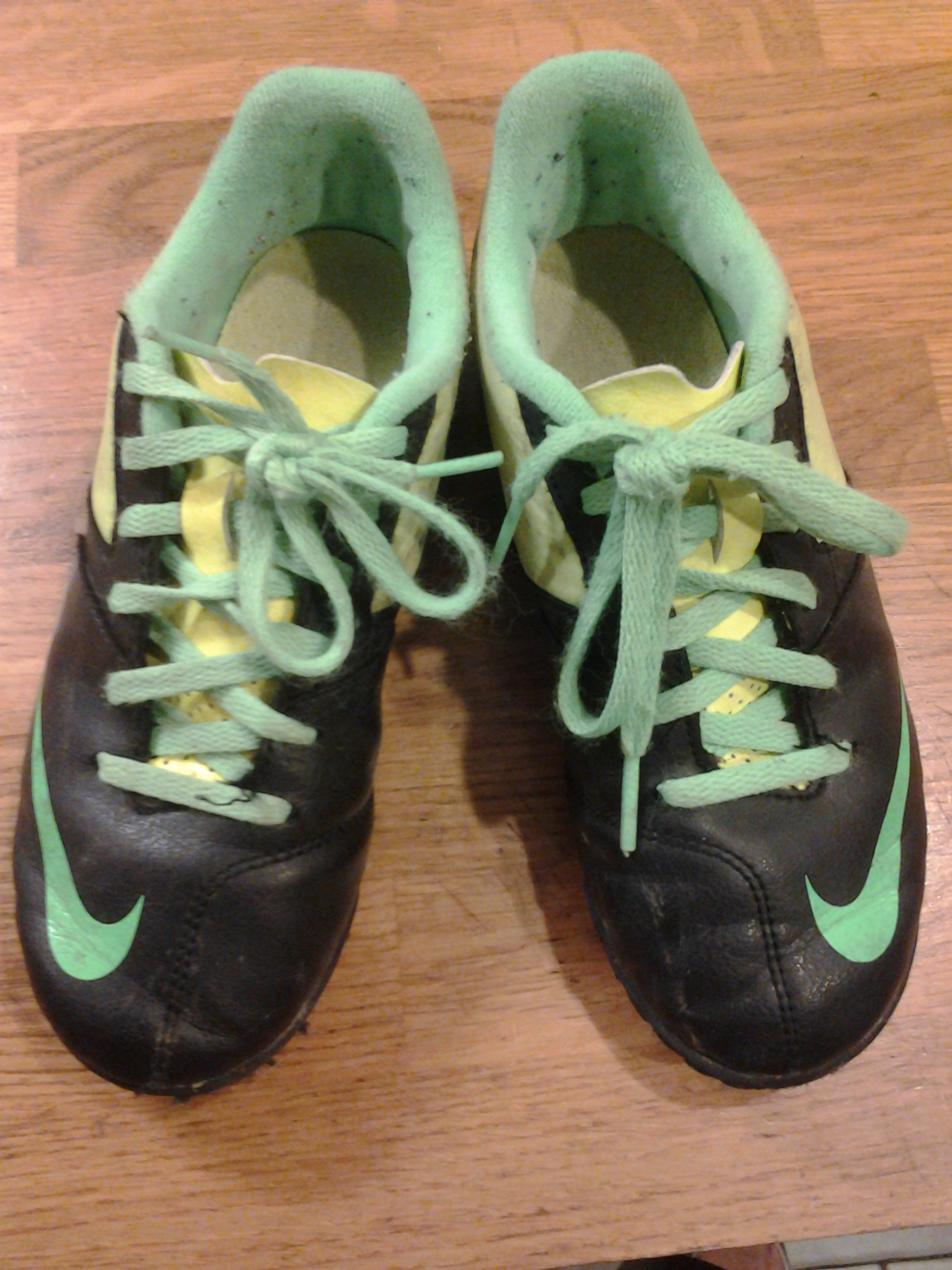
Shoes tied by M

Meal-times have become easier, thanks to the sets of caring cutlery I invested in soon after we met his OT for the first time.  M has grown in confidence as he’s mastered the co-ordination needed to cut up his food himself, although constant reminders to actually use his cutlery are still a main feature at our dinner table!  After a year of having to ask for help to tie the laces on his football boots, M decided he was going to crack that challenge over the summer and having so determined, succeeded quicker than any of us expected, himself included, and was rewarded by 2 new pairs of trainers – with laces – whilst we were out in Florida.  As for the bike, well it’s still something of a no-go area for M right now, but the draw of being able to cycle to his godmother’s house along our local cycle-path, may be all the impetus for learning that we’re going to need this autumn.

However, the one skill that still needs a lot of work is that of his handwriting and was the key area for my discussion with his OT yesterday.  Over the last few weeks, I have been trying to track down some additional support with his literacy skills as we have become increasingly concerned that his school-work will start to suffer if an improvement isn’t made soon.  I contacted both our local Dyslexia Centre and the local branch of Dyslexia Action, to find out what support might be available to M and similar answers came back from both.  There was an opportunity for weekly, 1 hour small group sessions to develop his writing and literacy skills, but although it sounded good, there inevitably was a downside.  The sessions are only run during the day, Monday to Thursday, which would mean that he would need to miss around 2 hours of school a week, by the time you allowed for pick-up and travel.  As the helpful Dyslexia Action representative warned me, “You’ll have to get the school on board first, as they may be reluctant to allow him to miss that much school each week.”

I mused over the decision and discussed it at length with Mike.  Whilst we both know that the time is critical for M right now and he really needs that support, we are also waiting for an admission to GOSH, which will mean at least a week off school.  On top of all his other regular appointments, I felt that it was just too much time absent from his friends and his learning and so decided to put this plan on a back-burner for the time being until we have some more information about the admission.

At this point, like some sort of guardian angel, his OT expressed her own increasing concerns about his handwriting skills and suggested the perfect solution to our dilemma.  She has offered to visit M in school for an hour a week for 6 weeks and will work with him and a member of staff, teaching him how to properly form cursive handwriting and write in a size that makes his writing legible.  handwritingShe will make sure he is sitting correctly, holding his pencil in the right way and knows how each letter should be formed.  His class teacher has said that M is reluctant to use cursive writing, believing that he needs to print instead, so the OT will show him some examples of work from other children she has worked with to convince him that this is the way to go.

I am so delighted that this is being offered by an OT who is as concerned about M’s handwriting and the impact on his learning as we are and, what’s more, wants to actively do something about it. As well as teaching M the skills he needs, she will also be teaching the member of staff about what he needs to be doing in class and how they can encourage him to continue the good work once her 6 weeks are up.  M’s SENCo, who also just happens to be his class teacher this year, has already agreed that the school are happy to accommodate the OT’s visits and now I’m just waiting for confirmation of when the sessions will start.

“Out of difficulties grow miracles” – Jean de La Breyere

stormyThese last few months have been, well, interesting; and yes, that’s one of those euphemisms you use when you really don’t know how else to explain what’s been going on.  In many ways life was reduced to a whole new level of hell in our household; one that I’ve hesitated to discuss because of the nature of our experience.  Sometimes I need to delay publishing my posts to give us all time to process what we were dealing with before revealing it to the outside world, to allow the storm to pass and to let those memories start to fade.  Now, I’m – we’re – finally ready.

The reason for it all has been M’s ongoing issues with his bowel.  When the pellet study was done a year ago at our local hospital, the x-rays indicated that he had developed what is termed “mega-rectum” and “mega-colon“, caused in all likelihood by ongoing and previously undiagnosed impaction.  The priority at the time was to clear out his system and keep it clear, but unfortunately, for reasons still unknown, M has limped from one bout of constipation to another over the last 15 months.  The constant flow of problems has taken its toll on the whole family, but most noticeably on M, who is finding it tough to be positive when he feels that nothing is making a difference.

Our first meeting with our local consultant led to a long discussion about what, if anything, we could do to try and ease this problem and how we could help M’s bowel to recover.  He suggested a course of treatment that sounded extreme, but which he felt would encourage this troublesome body part to start to repair and would therefore hopefully alleviate some of the issues.  He proposed starting M on yet another laxative, called Bisacodyl, which would be administered by a daily suppository each evening.  This would cause an immediate response, thus reducing the likelihood of ongoing impaction and hopefully M’s bowel muscles would eventually recover some of their elasticity.  This treatment was not to be a long-term one and we would start doing it daily for just 4-5 weeks before being assessed in clinic again.

willowtreeOf all the medicines that M has endured over the last 3 years, this is, by far and away, the worst one we’ve had to put him through.  Day 1 was tricky as he was incredibly nervous and had no idea what to expect.  The subsequent week was hell and the nightly battles as I gave my boy this medicine accompanied by his incessant crying and pleading took an almighty toll on the family.  Job being done, a nightly cuddle was needed to reassure and comfort us all.  Due to unexpected problems during that first week, M experienced a heavy bleed and we were advised to take a week’s rest before restarting and finishing the course of treatment.  Unsurprisingly that was even more difficult to do, in fact almost impossible, but we persevered and carried on until our next appointment.

Mike and M had their hopes pinned on the medicine stopping then, I was slightly more sceptical and sadly I was proved right.  There had not been sufficient progress in that 5 week period for our new consultant to be satisfied and he wanted us to keep going until the start of the school holidays.  At that point, he asked us to double the dosage, administering the medicine both morning and evening until we flew to Florida.  I think that everybody’s heart sank at that point, although M cheerfully focused on his idea of a silver lining – he got to stop taking the Senakot, which was his least favourite medicine and that it would all stop as soon as we got to Florida.  How we got through those 8 weeks, I really don’t know and I hate knowing that we might be told to restart the medicine again in the future.  Worst of all, we won’t know whether this treatment has been of any help for a while yet, which is discouraging, but we will continue to keep our fingers crossed and hope that out of that difficult time, we really will start to see small miracles grow.

hope

The Great ‘Flu Vaccination Debate

fluIt’s that time of year once again, when the NHS starts talking about ‘flu vaccinations and those of us with chronic illnesses – or who fall into one of the other qualifying categories – attempt to book our appointment before winter’s half over and we’ve already been laid low by the ‘flu.  Somewhat astonishingly this year, both my GP’s surgery and I were quick off the mark in being organised and by mid-September, not only had my appointment been booked, but I’d also had the injection itself.  They had checked my medical records and found that it didn’t appear that I’d ever had the pneumo-vac, which led to the unexpected double whammy of a needle in each arm during my 5-minute appointment.  The only years I’ve not had the ‘flu jab in the past 29 years of my T1D life were those when I was pregnant and that was down to personal choice.  My one experience of the ‘flu, caused by an inability to get an appointment before November, saw me laid low for the best part of 2 weeks by a bad bout of the ‘flu and Mike and my Mum were let to rally the troops on a daily basis.  For me, the ‘flu jab is not an option – its a necessity.

Since having M’s diagnosis with EGID and learning more about the long-term nature of his condition as well as knowing firsthand all about life with a chronic illness, I started to investigate whether he should also be having an annual ‘flu vaccination to help keep him healthy.  Our GP offered no opinion on whether he should have it or not, though he was more than happy to agree if we wanted to go ahead, and our GOSH consultant thought it a good idea, but something that needed to be actioned by our GP.  It quickly became evident that Mike and I would be the ones making the final decision and so the hard work began.  I started researching the pros and cons of the vaccination for M, but with one thing and another, including his admission to GOSH for more scopes, last year just passed us by and as we had survived the onslaught of winter colds and bugs reasonably well, I shelved the idea for another time.

Courtesy of blog.fromyouflowers.com

Courtesy of blog.fromyouflowers.com

This autumn has sneakily crept up on me and with its arrival has come the need to revisit that discussion and make our decision.  One of my main concerns was M’s egg allergy as the vaccines given are grown in hens eggs, which can cause an allergic reaction and that is something we need to avoid given M’s delicately balanced state of health right now.  However, reading more on the subject (and trust me there’s a lot of information out there), the fact that M does not suffer with anaphylaxis, but rather a delayed reaction to egg combined with the availability of ‘flu vaccines with low or no egg content, I was reassured that it would be safe to give it to him.

Next I needed to consider whether to insist he has the traditional injected vaccine or if we should try the new nasal spray vaccinations, which are currently being rolled out across the UK for all children under 4.  Whilst the nasal spray would certainly be easier to administer, the current NHS recommendations are that this is not given to children with a known egg allergy as there is simply not enough evidence to conclude whether it is safe or not.  Much as I feel M needs to be protected against the ‘flu, I am not yet prepared to take an unnecessary risk whilst there are still alternatives available.  We are struggling with his EGID at the moment anyway and adding an unknown to the mix could lead to repercussions that could affect us all for months.

dateSo, it would appear that the debate has been settled.  I have requested with our new GP that M is given the ‘flu vac and am waiting for the phone-call back to confirm that a low/no egg vaccine has been delivered to the surgery.  Fortunately, M is astonishingly stoic about having injections, so I’m confident that he will take it with the minimum of fuss – it would be a whole other story if the child in question was G, but luckily we don’t feel she needs to have it too for the time being.

The Battle is won

battleThis has been a surprisingly difficult post to write.  I’ve found it challenging to give the details of our progress over the last 4 months following my formal complaint to our local hospital about the poor treatment we received when we were there earlier in the year, without it sounding either overly clinical or emotional beyond belief.  I’ve finally resorted to bullet-point format as the steps we’ve taken have been an important part of our journey with M that I want to share, but they don’t need any unnecessary waffle in the re-telling.

  • 24-Feb-2014: Write a formal letter of complaint to the Patient Advice and Liaison Service (PALS) based at our local hospital, giving details of our appointment, what happened whilst we were there and our areas of concern regarding the care they’re refusing to offer to M.
  • Mar-2014: I also write to our local MP asking for his help in getting local hospital support for M and giving brief details of our poor experiences to date, including a copy of our formal complaint and my blog-posts, so that he has all the relevant facts to hand.
  • Mar-2014: Receive an acknowledgement of my complaint from the hospital, who advise they are looking into the matter and will send a formal response by the end of April 2014.
  • Mar-2014: Our MP’s secretary calls from Westminster to express their dismay at learning about our experience and to offer an appointment at his next local surgery to discuss the matter further and to see how he can usefully support us in our quest to get local input for M.
  • Mar-2014: Receive a copy letter from the General Paediatrician we saw in February giving details of the appointment and what next steps they suggest are followed to help M.  Given the date of the letter and the way it is written, it is blatantly obvious that it has been written with my complaint in mind and does little to reassure me that this medic will be fighting M’s corner going forward.  The letter stresses that they are concerned about our request for shared care, but that they will refer M to one of the gastro consultants based at our local hospital to see if he will help.
  • Mar-2014: Same day that we receive the letter from the last doctor, I meet with our MP to seek his advice.  He listens with a sympathetic ear and immediately offers to do whatever necessary to ensure M is given the chance to receive local support as well as the care from GOSH.  In the light of the letter received, he proposes that we wait to see what the formal response from the local hospital is and whether the referral is successful or not. He also asks that I keep in touch with his secretary and let her know how things progress.
  • April-2014: A month passes without much movement on either the complaint or the referral front.  I contact our GP to ask him to also refer M to the gastro consultant as I am still lacking confidence that the hospital doctor will do a favourable referral given the nature of my complaint.  During this wait, we have a planned appointment at GOSH and I am able to discuss with them whether they would support our request for shared care. The gastro team is very supportive of our request and advises that they usually recommend that a general paediatrician is the point of contact locally to avoid any unnecessary conflicts concerning M’s treatment.  However, given our local’s apparent reluctance, GOSH agree they will discuss M’s care with anyone in the local hospital.
  • April-2014: We finally receive a reply from the Chief Exec, offering his apologies for our poor experience as well as giving me their findings about the complaint.  He also offers a meeting with both the gastro consultant and a member of the Senior management team at the hospital to see how we can take M’s care forward.  There is some confusion as to who will schedule this appointment, but a series of phone-calls on my part and a very helpful admin assistant at their end means that the appointment is finally organised for June.
  • May-2014: I receive a follow-up email from our MP asking how things are going and reminding me to keep him informed of any changes in our situation.  I’m delighted to be able to inform him that we’ll be meeting our local hospital at the beginning of June and agree to let him know how that meeting goes.
  • June-2014: The day finally arrives and Mike and I head off to our local hospital to meet with members of staff to discuss M’s needs, having left a poorly M with Mum for the duration.  Our aim is to get our local to agree to having “shared care” with GOSH, so that we don’t have a repeat episode of our Christmas hell with a M who desperately needed admitting for treatment and nowhere that would take him.  The consultant we meet is delightful and we’re thrilled to learn he worked at GOSH for a number of years and, even better, has worked alongside M’s consultant there.  He instantly agrees to look after M on a secondary care basis, dealing with our existing issues with recurring constipation/impaction and any emergency situations which may arise.  The management team has no choice but to go along with his suggestions and we agree on a system that should work well for us all and will ensure that M gets the very best care at all times.  The meeting ends with a follow-up appointment with the consultant 5 days later to deal with the current bout of impaction that M is suffering.

champagneIt has not been an easy road to follow and the number of letters, emails, phone-calls and late night discussions that have been flying around is huge – BUT we did it.  We’ve got secondary care for M at a local level and a positive way forward for the next few years, which is everything we wanted and which I hadn’t dared to believe was possible.  Of course, we still need to see how it all works outs in practice, but the first signs seem positive and we know we’ve got at least one consultant on our, and M’s side.


Eosinophilic Awareness Week 18th-24th May 2014

This week I’m delighted to welcome Kate from The Recipe Resource as my guest blogger. Her blog was set up to support those catering for multiple food allergies, particularly in children and Kate is a fellow EGID Mum, who I’ve been privileged to meet through the fantastic FABED.  I was going to write a post to tell you all about Eosinophilic Awareness Week, but found Kate had already done an amazing job on her own blog and she kindly agreed to let me share it with you all:


18th-24th May 2014 is Eosinophilic Awareness Week.  Read about EGID here

Gastro research is drastically UNDER FUNDED.  It is not “glamorous” and rarely on the radar for celebrities and focus groups, and rarely attracts public interest unlike cardiac care and cancer research.  Gastro conditions are badly neglected in the UK when it comes to research funding allocation, but without research treatment and outcomes are not likely to improve much.

Approximately 1% of the total amount of medical research funding available in the UK can be accessed for Gastro research.  There are currently no listed projects specifically for Eosinophilic Disorders on the National Research database.  GOSH are running a Gastro Research Project that will include related conditions/problems.  Alarmingly, children with allergic gut conditions are reaching epidemic proportions according to GOSH.

No one knows why the UK has the highest incidence for Allergy.  I went to Westmnister to attend the All Party Group for Allergy in October 2013 and heard how in the 19th Century, a study into Hay Fever took two decades as it was so rare and there were insufficient people to include in the study.  Today it is incredibly common.  The UK tops the league table in the incidence of allergy in its population, with Australia second – which is interesting as their population obviously share a similar root.  Allergic gut conditions are becoming common and hugely problematic for NHS paediatric services and Eosinophilic Disease is a specific subset of this group.

FABED is the main UK charity supporting families with members (adult and children) who suffer from eosinophilic disease.

FABED

FABED are UK partners supporting the United States Eosinophilic Awareness Week.  This is coordinated by APFED.  Two years ago they made this video to promote awareness.

Read more about Eosinophilic Diseases here.

During Eosinophilic Awareness Week, do something to raise awareness.  Tell someone about EGID and the appalling lack of funding for gastrointestinal disorders in the UK.


This blog was first posted on May 9th 2014 at The Recipe Resource here

Local update

update-timeYou may remember that back in December, M was referred on an urgent referral to our local hospital based on the advice of GOSH.  He was suffering from chronic constipation, was in considerable pain and was losing weight as his appetite decreased.  Sadly, our local hospital felt it was unable to admit or treat M and instead our only option was to treat him at home, using a strong laxative and bucket-loads of patience as he struggled to recover his health. Our urgent referral resulted in the offer of an appointment with a general paediatrician in February, nearly 12 weeks after the referral was originally made.  We thought long and hard about whether we wanted to take up this appointment or not, given our previous experience with our local hospital, but we knew that local input could make a big difference to all our lives and felt that this could be our way into the local system.

apptFebruary’s appointment arrived quicker than we could have imagined and we went along with an attitude of “hoping for the best, but expecting the worst”.  The symptoms that M was suffering back before Christmas have disappeared and we have had the challenge of changing his diet and his medicines again in an attempt to reach a status quo with the EGID. What we hoped for was a local doctor who would listen to our concerns and who would offer us the helping hand we so desperately need.  We wanted a local doctor who could point us in the right direction at the hospital and would support our search for shared care between our local hospital and GOSH for M.

Instead we got a doctor who, through their less-than-professional manner, vocal criticisms of both our GP and GOSH and obvious impatience, left us feeling let down once again.  They belittled our decision to seek a second opinion when the local hospital had let us down 3 years ago and were unimpressed that we had our own point of view concerning the care given to M.  They reluctantly agreed to refer us on to the gastro team at the hospital, but made it clear that they believed it highly unlikely any of the gastro consultants would willingly take M on a shared care basis with GOSH.  Mike and I weren’t surprised, but we were disappointed that this consultant chose to make their opinions known so clearly in front of our impressionable and sensitive 7 year old.

complaintNeedless to say, we are not letting things drop there.  We have written a letter of complaint to our local hospital and are now waiting for their response to our concerns.  I am writing to our MP to make him aware of how badly M is being let down health-wise locally, to see if he will get involved on our behalf.  We will persist with the onward referral to one of the gastro consultants because we remain strong in our belief that shared care between our local hospital and GOSH is something M needs;  AND we will continue to fight M’s corner to make sure that he is put first and gets the support he needs.

New year, New plan

The first week of 2014 and our first visit of the new year to London and GOSH for a consultation with M’s gastro team.  Mike and I had our list of queries drawn up and were determined not to leave without some answers.  Topping the list were our concerns as to why M has been struggling so much with chronic constipation since the beginning of last summer.  It seems that no sooner have we managed to get his system cleared out, than the problems start all over again and nobody seems able to explain why this is happening in such a relentless manner.  My meeting with the wonderful local Bowel and Bladder clinic had given us a proposed plan to follow and I was keen to see if GOSH would jump on board.

Courtesy of telegraph.co.uk

Courtesy of telegraph.co.uk

Another on-going worry has been the restricted diet and number of medicines that M is taking and is one that his consultant has shared, especially as he is still symptomatic, which is the worst of all worlds.  We work hard with M to keep him going and stick to the daily grind, but he shows more and more reluctance to do so and sometimes the battle is just a step too far for us all.  I was keen to know if there was any possibility that we could remove one or two of his 7 daily medicines as we had discussed at our last proper appointment back in May.

Despite his weight loss in October whilst admitted to GOSH, and a further loss during December, M has managed to gain some weight in the last 12 months and is still creeping along his centile line, which keeps the medics happy.  This visit’s registrar was pleased to see that he had gained in both height and weight, though he mentioned that he would be happier if M could gain a little more weight in the coming months; a difficult feat when your child eats little other than “thin air” as M himself describes it.  We discussed at length the experiences and the numerous phone-calls that I’ve made over the last 8 months.  He even agreed that the current situation is less than ideal and supported, in principle, our tentative query as to whether we could drop a medicine or 2.

Courtesy of newharmonywellness.com

Courtesy of newharmonywellness.com

BUT – and admit it, you could sense that was coming, couldn’t you? – we can’t lose a medicine just yet.  Due to M’s new symptoms, the constant bowel problems swinging between chronic constipation and incessant diarrhoea and the general ill-health he’s been dealing with since the summer, we instead have to introduce new medicines to see if we can get a handle on the situation.  We’ve now got 2 more to add to the daily regime:  Senokot, which is a stimulant laxative, to help resolve the constipation issue, and Lansoprazole, a PPI to deal with the reflux that we’ve only recently learned M has been living with.

The problem with new medicines is that we can’t stop any of the old ones until we see if there is any improvement in his condition.  If we see a change for the better, we need to be certain that it is the new medication that is helping, an issue that would quickly become muddied if we took out any old medicines alongside starting new ones.  So, for the next 3 months until our return visit to GOSH, M will be on 9 medicines daily and already he has proved himself to be a real little trooper in his approach to it all.  I don’t know that I would be so keen to take so much every day, especially when there are no obvious outward signs that anything is making everything better, but he remains positive and determined to beat this condition and not let it rule his life.

We do have one other thing to do over the next 8 weeks and this resulted from the follow-up conversation with M’s dietitian.  She felt that we needed to exclude a couple more foods from M’s diet to try and reduce his symptoms.  We agreed to tackle the 2 that he has complained about when suffering from reflux.  His description of them making his throat feel as if “…someone has a pin and is pricking my throat and running it down the length of it..” as he swallowed had sounded the alarm with me and the dietitian agreed.  potatoesSo, for the next 8 weeks we are now experimenting with life without potatoes and raisins as well as the already excluded gluten, wheat, dairy, soya, egg and raspberries.  Fortunately, M almost always prefers to eat sweet potatoes to the humble spud and so I’m hopeful that, for the most-part, this won’t prove to be too difficult a challenge for us.

The visit to GOSH wasn’t quite as we’d hoped.  We’d gone with the dreams of reducing his medicines down to 5 or 6 and came back with the reality of 9 daily medicines and an even more restricted diet.  It’s hard to remain positive in the light of such a change, but we continue to strive towards a symptom-free M and will do whatever it takes to get him to that position.

Eating my words

For some time now, we’ve been seeking some emotional support for M as he struggles to come to terms with his condition and the impact of a restricted diet and the associated health issues on his day-to-day living.  As the result of a GOSH recommendation, we sought a referral to our local CAMHS service to see if they could offer any counselling to M.  We also hoped that we would have access to some family support as we all find it difficult at times, G especially, as she deals with her own reactions as well as M’s mood-swings.

Courtesy of connectsociety.org

Courtesy of connectsociety.org

Sadly, our experience of CAMHS has been less than favourable.  The worker we saw had not read M’s notes, didn’t understand why we had gone to GOSH for treatment and had no idea that he had been diagnosed with a chronic bowel condition.  She talked about using sticker charts to encourage him to use the toilet and failed to recognise that, in M’s case, it wasn’t that he wouldn’t use the toilet, but rather that he couldn’t.  At our last meeting, Mike and I sat in disbelief for nearly an hour and a half whilst she repeated her theory that a reward system would be the answer to all our woes; and our jaws hit the ground when our repeated comments about his “diagnosed chronic bowel condition” finally sunk in and she pondered whether maybe she would benefit from taking a look at the letters written by his consultant from GOSH.

ticklistIn the letter that followed, she discharged him from her care and suggested that we instead got a referral to our local NHS Bowel and Bladder clinic for their input.  I was unsurprisingly sceptical, having spent some time at one when G was suffering from her own bowel problems a few years ago, and feared that the ubiquitous zticker chart would form the crux of their treatment plan.  However, I have long since come to the conclusion that the only way to get the help that we need, is to agree to whatever steps the health professional concerned recommends and tick those boxes to prove that we really are taking the situation seriously.

And so this past week saw us attending the local Continence clinic, which runs once a month in our GP’s surgery.  I was brutally honest with the nurse we met with, T, telling her within minutes of sitting down that I was not expecting much to come from our meeting.  I apologised for my negative attitude, but admitted that I felt I needed to be honest, so that she understood the position we were starting from.  At this point, my expectations were low – and about to be blown out of the water!

T was not phased by my comment, but instead admitted that she too was uncertain whether she could help M or not, but having read his notes thoroughly and all the letters from GOSH, she was keen to offer whatever help and support she could.  I knew at this point, that this meeting was going to be a very different one from that I had been anticipating and the following 45 minutes proved this to be very much the case.  We talked at length about M’s history, his diagnosis, the experiences over the last 9 months and the problems we have recently faced.

She expressed no surprise that M has been struggling emotionally to come to terms with his life as it now is and discussed with me about how isolated M must be feeling.  She pointed me back in the direction of the wonderful charity, Eric, which offers support and advice about childhood continence issues.  Not only do they have a telephone helpline manned by knowledgeable and sympathetic volunteers, but there is also an area specifically designed to enable children to discuss their toileting problems with others in the same situation should they want.  We had made extensive use of their website when struggling with G’s problems, though we had never thought to look at the children’s area with either G or M.

Most importantly, she suggested a change to M’s prescribed laxatives, but was insistent that I discussed her proposals with our gastro team at GOSH, who fortunately we were seeing the following day.  My biggest fear was that she would be as reluctant as our local hospital to get involved in M’s care and would not be willing to discuss him with GOSH – nothing could be further from the truth.  T reassured me that she would work alongside GOSH, and us, to make sure that M is getting the very best care and would help us make those little adjustments to his medicines that feel so complicated when I’m discussing them over the phone to London.

We still have an initial assessment with our local paediatric team in place for February, and it would be fantastic to have them on board too, but I no longer feel so dependent on that relationship working out this time round.  We have found instead, an even more local solution to our need for support and I have never been so glad to be left eating my words and being proved wrong.