Category Archives: Chronic Illness

Five consultants, four registrars…and a partridge in a pear tree!

We had reached the end of our patience with the local hospitals and doctors. M had started school the previous September and was doing well, having managed to exceed all expectations and avoid any embarrassing toileting “accidents” during school hours. Things at home however, were not getting any easier.

We had now suffered disrupted nights for 5 years thanks to M’s inability to switch off and fall asleep until past 11pm and he often woke once or twice a night and ended up in our bed. Whilst not every night was sleepless, it certainly felt that way and our sheer exhaustion was taking its toll on the whole family.

Every day was a relentless routine of regularly cleaning and changing M as he suffered from chronic diarrhoea and still hadn’t cracked full toilet training. On the best days, we had to change him 3 times, on his worst, 5 or 6 times wasn’t unusual. We had even managed to blow the motherboard of our washing machine after doing load after load of dirty washing on an almost daily basis.

He continued to eat huge amounts, complained of feeling constantly hungry and relished the fact that he was the only one of the family able to eat everything he wanted – G was still wheat, dairy and oats free, Daddy was mildly lactose-intolerant and I had discovered an arch-nemesis in the form of the simple spud! Meal-times were challenging as I cooked to manage every dietary need, but I look back on those days with fondness now as cooking daily has become even more…well…challenging.

We were also struggling with manic mood swings and temper tantrums that rocked the house when something went wrong. We now understand that M was frustrated with his inability to manage his toileting and this tipped over into every other aspect of his life, but at the time it just seemed like another behaviour that needed to be managed. And no, the old favourite of the star chart, recommended to us by every medic who’s path we crossed, did not help at all.

By May 2011, M had seen or been referred to:

  • 5 consultants
  • at least 4 registrars
  • 2 hospitals
  • 2 GPs
  • 1 school nurse
  • 1 continence clinic
  • 1 CAMHS nurse
  • and numerous other medical staff along the way

Finally at my wit’s end and obviously showing signs of strain, I sat in our GP’s consulting room and asked where we could turn to next. My mother’s instinct was still full force and despite the now numerous diagnoses of toddler tummy and the reassurances that M would grow out of it all, I knew categorically that he wasn’t getting any better and that we were now 5 years on from the initial set of problems.  I will be forever grateful to this individual who had absolute sympathy for our plight and offered to refer us to anyone, anywhere in the country.

With this in mind, we started to investigate where M could go in search of some answers and were pointed in the direction of Great Ormond Street Hospital (GOSH) in London. My Mum had been suggesting that we should go to them for a long time, but I had always ignored this advice, believing that whilst I knew something was wrong, it wasn’t serious enough to warrant a visit to those hallowed grounds. However, every other avenue open to us had been fully explored and when, at our final visit to the local Children’s Hospital, the registrar refused to perform an investigative colonoscopy on the grounds that such invasive intervention was too traumatic and unnecessary in M’s case, I knew we had to take a chance.

Mike contacted GOSH and asked for a name of a gastro-specialist that our GP could refer us to. We had to pay for the benefit of a private referral as a NHS referral could only be done through our local hospital, who still held there was nothing wrong, but we believed that this was the only way to get the answers our family so desperately needed.

Gut instinct

Buffet-Table1

Despite an appetite to rival a grown man’s, M’s weight stuck determinedly to the 9th percentile and considering his complete inability to be successfully potty-trained, this wasn’t really surprising. When I say he could eat as much as an adult, I’m not exaggerating – on one occasion he managed to consume more in a day than a good friend of the family, who had an extremely healthy appetite.

M was diagnosed early on by our GP as having “toddler tummy” and we were told that he would just grow out of it. This was a diagnosis that was going to dog our steps for the next 3 years. At this point, G developed some gastro problems of her own following a bout of food poisoning and another of gastroenteritis, and we established ourselves, as the medical tests proved inconclusive, that she was struggling with intolerances to wheat, dairy and oats. The thought had crossed our minds that perhaps M had similar intolerances, but our attempts to remove these from his diet showed no improvement, unlike for G.

It was armed with all of this knowledge, that I went back to the GP and insisted on a referral to a specialist, having kept an extensive food diary for a couple of months. This recorded not just what and how much M was eating on any given day, but also his sleep patterns (which continued to be poor) and his toileting habits. We also put together a list of our main points of concern. Preparation is key and we wanted to make sure we had a case to put to the specialist.

Our first appointment was disappointing. The specialist listened carefully, nodded sympathetically and instantly agreed with the GP’s diagnosis and left me feeling, once again, a paranoid Mum. He also referred M to the same specialist that G was seeing, in the belief that maybe our children were suffering from the same problem. My gut instinct disagreed and I made my feelings on the matter clear. Although on the face of it, their symptoms seemed similar, there were key differences that I knew had to be taken into consideration.

I have learned that a parent’s gut instinct is possibly the most important thing that any medical practitioner can listen to or, at very least, consider to be as important as the physical symptoms described. I knew deep down that there were something very wrong with my boy, but on the face of it, few agreed. His lack of toilet training was an annoyance we should learn to manage; his healthy appetite nothing of note; his poor weight gain irrelevant as he was growing along his predicted percentile; and his poor sleep patterns the same as every other new parent had to deal with. At each and every appointment we attended with M in tow, he was active, energetic, chatty and showed no sign of the tremendous tantrums he could throw at the drop of a hat at home.

Depending on our gut instincts about M and our determination to find out what was wrong, we kept on battling and refused to accept that it was toddler tummy and that he would eventually get better without any intervention.

Unfortunately, over the next two and a half years, we would need to rely heavily on that perseverance and an inner depth of strength that exceeded what either of us knew we had. We moved from one consultant to another, one hospital to another and even one GP’s surgery to another as we moved house and chased a diagnosis. Finally, in May 2011, we were given the referral that would finally set us on the road to an answer.

The first signs

It’s only now, looking back at those first couple of years with M, that I can so clearly see that all the signs pointed to something being wrong. BUT, as with all young parents, we took the rough with the smooth and just assumed that it was part and parcel of the development process, especially with a premature baby. Hindsight is a wonderful thing, but only because it is exactly that.

In the months following his traumatic arrival into our lives, M suffered with chest infections, high temperatures, reflux, high-pitched screams, poor sleep patterns and what I now realise was almost constant diarrhoea. He was prescribed an infant inhaler, seemed to bounce from one course of antibiotics to the next, gulped back infant Gaviscon with every meal and, despite his epic size and weight at birth, stayed at the petite end of the scale. He dropped from the 95th percentile at birth down to the 9th percentile, but everyone assured me that he was healthy and thriving – one doctor even suggested that his weight had been recorded incorrectly at birth and that his massive weight loss and subsequent low weight gain was nothing to be concerned about.

Comparisons between M and G also seemed irrelevant – G was your typical first-born girl. Bright, articulate and not exclusively breast-fed, unlike M who successfully breast-fed for the first 7 months. The health professionals suggested that the differences in weight, appetite and nappies were because he was breast-fed and as M seemed to be a relatively happy baby, I had no reason to question any of the theories behind his small size and constant battles with illness.

It was purely a chance comment by our nanny when M was around 15 months that triggered a realisation that perhaps something was wrong. She had been chatting whilst out at a local toddler group with M in tow, when another mother commented on how many times she had to change M’s dirty nappy. It wasn’t a complete surprise to us when she mentioned that perhaps the 8-10 dirty nappy changes a day in my 15-month old wasn’t “normal” as I had raised a similar concern with our health visitor when M was 8 months old, but it did make me stop and think.

I went back to the local health centre and voiced once again my concerns that 8 dirty nappies a day wasn’t typical and was told to keep an eye on it and to come back in a couple of months and see the GP if I was still concerned. M appeared to be thriving and was growing along his percentile line, so they weren’t as worried as me and I now suspect that this is this time when I first got labelled as a fussy Mum!

Little did I know then, but 7 years on, we now know that I wasn’t just a paranoid or fussy Mum, but rather that there was a genuine medical problem behind our concerns and that really our battle was only just beginning.

M's arrival

It wasn’t the easiest of starts, especially after the wonderful experience of our firstborn daughter, G. My first pregnancy had been easy and I had loved every moment of becoming a first time Mum. When, two years on, we decided to bite the bullet and go for baby number 2, I naively thought that it would be a similar experience, though a little more tiring as I now had an active and inquisitive toddler to deal with too.

However, from pretty much day one, my second pregnancy was tough. I suffered from morning sickness for months, developed SPD from 8 weeks and by month 4 was using a walking stick and eventually a wheelchair to get around. I suffered from low blood pressure and frequently felt faint and dizzy when standing. I stumbled my way through G’s second birthday party from the comfort of my rocking chair and just about managed Christmas too.

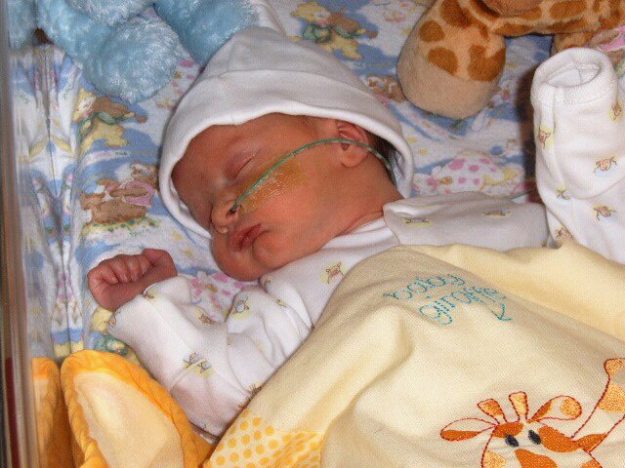
However, by the middle of January it was becoming obvious to everyone that something wasn’t quite right with my pregnancy. I was admitted into the High Dependency Unit of our local maternity unit at 26 weeks and that kick-started the roller-coaster ride to M’s birth on 8th March. M arrived 7 weeks early, weighing a mighty 5lbs 12.5oz (I dread to think what would have happened if I’d managed to get even close to full-term) and after an extremely harrowing birth experience for all concerned, M was born not breathing. He was resuscitated quickly and whisked off to NICU, without me even seeing or cuddling him. We had chosen a name and Daddy went with him and eventually came back clutching a polaroid photo of our new son for me to see.

Despite the extremely hairy start, M responded well and by just 3 weeks later, a full month ahead of when NICU would have expected it to be possible, we were sent home on Mothering Sunday with our baby boy in tow. It was, without doubt, one of the best Mothers’ Day gifts I’ve ever received – being able to be at home with both my children with me.

What we weren’t to know then, was that the following 7 years would be filled with a huge amount of tears and trials before we reached a diagnosis for the condition that would slowly appear.