Tag Archives: EGID

Waiting

Patience is a virtue, or so the saying goes.   I’d always thought of myself as a relatively patient person, but maybe not.  And definitely not when it comes to waiting for a hospital bed to become available and for testing and treatment to start.  Another week of waiting is over and a new one is about to begin.


#awatchedphoneneverrings

#awatchedphoneneverrings

Beating the Bullies – Anti-bullying Week 2014

November’s proving to be a busy month, what with Armistice Day (11th), Children in Need (14th), World Prematurity Day (17th) and this week it’s the turn of Anti-bullying week (17th-21st).  The aim of the week is to raise awareness of bullying and encourages children, young people, schools, parents and carers to come together and work towards stopping bullying for all.  There are no official statistics about the prevalence of bullying across the UK, but recent reports state that almost 45,000 children spoke to ChildLine about bullying during 2013, a worryingly high number and one that’s unlikely to scratch the surface of the problem.

Bullying is defined as Repeated incidents of physical or mental abuse (teasing, taunting, name calling, threatening, isolating) of a weaker person by a stronger person.”  Stronger is not necessarily defined by size, but also includes those who are more confident or more able to pinpoint a weakness in the person they are victimising. The sad reality is that this naturally makes disabled children or those with special educational needs a prime target for bullies and they are more likely to experience bullying in school and in the wider community that other groups.  The focus of this year’s campaign is to eradicate bullying for these vulnerable individuals in particular.

This focus has struck a particular chord with me this week as M has been dealing with some bullying over the last few weeks at school.  Some of the boys in his class have been teasing him about his allergies by saying that they are allergic to him and then pretending to be physically sick. This has had a knock-on impact in the playground, where the same children have then been avoiding playing with him, leaving him feeling isolated and on his own.  He has some good friends, who have stuck by his side and defended him when he’s felt unable to do it himself; and his big sister has lent her support too by watching out for him whenever she can and inviting him, and his friends, to join in games that she’s playing with hers.

Unfortunately, M’s complicated needs – dyspraxia, dyslexia, EGID and food allergies – make him an obvious candidate for attention from bullies, who only need the smallest difference to focus in on and attack. We’ve taught him to stand up for himself without being aggressive or rude, to ignore whenever possible the comments made and to walk away when the going gets tough; but it’s not an easy issue to tackle.  Right now, he’s anxious about their response when he finally has his tube fitted and is even worrying about how things will go next year, once G has moved on to secondary school.  Don’t get me wrong, his teacher and the school have been proactive in dealing with the bullies, but they can’t take away his fears or his belief that he’s not being heard.

Sadly he’s not on his own.  Children with complex medical needs can feel isolated by their illness as they struggle with feeling different and the questions of why they can’t be like their friends or why they are so frequently absent from school.  Even those with better known conditions, such as T1D or asthma, may have limited contact with others of the same age who are dealing with the same issues and I can only imagine how much harder it is for those with rare illnesses, who may know no-one else with the same diagnosis in their area.  A lack of true understanding about their medical needs and the impact on their everyday life can add to their frustration and the sense of being on their own.  Adding bullying to that already tumultuous mix is often a burden too many and these children may head into a downwards spiral that can result in poor self-confidence, depression and even self-harm.

What can we do?  I don’t have an easy answer to that difficult question.  As a parent I can educate my children to respect the differences of their peers and not to belittle those who don’t conform to society’s notion of “normal”.  I can encourage them to enjoy friendships with everyone and not just those who have similar interests or hobbies.  I can teach them that sometimes they won’t see eye to eye with their classmates and that those differences of opinion is what will challenge and shape their own beliefs.

And as a parent to children who stand out from the crowd, I can help them find their feet in our world, to stand strong when challenged and to see the value in their very uniqueness.

Busy days

Now that Halloween and Bonfire night are behind us and Christmas is fast approaching, there’s finally a little time to look back and reflect on the start of the new academic year.  September seems like a lifetime ago and yet was a busy month with appointments right, left and centre that have had a lasting impact on decisions about M’s long-term care.  We had appointments with GOSH, a new community paediatrician, M’s OT and with CAMHS; and I needed to be the thread that linked them all to ensure that M remained at the centre of their focus and that all agencies were working together to provide the best support they could.

Courtesy of travaasa.com

Courtesy of travaasa.com

The OT’s review was everything we needed it to be and she has already started going into school once a week to work with M on his handwriting skills.  The clinical psychologist he meets with fortnightly through CAMHS is slowly building a relationship with him and gently pushing him to talk about how he feels about life with EGID and the frustrations he experiences.  As for the new community paediatrician, who was recommended by our local hospital, well, lets just say we won’t be rushing to meet with her again.  Her complete lack of understanding of his condition was glaringly evident as she suggested that regular toileting and a sticker chart were the answers to all our problems.  How I refrained from saying something very rude is nothing short of a miracle!

The most important of all these, for us, was our regular appointment at GOSH with the gastro team charged with M’s care.  The restricted diet and increased medications over the last 3 years have not brought about the results we’ve been aiming for and M continues to be symptomatic a lot of the time.  We have become increasingly concerned about his emotional well-being as he struggles with the impact of EGID and multiple food allergies on his daily routines and I was determined to come away from that appointment with a tangible plan in place.  Despite our best efforts with the challenging treatment suggested by the local consultant leading into the summer, our worst fears were realised when the registrar told us that M appeared to be impacted again and we would need another course of fairly heavy-duty laxatives to empty his bowel.

planningThat led into a lengthy discussion about where we’re headed and what the most sensible next steps for M’s care are.  Short-term plans are all well and good, but we now need a long-term care plan put in place.  He agreed that we can’t keep limping from one appointment to the next and promised to discuss M’s current situation with our consultant.  Medical terms such as “pellet study“, “elemental diet” and “manometry” were bandied around and I am glad that, thanks to the support from other FABED families, I have a reasonable layman’s understanding of what all these terms actually mean.

We left the hospital feeling that we were beginning to making some progress in dealing with the problems that continue to dog M’s every step and a short-term plan that would start to deal with the current impaction issue.  The longer term decisions would be discussed both internally and with us before anything was settled on for definite.  A follow-up appointment with the consultant herself was made and our step was just a teeny bit lighter as we felt our concerns were being heard and addressed.

Courtesy of abercrombierealestate.com

Courtesy of abercrombierealestate.com

However, since that day, over 7 weeks ago, I have spoken to GOSH at least once a week and almost daily over the past 10 days.  The improvements expected haven’t happened and so the decision has been made to admit M into the hospital for further testing.  We need to understand whether his bowel is working as it should or not as that will give us a clue as to the direction we need to head.  We have also agreed with his consultant that the diet and medicines just aren’t helping his hugely allergic colon and so have made the decision to remove all food from his diet and follow the elemental diet via NG-tube for a while.  This should give his bowel and body some much-needed time to rest and recuperate, something I believe it so desperately needs.

Just when you thought it was going to be easy…

…something happens that shows you that it really doesn’t pay to be complacent, especially when it comes to children with complex medical needs.  The reason for my most recent angst? The whole ‘flu vaccination thing! Yes, you probably read my blog post over a month ago, where I discussed the decision process we were going through regarding M and the ‘flu jab, and almost definitely concluded by the end that everything was set firmly in place.  Having visited our new GP, I certainly felt that we had agreed what was best suited to M’s needs and was now just waiting for the confirmation phone-call and a date for my diary.

You’ll have guessed by now that it hasn’t been that easy and whilst that doesn’t come as any surprise to me when it concerns my youngest, the complexities of getting the situation sorted came at a time when, to be perfectly honest, I really didn’t need the added aggravation.  It all started when I phoned the surgery to book the appointment.  The receptionist needed to discuss which clinic to book M into because he was having the injection and not the nasal spray and so referred him on to the practice nurse, with a promise she’d call me back.  10 days and 3 phone-calls later, I was still waiting for the practice nurse to confirm which clinic M needed to attend.  Oh, and there was the added problem – or so I was told – that there wasn’t enough child vaccines in our health centre, so we would have to wait for those to arrive before I could make a definite appointment.

This is definitely a t-shirt us #EGID parents need!

This is definitely a t-shirt us #EGID parents need!

The string of events that followed are like the plot of a bad 1980s sitcom as we got bounced from one local medical establishment to the next.  The first problem was that the no egg vaccine is not licensed for use in under-18s and so the nurse wasn’t happy to give it to M, especially as he’s never had the vaccination before.  She was keen to discuss the situation further with one of our local hospitals and so I agreed to wait.  Next, I had a message telling me that the hospital would give M the injection, so that he could be monitored and could I confirm that I was happy for my contact details to be passed onto the appropriate administrator to arrange that appointment.  Needless to say, I confirmed as soon as I could and then sat waiting for the next installment in this latest saga.

Three days later, a copy letter arrived in the post from the community paediatrician, who has met M once, knows very little about him and just confirmed that he could have the ‘flu vaccination unless Mike and I knew of any reasons why he shouldn’t have it.  Er, no – after all, we’re the ones requesting he be given the damned thing.  A week after that, another phone-call from our local health centre, advising me that the local hospital won’t give M the injection because his 2009 blood tests didn’t show any sign of an egg allergy.  WHAT?!

Now, don’t get me wrong, M does not suffer an anaphylactic reaction to egg, rather a delayed non-IGE one, so I can understand that they don’t think it necessary to be monitoring him on the ward; but blood tests from 5 years ago are hardly a good basis for any medical decisions made in my opinion.  In the 5 years since those blood tests were carried out, he has been treated by GOSH, had a diagnosis of EGID and we have established that he struggles with several food allergies that, because of the very nature of his reactions, will never show up in the standard blood tests.

The next part of the conversation however, really took the biscuit for me, though I don’t blame the poor receptionist tasked with phoning me to make the relevant arrangements:


As his blood tests were negative, the hospital have said he can have the ‘flu vaccine here, so I can book him into this Saturday’s clinic for the nasal spray.”

“Um, no he can’t have the nasal spray because of his egg allergy and the nature of his underlying chronic illness.”

“Oh, well the hospital said he could have it as he doesn’t suffer an anaphylactic reaction, so they want him to have the nasal spray here.”

“Well,” – (a somewhat hysterical tone starts to creep into my voice) – “Great Ormond Street have said he needs to have the injection, so I think we’ll follow their advice as they understand his medical needs.”

“Right, so you want him to have the injection?” – (she’s now slightly perplexed) – “Well, I’ll have to check which clinic I need to book him into.  I’ll call you back.”

womenonthebusinessstage.co.uk

womenonthebusinessstage.co.uk

Have you ever felt like you’re going in circles?  Five weeks on from my original GP appointment and I was right back where I started and M still hadn’t had the ‘flu vaccine. I was even beginning to question just how important it is for him to have it, given he hasn’t had it before, but GOSH had recommended it as a good idea for him and I wasn’t prepared to give up at the first hurdle.  Fortunately, the receptionist was as good as her word, has booked him in for appointment after school one day next week and has left a note on the system for the nurse at that clinic to review his medical history before he has the injection.  Of course, I’m trying not to panic that she might take one look at his notes and refuse to give it to him, but at least we’re making steps in the right direction at long last.

Return of the Prodigal Cat

Do you remember the story of the Prodigal son?  The one who returns home, down on his luck after years of partying and living the high life with little regard for the family he left behind.  He is greeted with open arms and tears of joy from his father and a fatted calf is prepared to celebrate his return, whilst grumbling in the wings is his much relied on and increasingly disgruntled older brother.

No tale of cats is complete without mentioning M's precious Cat

No tale of cats is complete without mentioning M’s precious Cat

Last week, our household was the unexpected location for the return of our very own prodigal, G’s cat Misty.  Misty has been part of our family for a couple of years, but is considered the pain-in-the-neck younger member by our elder statesman family cat, Jet and M’s “fat” cat, Ginger.  When we returned home from our summer sojourn in the Florida sun, there was no sign of Misty and despite hours of calling, this errant puss appeared to have moved on from our humble abode. It seemed so unfair that once again it was G’s cat who had gone, as the last kitten we lost to the neighbouring A-road and a large milk tanker was also hers, but he was also the most independent of our feline trio and was often lured by the bright lights of the nearby farms.  We kept hope alive for a while, but there came a tearful hour one Sunday after church, when I had to explain to G and M that I thought it unlikely that Misty would be back.  I regaled them with a story from my own childhood, when our much-loved cat, Delilah – and yes, we also had her brother Samson – returned home after months away from the fold, saying it was possible he could return, although I thought it unlikely.  I was careful to make no promises and hoped that eventually the sorrow of his leaving would diminish.  As time passed, both children appeared to have moved on and even though G still occasionally called to him from the kitchen door when summoning the others inside for a cuddle, she seemed to have accepted his loss and had even added a new “kitten/hamster/gerbil” to the top of her birthday/Christmas wish list.

20140722_075343So, you can imagine my surprise and the children’s delight when, getting home from school last week, who should saunter around the car in the driveway, but Misty.  I’ve never seen G move so fast or heard her squeal so loudly than when she caught sight of her beloved pet reappearing as if he’d never been away and couldn’t understand what all the fuss was about.  In the 10 days since his return, G has taken every opportunity to shower love and fuss on this cat and both children anxiously ask every day at pick-up if I know whether Misty is at home or not; and he’s lapping up every moment of their unfaltering devotion.

You may wonder why I’m sharing this story with you.  It’s partly because our life isn’t all about EGID, there’s a lighter side to it that we strive to grab hold of much of the time and partly because it made me consider the impact of pets on our family life.  I’ve grown up with cats as an integral part of the family and so have G and M.  These cats have become a key part of our household and bring immeasurable comfort and enjoyment to us all.  There is nothing more soothing to me than a cat curled up on, or next to, me as I work or watch TV or read.  When M is feeling under the weather and is struggling with his EGID symptoms, he takes huge amounts of comfort from having any one of our cats alongside him and we have found that it has even helped him calm down and settle to sleep at the roughest moments. 20140803_200241The simple, unassuming acceptance by our family pets of my boy’s sometimes turbulent moods has been an unexpected blessing and Mike and I have been known to usher one cat or another towards him when nothing else can break through his tantrums.  G thrives on the peace that being curled up on the sofa with her book on one side and her beloved cat on the other brings.  Both children have learned to take some responsibility in looking after their pets and G can often be found dishing up their dinner in the evenings without being asked.  I know we’re not alone in experiencing the companionship and joy that pets can bring, nor the life lessons of love and loss that have been taught as our children grow up.  Our prodigal cat might not have been fed with a fatted calf, but we’re all delighted to have him back home, especially my beautiful girl.

The Message from “My Man” at the BBC

Three weeks on from that episode of the BBC’s hospital drama, Holby City and I’m still reeling from the amazing response to my blog post and the unexpected bonus of two phone-calls with series producer, Simon Harper.  When I penned my heartfelt response to what Mike and I had watched on-screen, I expected to reach a few more than my usual readership and dared to hope that I might beat my previous “top score” of 186 readers in a 24-hour period with my letter to our local hospital.  I never dreamed that over 2,000 people across the world would read, comment on and share that plea for responsible portrayal of chronic illness in the mainstream media.  As well as sharing my thoughts through my blog, I made a formal complaint to the BBC and, through the wonder of Google, managed to track down Simon Harper and sent him an e-mail, expressing my concerns about the inaccuracies about EGID portrayed in that episode.

Courtesy of bbc.co.uk

Courtesy of bbc.co.uk

I didn’t expect to hear anything back, so you can only imagine my surprise and absolute delight when Simon not only replied to my e-mail, but also offered to pick up the phone and discuss the matter with me.  We agreed a day and time to talk and I spent the week making notes and talking to fellow EGID parents through FABED and other on-line forums to get their points of view on what I needed to raise in my conversation.  That first phone-call lasted for around 30 minutes and at no point did I feel that Simon was keen to close down the conversation and finish the call,  He was genuinely interested in learning more about EGID and understanding why this episode had caused such distress in the on-line community. We spent a long time discussing the difference between “intention” – what the program was trying to portray – and “perception” – what the viewing public understood – when it comes to producing a drama for television viewing and here Simon explains it in his own words:

The intention: “the guest character’s general allergies were a dramatic smoke screen to the actual underlying cause of his pain, neuralgia – but that in no way were those allergies supposed to suggest a condition as specific and, as I now know from talking to you, severe as EGID.  In no way was the story supposed to say that EGID was in fact just neuralgia!“.

The perception:I think it comes down to one scene where Zosia (the doctor) mentions that Nigel’s eosinophils are up –  due to his general allergies – and she then goes on to mention “his eosinophilic gastro-enteritis”.  What I can see maybe wasn’t clear was that Zosia, excitedly bandying round theories and possible prognoses at this stage of the story, is in fact supposed only to be raising EGID at a possibility at that moment.  perceptionA possibility that, in fact, turns out not to be the case.  But I can see that the phrasing “his” – combined with the fact that dramatically speaking, we never see Zosia rule out EGID (a moment we assume happens off-screen) – could have given the wrong impression.  It’s a tough call with medical drama – you never play on-screen every single beat of medical treatment that would happen in real life, choosing the moments which best serve the story,  and sometimes rely on the audience’s imagination to assume and deduce. It’s a delicate balance, and there is definitely a lesson to be learned here, because evidently, missing out that moment has in this case given the wrong impression.

I also mentioned my concerns that a range of inflammatory bowel diseases had appeared to be ruled out through a simple ultrasound, whilst those of us living with this family of illnesses know, from our first-hand experiences, that endoscopies, colonoscopies and biopsies are the only reliable ways to confirm a final diagnosis.  The conversation ended with an agreement that Simon would spend time investigating what research was done, talking to the consultant concerned and checking out the ultrasound situation before phoning me back a week later to talk some more.  I was struck by his commitment to unpicking where and how things went so wrong and have to confess to being cheeky enough to send another e-mail, thanking him for his honest discussion with me and pointing him in the direction of various EGID websites, so that he could truly understand what our families deal with on a daily basis.

A week later and that second phone-call happened.  Another 30 minutes valuably spent clearing up those outstanding points, including his agreement that the discussion regarding the ultrasound came across as far more definitive than was their intention.  I have to say I’m impressed with the research into EGID he had done during that week and appreciate that he took the time to properly review the research done originally for the program.  Finally, and definitely most importantly, he has sent a huge apology to our EGID family and I truly believe it is a heartfelt one.

apology

Courtesy of psmag.com

I repeat,  I  am absolutely aware that despite all this, an upsetting impression was given due to the way EGID was referenced and never ruled out on-screen and there is absolutely a lesson to be learned there for the future.  I can’t undo any upset caused, I realise, but do so hope I have been able to reassure you that we take the medical research aspect of HOLBY with the utmost seriousness and that in this instance, it truly was not an instance of inaccuracy, but, I think, a point of clarity that had an unforeseen impact on how the story came across.

 I truly have enjoyed our conversations, as not only did I get an education on the condition that  your son,  you, your family and many others are so courageously living with, but, as a producer, it is always absolutely invaluable to get insights on how our story intentions actually translate to an audience member –  that gives us great help in the way we tell our stories for the better to make HOLBY an entertaining but hopefully also stress-free hour!  And I do hope that you will continue to watch and enjoy the show.

A big thank you to Simon Harper for his willingness to be open and honest about the research done for this storyline, the errors of judgement made in the production, to talk to me not just once, but twice and his apology for the upset unintentionally caused.  As one of my fellow EGID Mums asked (and I wholeheartedly agree):

Any chance they’ll get Mr Allergy (grrrrrr) back and do a proper episode on EGID?

Simon, I wait for your answer!

“Out of difficulties grow miracles” – Jean de La Breyere

stormyThese last few months have been, well, interesting; and yes, that’s one of those euphemisms you use when you really don’t know how else to explain what’s been going on.  In many ways life was reduced to a whole new level of hell in our household; one that I’ve hesitated to discuss because of the nature of our experience.  Sometimes I need to delay publishing my posts to give us all time to process what we were dealing with before revealing it to the outside world, to allow the storm to pass and to let those memories start to fade.  Now, I’m – we’re – finally ready.

The reason for it all has been M’s ongoing issues with his bowel.  When the pellet study was done a year ago at our local hospital, the x-rays indicated that he had developed what is termed “mega-rectum” and “mega-colon“, caused in all likelihood by ongoing and previously undiagnosed impaction.  The priority at the time was to clear out his system and keep it clear, but unfortunately, for reasons still unknown, M has limped from one bout of constipation to another over the last 15 months.  The constant flow of problems has taken its toll on the whole family, but most noticeably on M, who is finding it tough to be positive when he feels that nothing is making a difference.

Our first meeting with our local consultant led to a long discussion about what, if anything, we could do to try and ease this problem and how we could help M’s bowel to recover.  He suggested a course of treatment that sounded extreme, but which he felt would encourage this troublesome body part to start to repair and would therefore hopefully alleviate some of the issues.  He proposed starting M on yet another laxative, called Bisacodyl, which would be administered by a daily suppository each evening.  This would cause an immediate response, thus reducing the likelihood of ongoing impaction and hopefully M’s bowel muscles would eventually recover some of their elasticity.  This treatment was not to be a long-term one and we would start doing it daily for just 4-5 weeks before being assessed in clinic again.

willowtreeOf all the medicines that M has endured over the last 3 years, this is, by far and away, the worst one we’ve had to put him through.  Day 1 was tricky as he was incredibly nervous and had no idea what to expect.  The subsequent week was hell and the nightly battles as I gave my boy this medicine accompanied by his incessant crying and pleading took an almighty toll on the family.  Job being done, a nightly cuddle was needed to reassure and comfort us all.  Due to unexpected problems during that first week, M experienced a heavy bleed and we were advised to take a week’s rest before restarting and finishing the course of treatment.  Unsurprisingly that was even more difficult to do, in fact almost impossible, but we persevered and carried on until our next appointment.

Mike and M had their hopes pinned on the medicine stopping then, I was slightly more sceptical and sadly I was proved right.  There had not been sufficient progress in that 5 week period for our new consultant to be satisfied and he wanted us to keep going until the start of the school holidays.  At that point, he asked us to double the dosage, administering the medicine both morning and evening until we flew to Florida.  I think that everybody’s heart sank at that point, although M cheerfully focused on his idea of a silver lining – he got to stop taking the Senakot, which was his least favourite medicine and that it would all stop as soon as we got to Florida.  How we got through those 8 weeks, I really don’t know and I hate knowing that we might be told to restart the medicine again in the future.  Worst of all, we won’t know whether this treatment has been of any help for a while yet, which is discouraging, but we will continue to keep our fingers crossed and hope that out of that difficult time, we really will start to see small miracles grow.

hope

The Great ‘Flu Vaccination Debate

fluIt’s that time of year once again, when the NHS starts talking about ‘flu vaccinations and those of us with chronic illnesses – or who fall into one of the other qualifying categories – attempt to book our appointment before winter’s half over and we’ve already been laid low by the ‘flu.  Somewhat astonishingly this year, both my GP’s surgery and I were quick off the mark in being organised and by mid-September, not only had my appointment been booked, but I’d also had the injection itself.  They had checked my medical records and found that it didn’t appear that I’d ever had the pneumo-vac, which led to the unexpected double whammy of a needle in each arm during my 5-minute appointment.  The only years I’ve not had the ‘flu jab in the past 29 years of my T1D life were those when I was pregnant and that was down to personal choice.  My one experience of the ‘flu, caused by an inability to get an appointment before November, saw me laid low for the best part of 2 weeks by a bad bout of the ‘flu and Mike and my Mum were let to rally the troops on a daily basis.  For me, the ‘flu jab is not an option – its a necessity.

Since having M’s diagnosis with EGID and learning more about the long-term nature of his condition as well as knowing firsthand all about life with a chronic illness, I started to investigate whether he should also be having an annual ‘flu vaccination to help keep him healthy.  Our GP offered no opinion on whether he should have it or not, though he was more than happy to agree if we wanted to go ahead, and our GOSH consultant thought it a good idea, but something that needed to be actioned by our GP.  It quickly became evident that Mike and I would be the ones making the final decision and so the hard work began.  I started researching the pros and cons of the vaccination for M, but with one thing and another, including his admission to GOSH for more scopes, last year just passed us by and as we had survived the onslaught of winter colds and bugs reasonably well, I shelved the idea for another time.

Courtesy of blog.fromyouflowers.com

Courtesy of blog.fromyouflowers.com

This autumn has sneakily crept up on me and with its arrival has come the need to revisit that discussion and make our decision.  One of my main concerns was M’s egg allergy as the vaccines given are grown in hens eggs, which can cause an allergic reaction and that is something we need to avoid given M’s delicately balanced state of health right now.  However, reading more on the subject (and trust me there’s a lot of information out there), the fact that M does not suffer with anaphylaxis, but rather a delayed reaction to egg combined with the availability of ‘flu vaccines with low or no egg content, I was reassured that it would be safe to give it to him.

Next I needed to consider whether to insist he has the traditional injected vaccine or if we should try the new nasal spray vaccinations, which are currently being rolled out across the UK for all children under 4.  Whilst the nasal spray would certainly be easier to administer, the current NHS recommendations are that this is not given to children with a known egg allergy as there is simply not enough evidence to conclude whether it is safe or not.  Much as I feel M needs to be protected against the ‘flu, I am not yet prepared to take an unnecessary risk whilst there are still alternatives available.  We are struggling with his EGID at the moment anyway and adding an unknown to the mix could lead to repercussions that could affect us all for months.

dateSo, it would appear that the debate has been settled.  I have requested with our new GP that M is given the ‘flu vac and am waiting for the phone-call back to confirm that a low/no egg vaccine has been delivered to the surgery.  Fortunately, M is astonishingly stoic about having injections, so I’m confident that he will take it with the minimum of fuss – it would be a whole other story if the child in question was G, but luckily we don’t feel she needs to have it too for the time being.

A Chocolate-Lover’s Birthday

Recently someone posted a link to this easy cake recipe on one of the EGID support group forums I belong to on Facebook.  I was soon drawn to its simplicity, not least because it was already dairy-, soya- and egg-free, but also because the comments that followed suggested it could be easily converted to a gluten-free recipe too.  What was even better was that I had the perfect occasion to try the recipe out – my Mum’s birthday.  As you may recall, we had planned a special afternoon tea at the Grand Floridian whilst we were on holiday, but the actual date was now approaching and we had a family lunch booked for the day itself.

chocsI think it would be fair to say that my Mum is an avid chocolate-lover, one might almost say a chocoholic and there used to be a time when you’d be hard pressed to find her without an emergency chocolate bar stashed in her handbag, glove box or on the top shelf of the fridge.  Bearing that in mind, it was something of a no-brainer to decide on a cake that would satisfy her idea of chocolate heaven.  The bigger challenge was in making that creation both deliciously decadent and M-friendly.

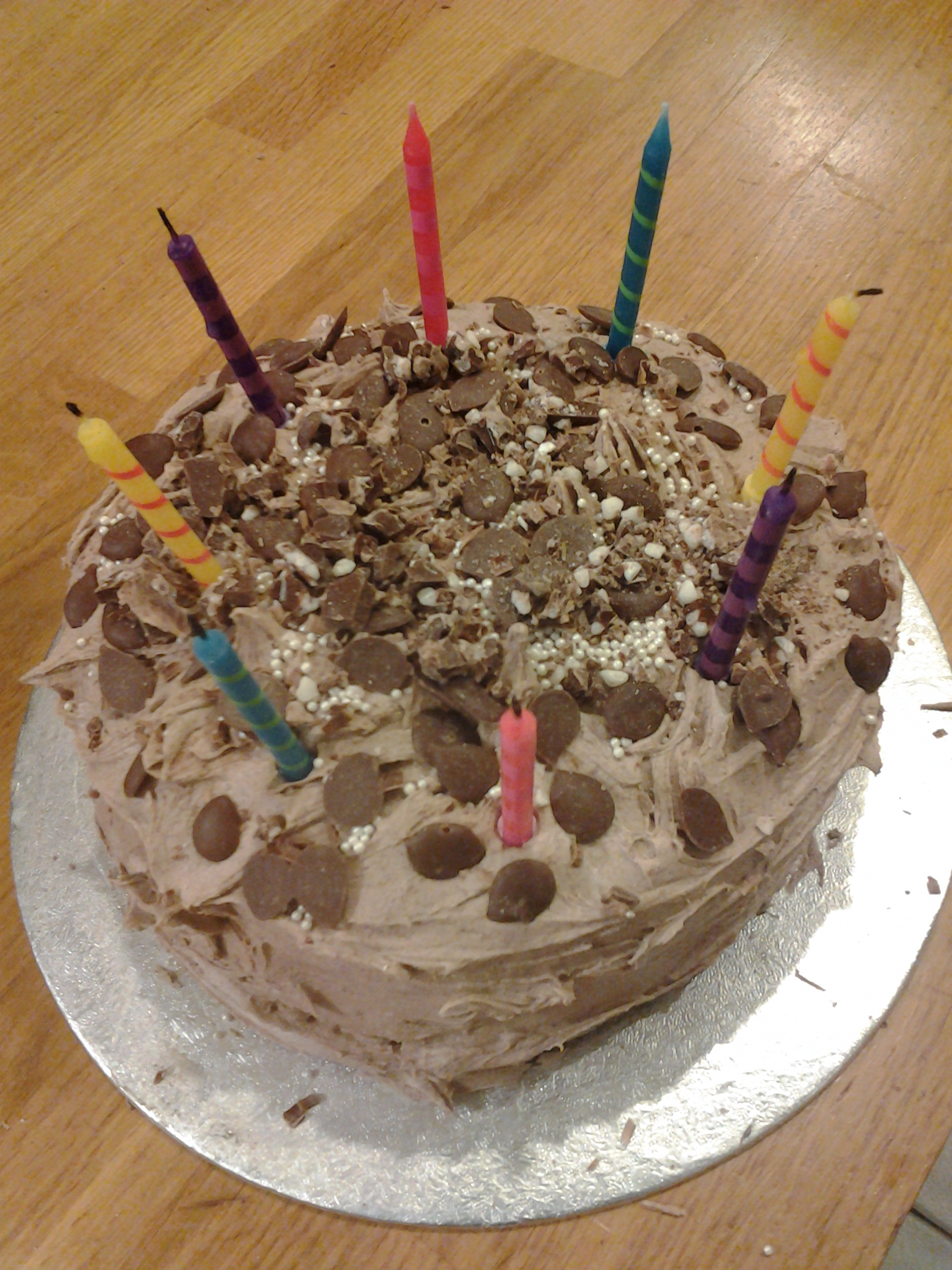
20140912_225331I doubled up the quantities in the chocolate crazy cake recipe and chose to mix the ingredients in a bowl, rather than in the cake tins themselves as I wanted to make 3 individual layers to sandwich together.  I replaced the flour with a blend of rice and tapioca flour and added a pinch of xanthum gum to help it on its way.  The cakes that came out of the oven appeared to be beautifully moist and not too granular, although Mike’s first comment on tasting some of the trimmings was that they were a lot sweeter than my usual bakes.  I swirled vanilla butter-cream icing with spoonfuls of Grandma’s strawberry jam (all the way from Canada) and used this to sandwich the layers together.  Lashings of home-made chocolate butter-cream icing then covered the entire cake, before I finished it all off with a generous sprinkle of pearl drops, moo-free chocolate buttons and shavings of moo-free orange chocolate.

It looked like my idea of a chocolate-lover’s dream birthday cake and tasted good too.  My Mum thought adding raspberries would have added a little sharpness to cut through the sweetness of the chocolate, but there wasn’t much left after her meal, which is always a sign of a good bake!

EGID – the real story

I am still reeling from the astounding response to my last blog post, Dear BBC Controller.  When I asked you, my wonderful readers, to share what I had written in a hope of raising some much-needed awareness about EGID, I have to admit to only expecting the odd person to possibly share the link on Facebook with a few of their friends and nothing prepared me for what happened next. From the 20 shares that I know about, that post gathered momentum and I experienced a fantastic demonstration of exactly what social media can do.  Within 48 hours of publication, that blog was viewed by over an amazing 1,800 people across 33 countries and the statistics are still creeping up on a daily basis.  I have been humbled by this response to my plea and I can do nothing more than extend my heartfelt thanks to you all.

One of the things I realised, however, is that I have never given a comprehensive explanation of EGID and that my last blog post may have left new readers wondering what on earth all the fuss was about. Those of you who follow my blog will have an understanding of how this chronic illness impacts our lives and for those who know our family personally, you have probably had a brief explanation of the disease along the way.  In that last blog post I didn’t want to go into the finer details of what exactly EGID is, so now I want to set the record straight, so to speak, and explain in a little more detail M’s condition.

17348-custom-ribbon-magnet-sticker-Eosinophilic+Disorders+++AwarenessEGID, or Eosinophilic Gastro-Intestinal Disorders, are a complex and chronic group of digestive system disorders caused by an abnormally raised level of eosinophils within the gastro-intestinal tract.  Eosinophils are an important type of white blood cell, which normally help the body fight off certain infections and parasites and are typically involved in attacking the causes of allergic reactions, thus protecting the body.  In some individuals, the body produces too many eosinophils in a particular part of the GI tract, which leads to chronic inflammation and can cause extensive tissue damage in that area.  It is currently thought that there is both auto-immune and genetic involvement in EGID, but further research will be needed to confirm these links.  Like many inflammatory bowel diseases, EGID is a classic waxing and waning condition, meaning that the symptoms and their severity can change on a daily basis.

This family of rare diseases is diagnosed depending on where in the GI tract the elevated eosinophilic count has been found:

  • Eosinophilc Oesophagits (EE or EoE) – in the oesophagus and is the most commonly diagnosed form of EGID
  • Eosinophilic Gastroenteritis (EG) – in the stomach and/or small intestine
  • Eosinophilic Enteritis (EGE) – in the small intestine
  • Eosinophilic Colitis (EC) – in the large intestine (colon)

This last one is the type that M has been diagnosed with, which means he has, in typical M-fashion, a relatively rare type of a rare chronic illness.  Statistics are not readily available as it was only first recognised during the first half of the 20th century, but over the last 20 years, cases have been recorded in the UK and there are currently in the region of 700 cases looked after at Great Ormond Street Hospital.  This suggests around 2,000 diagnosed cases across the UK as a whole and there are also known cases of EGID in other countries, including Australia and Canada, with a starting point of 3,000 people diagnosed in the USA.

Symptoms of EGID include:

  • Diarrhoea
  • Constipation
  • Blood and/or mucous in the stools
  • Stomach pains
  • Lethargy
  • Mouth Ulcers
  • Rash
  • Asthma attacks
  • Sore throat
  • Joint Pains
  • Headaches
  • Vomiting
  • Nausea
  • Reflux
  • Failure to thrive
  • Sudden weight loss
  • Loss of appetite
  • Mood swings
  • Excessive sweating/body odour
  • Loss of colour in the skin
  • Dark rings under the eyes

None of these symptoms is exclusive to EGID and not all are experienced by all patients.  We had noticed a number of these with M in the years leading up to his diagnosis and it was the odd combination of them – diarrhoea, poor weight gain, joint pains, mood swings, excessive sweating, body odour and dark shadows under his eyes – that led to our conclusion that this could well be what he had.

As eosinophils are part of the body’s response to allergic reactions, it comes as no surprise that many people with EGID also struggle with a varying level of food and environmental allergies. What makes it even harder is that these allergies can also wax and wane and therefore can change over the years.  allergiesWhen M was diagnosed we were asked to put him on a MEWS (Milk, Egg, Wheat, Soya) free diet, which is a common starting point for those with EGID.  Over the years, we have also had to remove gluten, potatoes, raisins and raspberries from his diet to try and alleviate his symptoms and we still don’t seem to have the answer to whether this list is complete or not.  Some of the lovely families we have met through FABED have had to go a step further and remove all foods from their child’s diet due to a constant flare-up of their EGID. These brave children are now tube-fed an elemental diet in an attempt to help them feel better and grow stronger.

These families have to cope with numerous hospital visits, regular hospital stays, invasive diagnostic procedures such as colonoscopies and endoscopies, tube-feeding, colostomies, huge amounts of medicines daily and the unavoidable emotional fall-out from children who long to be just like their peers.  All of this is why it’s important that the media realises that EGID is not about “Mr Allergies” and why such factually inaccurate portrayals of chronic illnesses are problematic for this EGID Mum.


If you are interested in finding out more about EGID, you can also look at these sites: 

FABED   CURED    Apfed   ausEE

***Breaking news – today I received an e-mail response to my complaint from the Holby City series producer.  He has offered to look into the research done for this story-line and will discuss it with me, over the phone, later this week***